🧂 Brining Time Calculator
Calculate exact brine time, salt amount & water volume for any meat or seafood
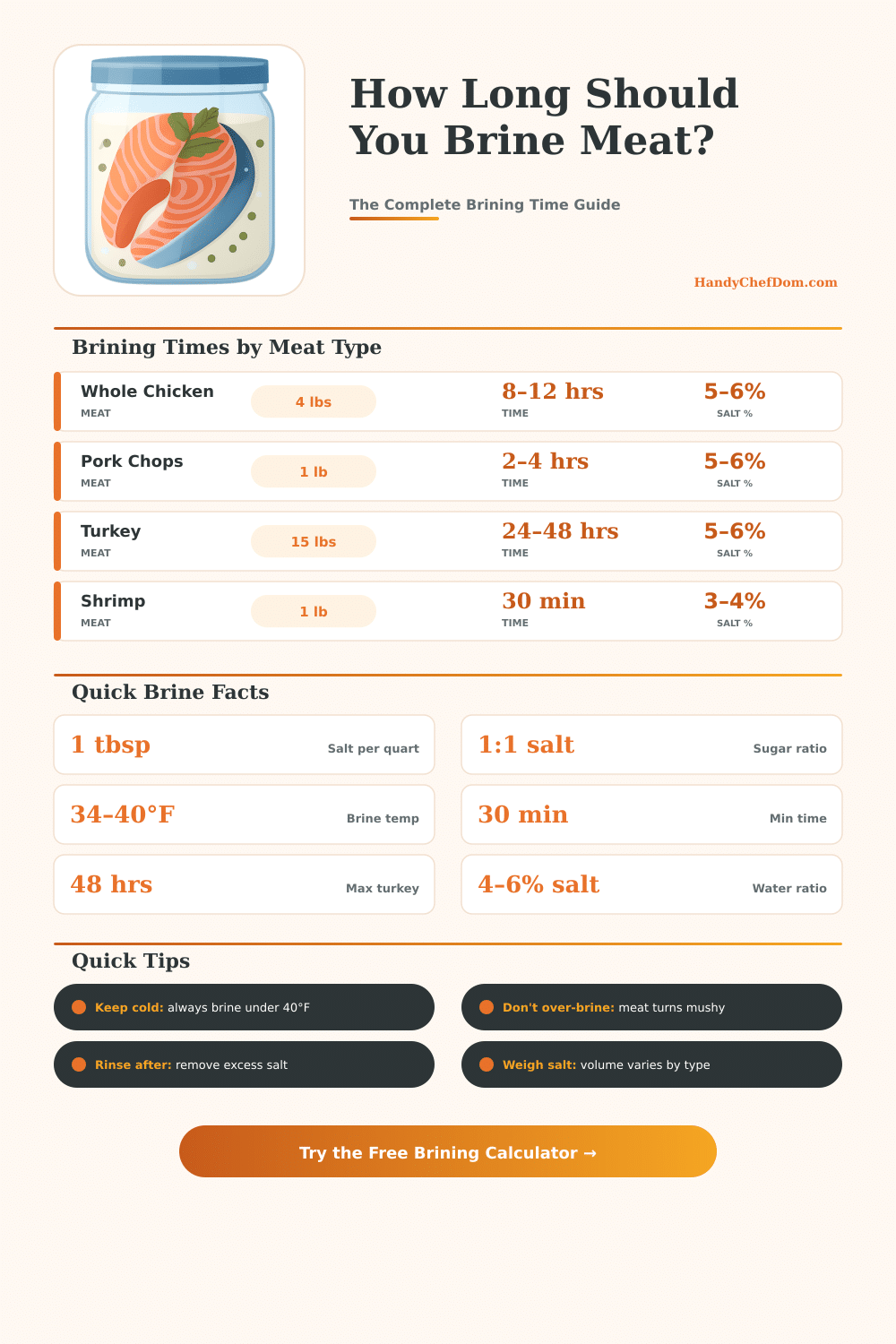
| Meat / Cut | Weight | Min Time | Max Time | Salt % |
|---|---|---|---|---|
| Whole Chicken | 3–5 lbs | 4 hrs | 12 hrs | 5–6% |
| Chicken Breasts | 6–8 oz each | 1 hr | 4 hrs | 5% |
| Chicken Wings | 2–3 lbs | 30 min | 2 hrs | 5% |
| Cornish Hen | 1.5–2 lbs | 2 hrs | 6 hrs | 5% |
| Whole Turkey | 12–20 lbs | 12 hrs | 48 hrs | 5–6% |
| Turkey Breast | 4–8 lbs | 6 hrs | 24 hrs | 5% |
| Whole Duck | 4–6 lbs | 6 hrs | 24 hrs | 5–6% |
| Pork Chops | 0.5–1 lb each | 1 hr | 4 hrs | 5–6% |
| Pork Tenderloin | 1–1.5 lbs | 2 hrs | 6 hrs | 5% |
| Pork Shoulder / Butt | 6–10 lbs | 12 hrs | 24 hrs | 5–6% |
| Beef Brisket | 8–14 lbs | 12 hrs | 48 hrs | 5–6% |
| Beef Roast | 3–6 lbs | 8 hrs | 24 hrs | 5% |
| Lamb (whole/legs) | 5–9 lbs | 8 hrs | 24 hrs | 5–6% |
| Salmon Fillets | 1–3 lbs | 30 min | 2 hrs | 3–4% |
| Shrimp | 1–2 lbs | 15 min | 30 min | 3% |
| Fish Fillets | 0.5–2 lbs | 20 min | 1 hr | 3–4% |
| Salt Type | 1 oz by weight | 1 tbsp volume | Notes |
|---|---|---|---|
| Kosher – Diamond Crystal | ≈ 3.5 tbsp | ≈ 9g | Lightest, flakiest |
| Kosher – Morton | ≈ 1.75 tbsp | ≈ 15g | Denser flakes |
| Table Salt (fine) | ≈ 1.5 tbsp | ≈ 18g | Most concentrated |
| Sea Salt (coarse) | ≈ 2 tbsp | ≈ 14g | Varies by grind |
| Meat Size | Recommended Water (Imperial) | Recommended Water (Metric) | Container Tip |
|---|---|---|---|
| Small cuts (under 2 lbs) | 1 quart | 1 liter | Large bowl |
| Chicken breasts / chops | 1–2 quarts | 1–2 liters | Gallon zip bag |
| Whole chicken | 2–3 quarts | 2–3 liters | Large stockpot |
| Pork shoulder / brisket | 1–1.5 gallons | 4–6 liters | Large stockpot or cooler |
| Whole turkey (under 16 lbs) | 2–2.5 gallons | 7.5–9.5 liters | Brining bag or cooler |
| Whole turkey (over 16 lbs) | 3 gallons | 11.5 liters | Large cooler with ice |
| Seafood / shrimp | 0.5–1 quart | 0.5–1 liter | Bowl or zip bag |
Brine is simply water with a lot of salt mixed in it. Usually one uses table salt or rock salt for that. The word commonly points to solutions of around 3.5 percent salt levels what matches seawater, until much stronger mixes.
True brine is water fully filled with salt, so no more salt can dissolve. One can look at seawater as brine, although it is at the most bottom end of the salt levels.
What Is Brine and How It Helps Food
One used Brining during centuries to preserve foods. In farms, one would apply it to treat pork loin or pork belly, what gives ham or bacon. Brining for keeping mixes salt with other liquids to ferment or preserve food.
The process pulls moisture from the food and creates lactic acid, that preserves it against bacteria.
In meat, Brining is a wet method, not cooked. It is made up of dipping cuts of meat in a mix of salt and water. The salt enters the meat from inside to outside, helping it keep moisture and making every thick bite more tender.
Brine a bit breaks muscle fibers, what results in more juicy meat. Even some hours of Brining shorten the cooking time and give more evenly cooked poultry.
Two main kinds exist. Wet Brining is a bath of salty water. Dry Brining applies a rub of salt, herbs and spices.
For dry Brining, one puts plain salt above the meat and leaves it to dry in the refrigerator, without cover, on a rack. One can add to wet Brining sugar, herbs or spices according too desire. The main rule to call it brine is, that it be a salty solution.
Water-based brines well go into meat to add moisture, but they less well carry taste, mostly because of the water itself. Without salt, many marinade mixes do not go deeply in the meat, so they do not well flavor thick steak bits.
Meat can absorb up to 10 to 15 percent of its weight from brine. Every recipe for wet Brining has a maximum time, before the meat too salty becomes, usually 8 to 12 hours. For Brining turkey, one must keep it under 34 degrees to slow bacterial growth.
Starting with whole turkey can seem a bit scary, because it is really big. It needs much brine, a big bag or pot andenough space in the refrigerator.
Olive brine has its own uses. It serves as a basic ingredient for dirty martini. One can add half glasses of olive brine in bread dough, but then one must reduce the other salt in the recipe.
Brine from goats gives salty kick, that well goes with garlic, butter and herbs. If the brine tastes too strong, a bit of sugar or black pepper can soften it.