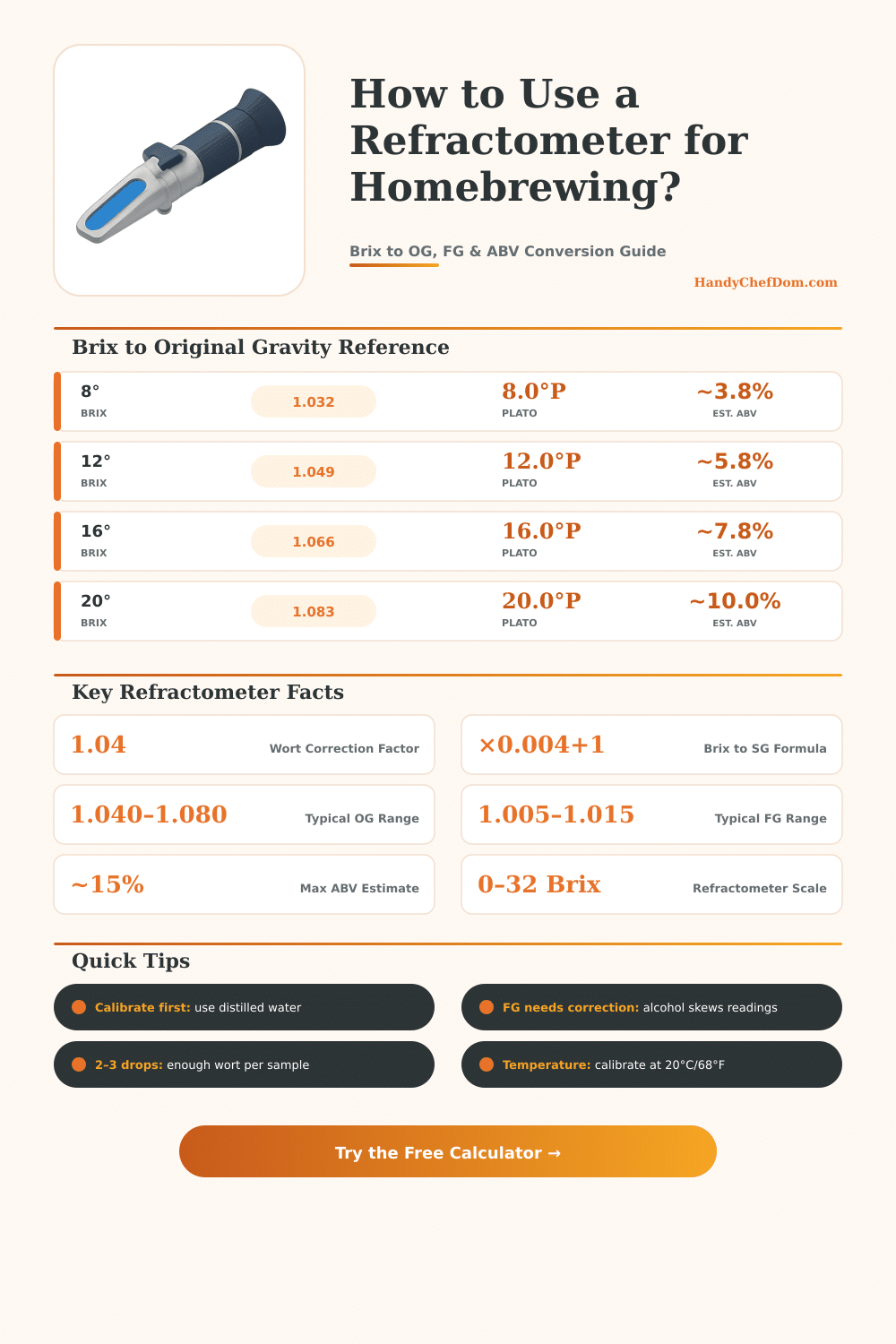
🍺 Homebrew Refractometer Calculator
Convert Brix readings to OG, FG & ABV — with alcohol correction for final gravity
| Brix (°Bx) | Specific Gravity | Degrees Plato | Est. OG Style |
|---|---|---|---|
| 6.0 | 1.023 | 5.8°P | Very Light |
| 8.0 | 1.032 | 7.9°P | Light Lager |
| 10.0 | 1.040 | 9.9°P | Pale Ale |
| 12.0 | 1.049 | 11.9°P | Amber / IPA |
| 14.0 | 1.057 | 13.9°P | Stout / Porter |
| 16.0 | 1.066 | 15.9°P | Strong Ale |
| 18.0 | 1.074 | 17.8°P | Belgian Strong |
| 20.0 | 1.083 | 19.8°P | Barleywine |
| 22.0 | 1.092 | 21.8°P | Imperial Stout |
| 26.0 | 1.110 | 25.8°P | Mead / High Gravity |
| Beer Style | Typical OG | Typical FG | ABV Range |
|---|---|---|---|
| Light Lager | 1.028–1.040 | 1.004–1.008 | 3.0–4.2% |
| American Pale Ale | 1.045–1.060 | 1.010–1.015 | 4.5–6.2% |
| IPA | 1.056–1.070 | 1.008–1.014 | 5.5–7.5% |
| Stout / Porter | 1.050–1.075 | 1.010–1.022 | 4.0–7.0% |
| Wheat Beer | 1.044–1.052 | 1.010–1.014 | 4.2–5.5% |
| Saison | 1.048–1.065 | 1.002–1.012 | 5.0–7.0% |
| Barleywine | 1.080–1.120 | 1.016–1.030 | 8.0–12.0% |
| Double IPA | 1.075–1.100 | 1.008–1.018 | 7.5–10.5% |
| Hard Cider | 1.045–1.065 | 1.000–1.010 | 4.5–8.5% |
| Traditional Mead | 1.080–1.120 | 1.000–1.020 | 8.0–14.0% |
| Formula | Best For | Accuracy | Notes |
|---|---|---|---|
| Sean Terrill | Most fermented beers | ★★★★★ | Empirically derived, most accurate |
| Standard | Quick estimates | ★★★ | Simple, slight overestimate at high ABV |
| Novotny Linear | Low-gravity beers | ★★★★ | More accurate below 6% ABV |
The term „homebrew” can point to various things according to the situation. It commonly relates to the process of making beer at home, or to programs for installing apps, or even to own created elements for table- and computer games. Key is that every use comes from its own range.
In the range of computers, Homebrew is a free and open package manager, that simplifies the installation of programs on macOS and Linux. It adds that, what the Apple- or Linux-system itself does not carry. The name itself hinted to the idea of building programs for Mac according to the needs of the user.
Homebrew: Beer, Computer Programs and Game Add‑ons
Practically it works like a store for apps, that developers and expert users truly require. Homebrew stands on Git and Ruby, and it prepares everything in the default directory during the first launch. The whole project works thanks to volunteers without salary, as a not-for-profit group, that requires money for programs, servers and website.
Homebrew takes less than 100 MB on Mac, if nothing is installed. When one clones the deposit homebrew-core, it uses around 82 MB. Between the commonly used packages through it are basic tools for services of Amazon, add-ons for Bash for fatser auto complete, calculators and programs for file encryption.
On macOS, Homebrew serves as mainstream supplier for tools alike to Chef. There is even a simple command, that allows the system to download GitHub-deposits by means of HTTPS.
Now we talk about the beer side. Homebrewing means the home making of beer, cider, mead or wine. In United States, it was not legal on federal level until 1978.
Many newcomers start by means of malt essence, and the results commonly give excellent beer. Complete starter sets are available at various stores for brewing. One can also go directly to brewing from bag.
Each homebrewer has their reason. Some aim to compete and create the best variety. Others want too spare money compared to store beers in bottles.
Some simply want to experiment with something entirely fresh. All exist by means of recipe. There are even guides for fermentation prodding and calculators for starters, that help with dry fermentation, liquid yeast, suspensions and preparations.
Nearby homebrew-stores usually offer many kinds of barley malt, and also less usual like wheat, rye or spelt.
Homebrew shows also in video games. Own backgrounds, magic objects, creatures and spells form part of homebrew materials for Dungeons & Dragons in the fifth edition. The simplest way to create new spells is to take existing, observe alike and add changes.
Sometimes only a stylistic change in the description is enough. There are also homebrew-games for old consoles, that intend toenjoy fresh titles on classic platforms.