🍞 Bulk Fermentation Time Calculator
Calculate exact bulk fermentation timing based on dough temperature, starter percentage, and hydration level.
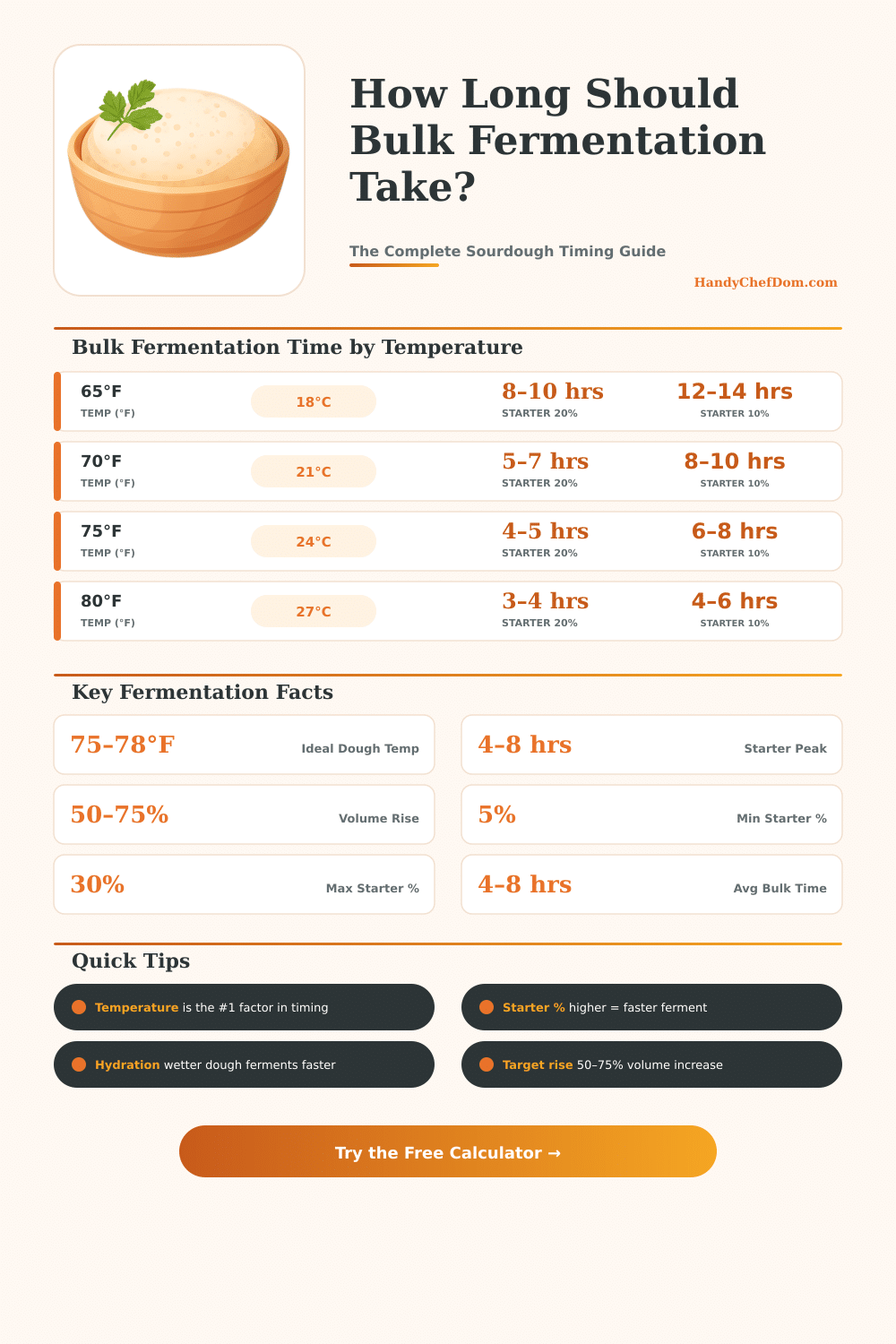
| Temp (°F) | Temp (°C) | 10% Starter | 15% Starter | 20% Starter | 25% Starter |
|---|---|---|---|---|---|
| 64°F | 18°C | 12–14 hrs | 9–11 hrs | 8–10 hrs | 6–8 hrs |
| 68°F | 20°C | 9–11 hrs | 7–9 hrs | 6–7 hrs | 5–6 hrs |
| 72°F | 22°C | 7–9 hrs | 5–7 hrs | 4–5 hrs | 3.5–4.5 hrs |
| 75°F | 24°C | 5–7 hrs | 4–5 hrs | 3–4 hrs | 2.5–3.5 hrs |
| 78°F | 26°C | 4–5 hrs | 3–4 hrs | 2.5–3 hrs | 2–2.5 hrs |
| 80°F | 27°C | 3–4 hrs | 2.5–3 hrs | 2–2.5 hrs | 1.5–2 hrs |
| 82°F | 28°C | 2.5–3 hrs | 2–2.5 hrs | 1.5–2 hrs | 1–1.5 hrs |
| Factor | Lower Value | Higher Value | Time Impact |
|---|---|---|---|
| Hydration | 60–65% | 80–90% | High hydration ferments 10–20% faster |
| Starter % | 5–10% | 20–30% | High starter ferments 30–50% faster |
| Whole Grain | 0% | 30–50% | Adds 15–30% fermentation speed |
| Salt % | 1.5% | 2.5% | High salt slows by 5–10% |
| Starter Health | Sluggish | Peak Activity | Peak is 40–75% faster than sluggish |
| Total Bulk Time | No. of S&F Sets | Frequency | Last S&F At |
|---|---|---|---|
| 2–3 hrs | 2–3 sets | Every 30 min | 1 hr mark |
| 3–5 hrs | 3–4 sets | Every 45 min | 2–2.5 hr mark |
| 5–8 hrs | 4 sets | Every 60 min | 3–4 hr mark |
| 8–12 hrs | 4–5 sets | Every 90 min | 5–6 hr mark |
| 12+ hrs | 4–5 sets | Every 2 hrs | 6–8 hr mark |
- Dough should increase in volume by 50–75% (not necessarily double)
- Jiggle the container — the dough should move as one jiggly mass
- Bubbles should be visible on the sides and surface of the dough
- A dome or slightly domed top indicates the dough has peaked
- Use a straight-sided container and rubber band to track exact rise
The wholesale Fermentation is one of the most important stages in the baking of fermented bread. One commonly calls it the first rise or the mainstream Fermentation. From the moment when you mix the ingredients, the clock starts ticking and it lasts until you divide and pre-shape the dough.
In that time, the dough stays one solid crowd, while the Fermentation produces carbon dioxide and other elements. Here forms the biggest part of the flavor.
The First Rise of Bread Dough
It is possible to hardly reach the right length for wholesale Fermentation. The trick consists in allowing the bacteria to generate enough gas, that spreads evenly through the dough, without overdoing. If you push too strongly, the dough becomes weak and can not hold the gases.
Knowing exactly when to stop is one of the most challenging tasks for a master baker of bitter bread.
The temperature affects more than one imagines. The speed of Fermentation almost doubles for every increase of 15°F. Hence the warming of the surroundings makes the process even more sensitive. To reach stable and repeatable results, you must keep steady conditions during the wholesale Fermentation.
The most common advice points, that it happens at room temperature, between 75°F and 82°F. In summer the first rise lasts usually four to six hours, while in winter it can extend too twelve hours or even more. A formula for the wanted temperature of the dough helps to plan. When the dough reaches around 78, 80°F after blending, expect three to four hours, what commonly gives sweeter tastes.
The surrounding conditions also decide, how far you can rush the process. If it is warm, above 80°F, the wholesale Fermentation limits to 25% rise, before the dough becomes too thin. Lower the temperature to around 68°F, and you can comfortably reach 75%.
The strength depends on the force of your starter and the kind of flour. Use strong flour with especially active starter, and it will last wholesale Fermentation past full doubling, ending well.
The best way to control the finish of wholesale Fermentation is to watch the volume increase. Widely aim for 50, 75% rise, although it depends on what works for you. A container with clear marks for quarters helps a lot.
A four-quart container works for one standard amount, while six-quart is better for two or three amounts at once. Simply measure from the table to the level of your dough, easily and practically.
Stretching and folds, or coil folds, during the wholesale Fermentation strengthen the dough. Doing coil folds each thirty minutes is a good method. The gradual building during the wholesale hours eases the next stage, when you arrive there.
Or pre-fold the dough before the wholesale Fermentation to add force. Recall, that stretching and folds push out a bit of air, so considerthat.
The more long the wholesale Fermentation lasts, the less long the final proof must be. The wholesale Fermentation ends, when the dough has almost doubled and is full of brief bubbles.