🧈 Butter to Olive Oil Converter
Instantly convert any amount of butter to olive oil with precise measurements
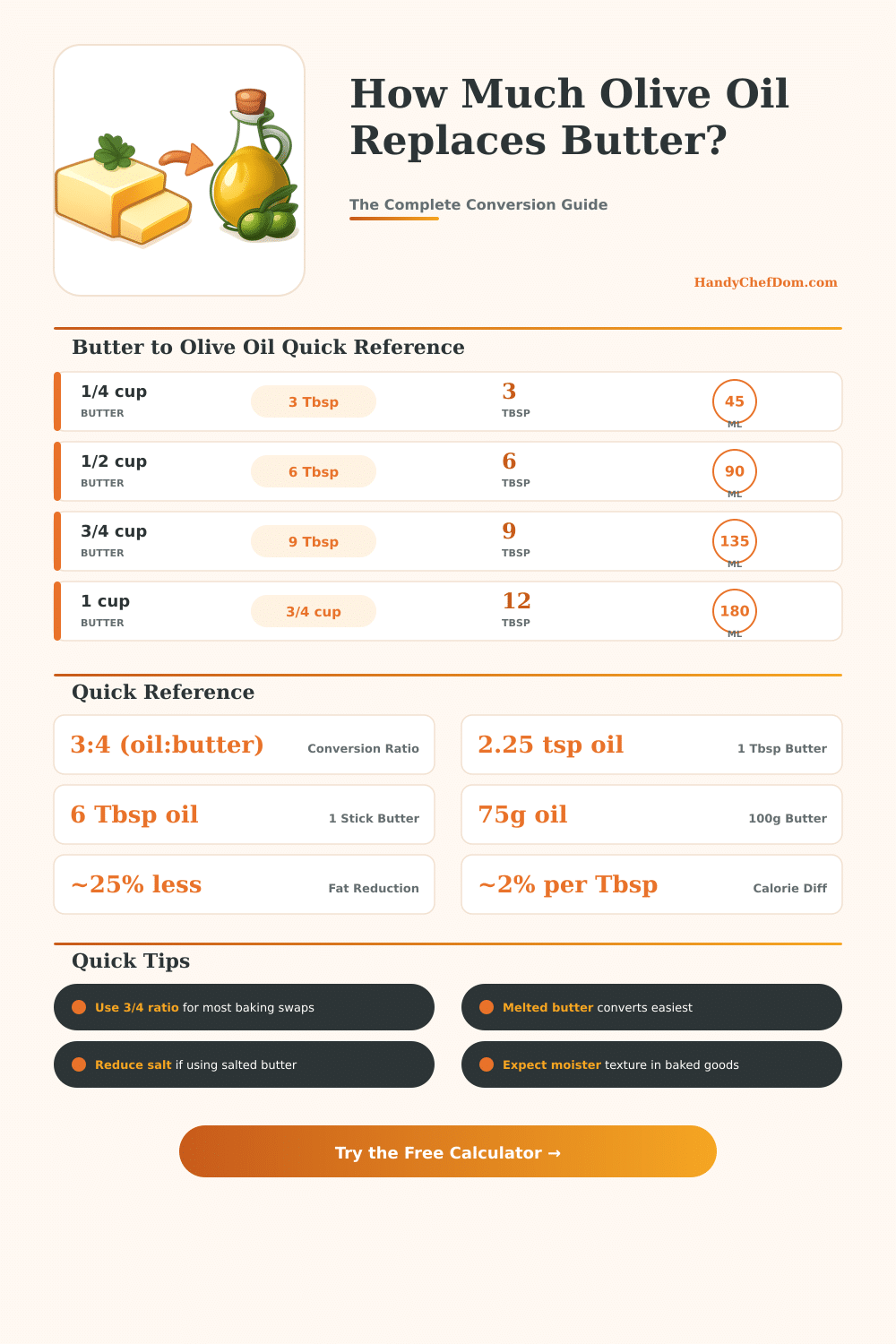
| Butter | Olive Oil | Butter (g) | Olive Oil (mL) |
|---|---|---|---|
| 1 tsp | 3/4 tsp | 4.7 g | 3.4 mL |
| 1 Tbsp | 2 1/4 tsp | 14.2 g | 10.1 mL |
| 2 Tbsp | 1 1/2 Tbsp | 28.4 g | 20.3 mL |
| 1/4 cup | 3 Tbsp | 56.7 g | 40.5 mL |
| 1/3 cup | 1/4 cup | 75.6 g | 54.0 mL |
| 1/2 cup (1 stick) | 6 Tbsp | 113.4 g | 81.0 mL |
| 2/3 cup | 1/2 cup | 151.2 g | 108.0 mL |
| 3/4 cup | 9 Tbsp | 170.1 g | 121.5 mL |
| 1 cup (2 sticks) | 3/4 cup | 226.8 g | 162.0 mL |
| 2 cups (1 lb) | 1 1/2 cups | 453.6 g | 324.0 mL |
| Butter Measure | Weight (g) | Weight (oz) | Volume (mL) |
|---|---|---|---|
| 1 teaspoon | 4.7 g | 0.17 oz | 4.9 mL |
| 1 tablespoon | 14.2 g | 0.5 oz | 14.8 mL |
| 1 stick (1/2 cup) | 113.4 g | 4 oz | 118.3 mL |
| 1 cup | 226.8 g | 8 oz | 236.6 mL |
| 1 pound | 453.6 g | 16 oz | 473.2 mL |
| 1 kilogram | 1000 g | 35.3 oz | 1043.8 mL |
| Fat Type | Butter (%) | Olive Oil (%) | Notes |
|---|---|---|---|
| Saturated | 63% | 14% | Olive oil much lower |
| Monounsaturated | 26% | 73% | Heart-healthy fats |
| Polyunsaturated | 4% | 11% | Includes omega-6 |
| Trans Fat | 3–4% | 0% | Naturally occurring in butter |
| Water Content | ~16% | 0% | Key reason for 3:4 ratio |
The basic ratio, that I altered after testing, are made up of 3 parts of olive oil for every 4 parts of butter according to volume. That matches to 75 %. The reason lies in the different water level, butter stores around 80 to 82 % of fat with 16 to 18 % of water while olive oil consists almost of 100 % of fat.
One spoon butter weighs about 14 grams and carries 102 calories. What about olive oil? Around 13,5 grams of pure fat per spoon with 119 calories.
How to Replace Butter with Olive Oil
Packed fats drop greatly by means of that swap, from around 7,2 grams down to 1,9 grams for one spoon. That is a 74 percent drop. For a whole cup butter (227 grams) only three quarter cups of olive oil is enough, which is around 162 ml.
Cleared butter or ghee are closley a 1:1 ratio, because the water already went… I use 95 % for that. Half a stick fits in only 3 spoons of oil, give or take.
The details below do not come from any calculator or converter tool on that page. They are based on real research, forum talks and cooking experiences of communities, that one finds across the net.
Butter is an everyday product, made from the fat and proteins of beaten cream. It forms a solid emulsion at room temperature, with around 81 % of butterfat. The word comes from the old English “butere”, taken from the Latin “butyrum”.
It spreads at room temperature and can melt four use as a topping.
Butter matches only 80 % of oil, while the other 20 % are made up of milk solids and water. That marks a big difference between butter and oil. The high fat content does explain, why butter is so liked in cooking.
More fat means less water, which ensures strong buttery taste together with richer smell and texture in the foods.
Home made butter is surprisingly simple. It starts with heavy cream, and the method is as easy as mixing it in a food processor for around 10 minutes. The cream whips until it splits and the butterfat forms.
Later one only washes, dries it and maybe salts. Then one rolls it flat, and it is ready to use.
Eggs fried in butter instead of olive oil have a truly wonderful taste. Even 5 grams of butter, which is around 36 calories, create a big change. One spoon butter stores almost 100 calories, just like an average banana.
French butter is famous because of its unique taste. In the United States the access to butter can seem limited compared with France. Local butters from small farms, sold at farm markets or tiny stores, stand out by means of quality.
Grass fed butter and traditional types from small American dairies offer high percentage of butterfat and rich taste.
Compound butter is a French method, in which liquids or solids mix with soft butter. One rolls the mix into a cylinder form and freezes it until use. For instance, steak butter is made with crushed peppers, diced shallots, parsley and blue cheese, mixed with unsalted butter.
Whipped butter is another type, where one adds flavors like red wine.
Drawn butter is butter that is melted with the solids left inside. Cleared butter, rather, is melted and then the solids are removed. Cleared butter works when one needs a high smoke point.
Drawn butter is commonly used for topping. It matters to avoid heating butter until smoking, because that shows that thefat is splitting.
The old belief, that butter and packed fats harm, came from studies, that showed, that butter raises LDL-cholesterol. Even so those studies did not consider HDL-cholesterol, which helps to remove cholesterol from arteries. The margarines, once pushed as replacements, turned out full of trans fats, that proved dangerous.
Hydrogenated oils, as in margarine from vegetable oil, are the most harmful fats to eat.