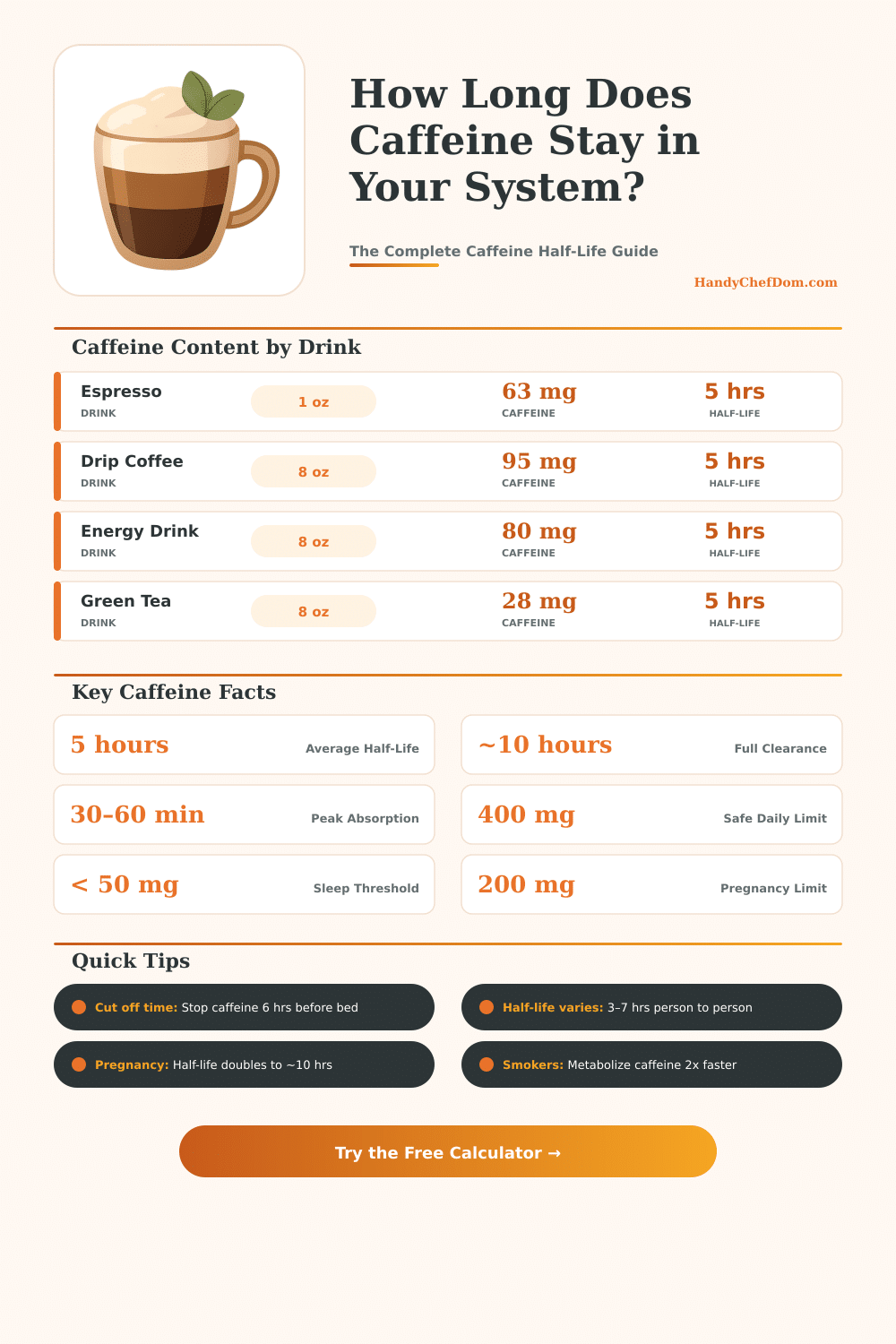
☕ Caffeine Half-Life Calculator
Find out exactly how much caffeine is in your system — hour by hour
⚡ Quick Presets
🧪 Calculator Inputs
📋 Caffeine Content Reference
| Drink / Source | Serving Size | Caffeine (mg) | Metric Serving | Half-Lives to Clear |
|---|---|---|---|---|
| Drip Coffee | 8 fl oz | 95 mg | 240 ml | ~3.3 half-lives |
| Espresso (single) | 1 fl oz | 63 mg | 30 ml | ~2.6 half-lives |
| Espresso (double) | 2 fl oz | 126 mg | 60 ml | ~3.6 half-lives |
| Cold Brew Coffee | 8 fl oz | 155 mg | 240 ml | ~4.0 half-lives |
| Americano | 12 fl oz | 150 mg | 355 ml | ~3.9 half-lives |
| Latte / Cappuccino | 12 fl oz | 75 mg | 355 ml | ~2.9 half-lives |
| Red Bull | 8.4 fl oz | 80 mg | 250 ml | ~3.0 half-lives |
| Monster Energy | 16 fl oz | 160 mg | 473 ml | ~4.0 half-lives |
| Bang Energy | 16 fl oz | 300 mg | 473 ml | ~5.2 half-lives |
| Black Tea | 8 fl oz | 47 mg | 240 ml | ~2.2 half-lives |
| Green Tea | 8 fl oz | 28 mg | 240 ml | ~1.8 half-lives |
| Diet Coke | 12 fl oz | 46 mg | 355 ml | ~2.2 half-lives |
| Pre-Workout (avg) | 1 scoop | 200 mg | — | ~4.3 half-lives |
| Dark Chocolate | 1.4 oz | 35 mg | 40 g | ~2.0 half-lives |
🧬 Half-Life Factors
⏰ Caffeine Clearance Timeline (at 5-Hour Half-Life)
| Hours After Intake | % Remaining | Remaining (200 mg dose) | Effect Level |
|---|---|---|---|
| 0 hours | 100% | 200 mg | Peak onset |
| 1 hour | 87% | 174 mg | Near peak |
| 2 hours | 76% | 152 mg | High alertness |
| 3 hours | 66% | 132 mg | High alertness |
| 5 hours | 50% | 100 mg | Moderate (1 cup coffee) |
| 8 hours | 33% | 66 mg | Mild stimulation |
| 10 hours | 25% | 50 mg | Sleep may be affected |
| 15 hours | 10% | 20 mg | Minimal effect |
| 20 hours | 4% | 8 mg | Trace amount |
| 25 hours | 1.5% | 3 mg | Negligible |
💤 Sleep Disruption Guidelines
| Sensitivity Level | Threshold (mg) | Stop Caffeine Before Bed | Notes |
|---|---|---|---|
| Very Sensitive | 25 mg | 9–10 hours | Avoid afternoon coffee entirely |
| Standard Adult | 50 mg | 7–8 hours | No coffee after 2–3 PM |
| High Tolerance | 100 mg | 5–6 hours | May tolerate early evening caffeine |
| Pregnant | 50 mg | 12+ hours | Limit total intake to 200 mg/day |
Natural stimulant, Caffeine, that rush the signals that travel between your brain and body. It belongs to the group of methylxanthines and acts on your central nervous system. It ranks as the most heavily used mind-changing substance in the world although many folks link it only with coffee when they hear that word.
One finds it in tea, cola, cocoa, guarana, mate and even in more than 60 other products.
What Caffeine Is and How It Works
The way it works really stick. It works on your central nervous system, heart and muscles, while it also reaches the areas that rule blood pressure. Besides simply helping you wake up in the morning, one knows that it boosts the energy, speeds the physical activities and sharpnes the thoughts.
So it does much more than most folks imagine.
About safety, the healthiest adults can handle up to 400 milligrams a day without problems. That equals about four cups of drip coffee, almost 10 cans of cola or two energy drinks. An average 12-ounce cup of drip coffee stores between 113 and 247 milligrams, according to the kind.
A normal cup of tea has almost half that much. Green tea is on the lighter side, around 25 milligrams for an 8-ounce serving. Black tea however has more.
An 8-ounce cup of green or black tea stores around 30 to 50 milligrams. Caffeinated fizzy drinks usually have less, with a 12-ounce can storing around 30 to 40 milligrams. Coca-Cola specifically has 34 milligrams four one can.
Mate is another option that deserves thought. It started as a traditional tea from a South American plant called Ilex paraguariensis. Like coffee, the content of Caffeine ranges according to how you prepare it.
Here is something that surprises, many bigger cups of coffee from espresso machines do not really give more Caffeine. You simply receive a more diluted drink. That is surprising for most folks.
The downsides? Nerves and empty stomach top the main complaints. Caffeine also acts as a diuretic, which means that if you do not replace the lost liquids, dehydration can come quietly.
When you use Caffeine commonly, your body ramps up the making of adenosine, a hormone that helps you feel tired. This is probably tied to the tolerance against Caffeine. Too much can cause side effects, so stay careful.
Notably, some medicines and supplements interact with Caffeine, including stimulants, some antibiotics, asthma cures and heart medicine. Talking with your doctor aboutpossible interactions is a good idea.
One final thing; Caffeine does not disappear during cooking. When food with Caffeine heats or bakes, it stays there. It stays stable in usual cooking heats and does not break down.
It can even get stronger during the cooking process.