🌾 Carb to Fiber Ratio Calculator
Find your net carbs, fiber quality score & dietary fiber rating for any food
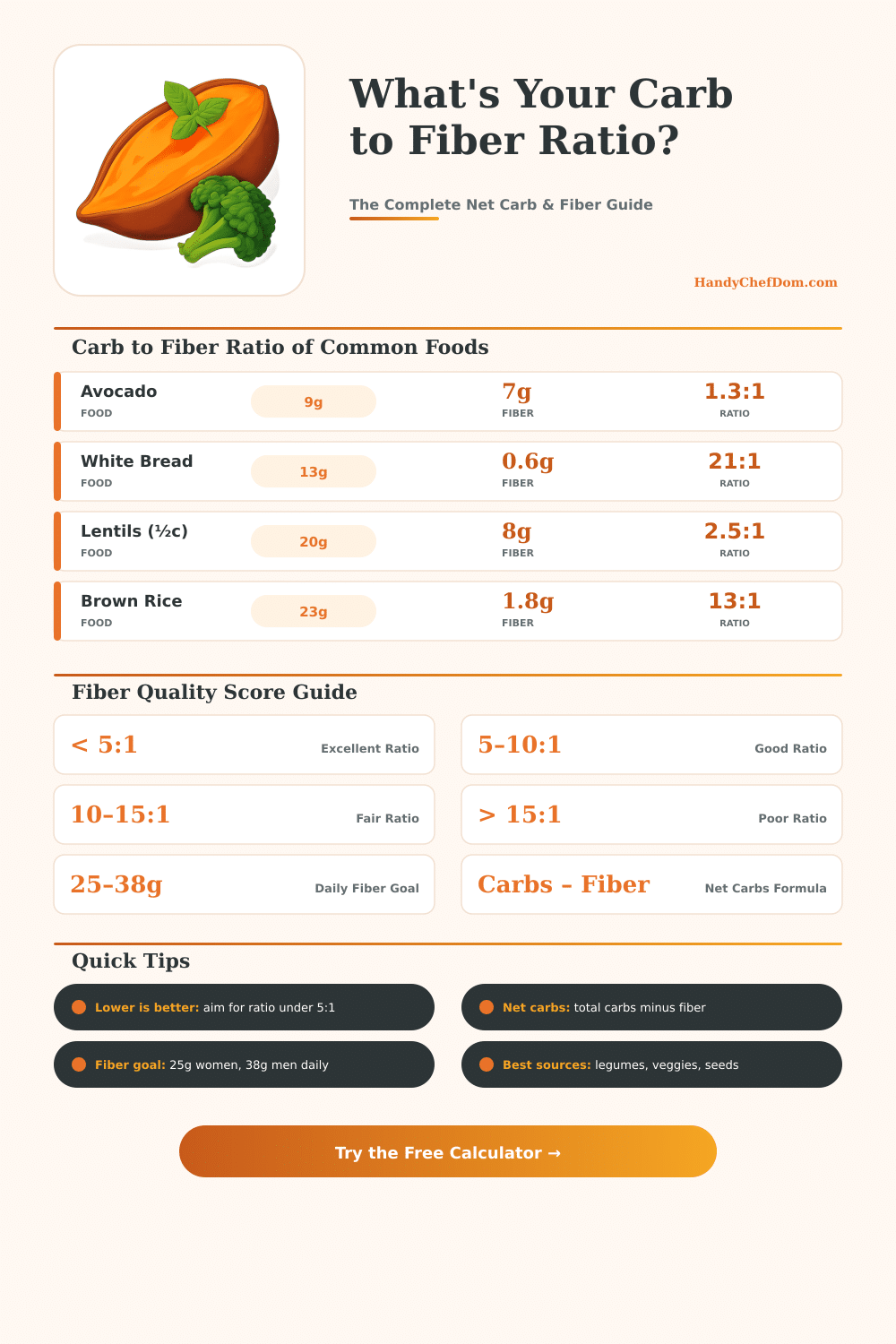
| Food | Serving | Total Carbs | Fiber | Net Carbs | Ratio | Rating |
|---|---|---|---|---|---|---|
| Avocado | 100g | 9g | 7g | 2g | 1.3:1 | Excellent |
| Broccoli | 1 cup (91g) | 6g | 2.6g | 3.4g | 2.3:1 | Excellent |
| Lentils (cooked) | ½ cup (99g) | 20g | 8g | 12g | 2.5:1 | Excellent |
| Apple (with skin) | 1 medium (182g) | 25g | 4.4g | 20.6g | 5.7:1 | Good |
| Whole Wheat Bread | 1 slice (28g) | 13g | 2g | 11g | 6.5:1 | Good |
| Oats (dry) | ½ cup (40g) | 27g | 4g | 23g | 6.8:1 | Good |
| Brown Rice (cooked) | ½ cup (98g) | 23g | 1.8g | 21.2g | 12.8:1 | Fair |
| Banana | 1 medium (118g) | 27g | 3.1g | 23.9g | 8.7:1 | Good |
| White Rice (cooked) | ½ cup (93g) | 27g | 0.5g | 26.5g | 54:1 | Poor |
| White Bread | 1 slice (25g) | 13g | 0.6g | 12.4g | 21.7:1 | Poor |
| Potato (baked) | 1 medium (173g) | 37g | 3.8g | 33.2g | 9.7:1 | Good |
| Black Beans (cooked) | ½ cup (86g) | 20g | 7.5g | 12.5g | 2.7:1 | Excellent |
| Rating | Ratio Range | What It Means | Example Foods |
|---|---|---|---|
| Excellent | Less than 5:1 | Very high fiber density; excellent for blood sugar stability | Avocado, lentils, leafy greens |
| Good | 5:1 – 10:1 | Adequate fiber; supports digestive health | Whole wheat bread, oats, banana |
| Fair | 10:1 – 15:1 | Low fiber; pair with higher-fiber foods | Brown rice, corn tortilla |
| Poor | Greater than 15:1 | Very low fiber; may spike blood sugar quickly | White bread, white rice, sugary cereal |
| Group | Daily Fiber Goal | Carb Goal (general) | Ideal Ratio Target |
|---|---|---|---|
| Adult Women (under 50) | 25g / day | 130–225g | < 10:1 |
| Adult Men (under 50) | 38g / day | 130–225g | < 10:1 |
| Women 50+ | 21g / day | 130–225g | < 10:1 |
| Men 50+ | 30g / day | 130–225g | < 10:1 |
| Children (4–8 yrs) | 25g / day | 130g minimum | < 10:1 |
| Low-Carb Diet | 25–38g / day | 20–100g | < 5:1 |
Whether you know what is the main fuel for your body? Carb. When you eat foods or drinks rich in Carb, your body starts to break them into glucose, that simple form of sugar that flows through your blood.
Here is the glucose boost that gives you energy for the whole day, from morning coffee until evening exercise.
What Carbs Are and Why They Matter
So Carb split into two main kinds: simple and complex. Simple Carb are basic sugars, made up of one or two sugar molecules bound to one another. Fructose happens in fruits and honey, and fructose with glucose form sucrose, that is the usual sugar on your table.
Here is the problem with simple Carb, as in sweets: their sugar chains are already almost broken, which is why they taste so nice. If you eat them, the sugar in blood quickly rises, which forces your pancreas to release a big dose of insulin at once. Later?
The blood sugar quickly falls down.
Complex Carb work entirely otherwise. The more links between carbon and hydrogen they have, the more long lasts the breakdown in your belly. They absorb the water and move throuhg your digestion more slowly.
This slow process truly helps, it helps you stay full more steadily and care about good gut functions. Then your body turns that sugar from Carb into ATP, which is short for adenosine triphosphate. It is the chemical that powers the move of muscles.
More than only energy, Carb play a role in several important processes. They provide fuel too your central nervous system and give force to your working muscles during physical activity. Also they stop your body from using protein as energy source, and they help to control the metabolism of fat.
In addition, Carb back the building of muscular protein and affect the control of mood. They are especially needed when you do things that require sudden, strong effort, for instance running.
Here is the tricky part: if you eat big amounts of Carb, your body releases rough insulin waves. Insulin, among other tasks, forces your body to store fat. Because of that low-Carb diets became so popular.
That approach usually means that you get around 12 to 20 percent of your daily calories from Carb. Some prefer to cycle the Carb instead; that is a method where you change the intake of Carb up and down during certain times.
When you care about diabetes, the planning of meals becomes more exact. One serving of Carb matches about 15 grams, and for most folks one aims for 45 to 60 grams per meal, so around 3 to 4 servings. Know well: the size of serving on the food label does not always match one counted serving of Carb.
The main trouble is that many store products are filled with too many Carb and extra sugar. Protein bars, shakes, sauces, nut butters, yogurts, factory made replacements and frozen meals commonly fall intothat trap. Even so, removing Carb completely is not wise.
Your body truly needs healthy, low-sugar Carb as part of a good, balanced diet. Fiber matters too, so do not skip it.