🥥 Coconut Flour Converter
Convert coconut flour between cups, grams, ounces, tablespoons & teaspoons instantly
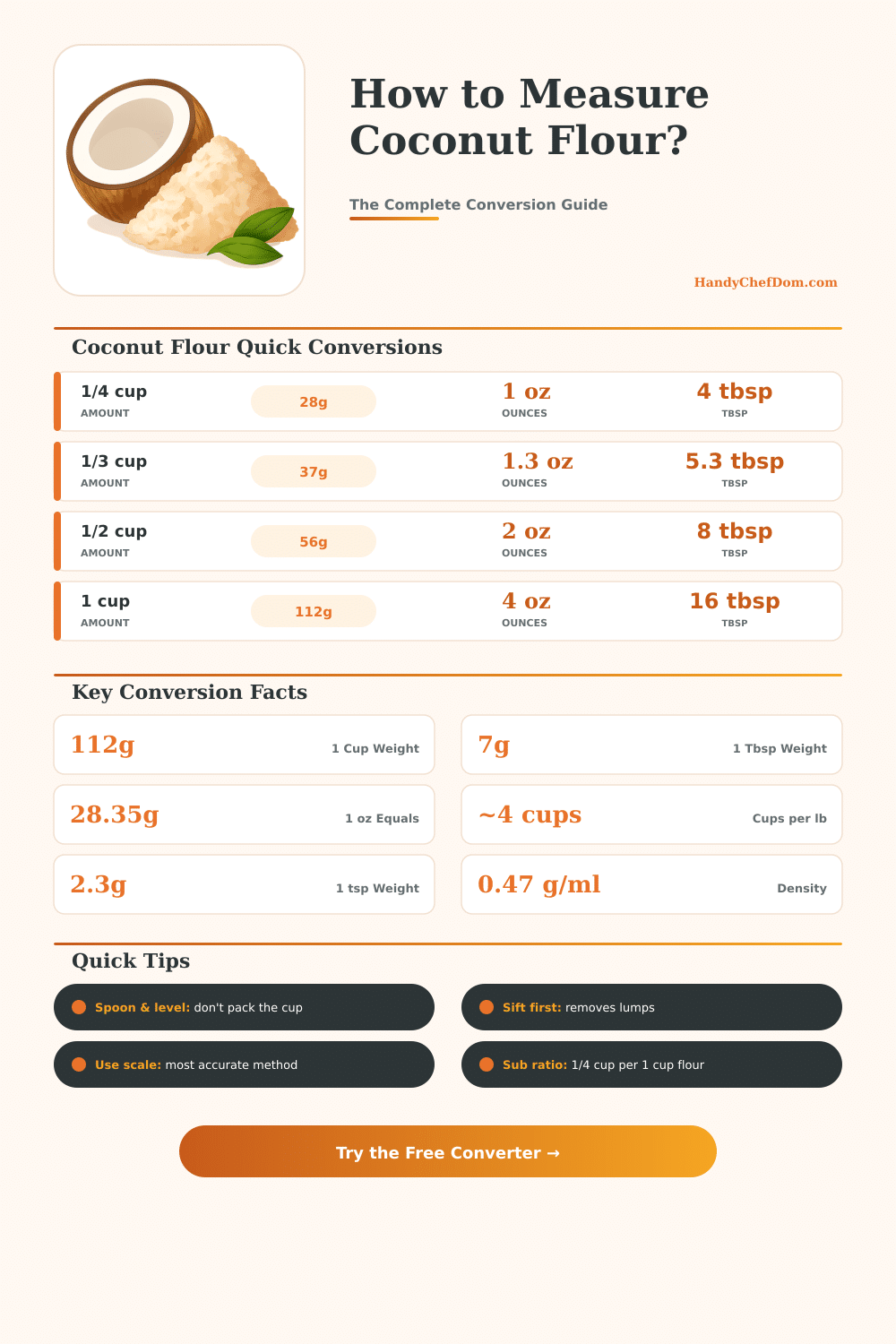
| Cups (US) | Grams | Ounces | Tablespoons | Teaspoons |
|---|---|---|---|---|
| 1 tsp | 2.3g | 0.08 oz | 0.33 tbsp | 1 tsp |
| 1 tbsp | 7g | 0.25 oz | 1 tbsp | 3 tsp |
| 1/8 cup | 14g | 0.5 oz | 2 tbsp | 6 tsp |
| 1/4 cup | 28g | 1 oz | 4 tbsp | 12 tsp |
| 1/3 cup | 37g | 1.3 oz | 5.3 tbsp | 16 tsp |
| 1/2 cup | 56g | 2 oz | 8 tbsp | 24 tsp |
| 2/3 cup | 75g | 2.6 oz | 10.6 tbsp | 32 tsp |
| 3/4 cup | 84g | 3 oz | 12 tbsp | 36 tsp |
| 1 cup | 112g | 4 oz | 16 tbsp | 48 tsp |
| 1.5 cups | 168g | 6 oz | 24 tbsp | 72 tsp |
| 2 cups | 224g | 8 oz | 32 tbsp | 96 tsp |
| 3 cups | 336g | 11.9 oz | 48 tbsp | 144 tsp |
| Grams | Kilograms | Ounces | Pounds | Cups (US) |
|---|---|---|---|---|
| 25g | 0.025 kg | 0.88 oz | 0.055 lb | ~0.22 cups |
| 50g | 0.05 kg | 1.76 oz | 0.11 lb | ~0.45 cups |
| 100g | 0.1 kg | 3.53 oz | 0.22 lb | ~0.89 cups |
| 150g | 0.15 kg | 5.29 oz | 0.33 lb | ~1.34 cups |
| 200g | 0.2 kg | 7.05 oz | 0.44 lb | ~1.79 cups |
| 250g | 0.25 kg | 8.82 oz | 0.55 lb | ~2.23 cups |
| 500g | 0.5 kg | 17.64 oz | 1.1 lb | ~4.46 cups |
| 1000g | 1 kg | 35.27 oz | 2.2 lb | ~8.93 cups |
| Flour Type | 1 Cup Weight | vs Coconut Flour | Notes |
|---|---|---|---|
| Coconut Flour | 112g | — Baseline | Very absorbent |
| All-Purpose Flour | 125g | 4x more needed | Not gluten-free |
| Almond Flour | 96g | 4x more needed | High fat content |
| Oat Flour | 92g | 3x more needed | Mild flavor |
| Cassava Flour | 130g | 1:1 substitute | Closest texture |
| Rice Flour | 158g | 3-4x more needed | Gluten-free |
Coconut flour is made from dried and finely ground coconut meat. That flour gives a wet texture with a gentle nutty flavor. It does not really deserve the name “flour” in the traditional sense.
It does not contain any grain and is based on whole coconut meat. Here is what entirely sets it apart from the usual flour that one finds in many kitchen stores.
Coconut Flour: What It Is and How to Use It
Among the main things to know are that coconut flour is entirely without gluten. It is a popular replacement for regular flours, because it has fairly few carbohydrates, but plenty of proteins and fiber. It works well for keto, paleo, and vegan baking.
It has a natural softness that adds a tender coconut taste to baked goods, crepes, and others.
Fiber stands among the benefits of coconut flour. Compared to wheat flour, it stores much more fiber, both soluble and insoluble. Foods rich in fiber support healthy digestion and help good bacteria spread in the bowels.
Like this one keeps the bowel moves regular and can defend against various diseases. High fiber also helps you feel full more steadily, what strengthens energy and blocks hunger. Also, coconut flour has useful fat like MCTs, which means medium chain triglycerides, together with good protein amount.
Here comes the difficult part. Coconut flour does not act like usual flour. It absorbs extremely.
You can imagine it almost like sawdust. It swallows all liquids from a recipe, so one must add more eggs and other liquids. It does not work as a one-for-one replacement for regular flours.
A simple thumb rule says too use one-quarter to one-third cups of coconut flour for one whole cup of regular. Also, it does not thicken sauce or gravy like the usual flour.
Texture commonly turns out dense, and sometimes a bit crumbly. Without gluten, coconut flour does not rise on its own. Raising agents, like baking powder, help well.
Mixing it with almond flour is a good idea and usually gives better results. The more fine the flour, the more it affects thefinal product.
Coconut flour does not limit to sweet recipes. It works well in dishes that use coconut milk. Just add a spoon of it in the liquid some minutes before serving and mix well.
Baking with it needs attention, but it works well for tasty treats with many eggs and with fruit puree like pumpkin or pureed squash. Also it has more natural sugar than wheat flour, what is worth noting during recipe planning.