🍳 Cooking Ratio Calculator
Scale any recipe instantly — enter your base amount & desired servings to get perfect ingredient ratios in imperial or metric units.
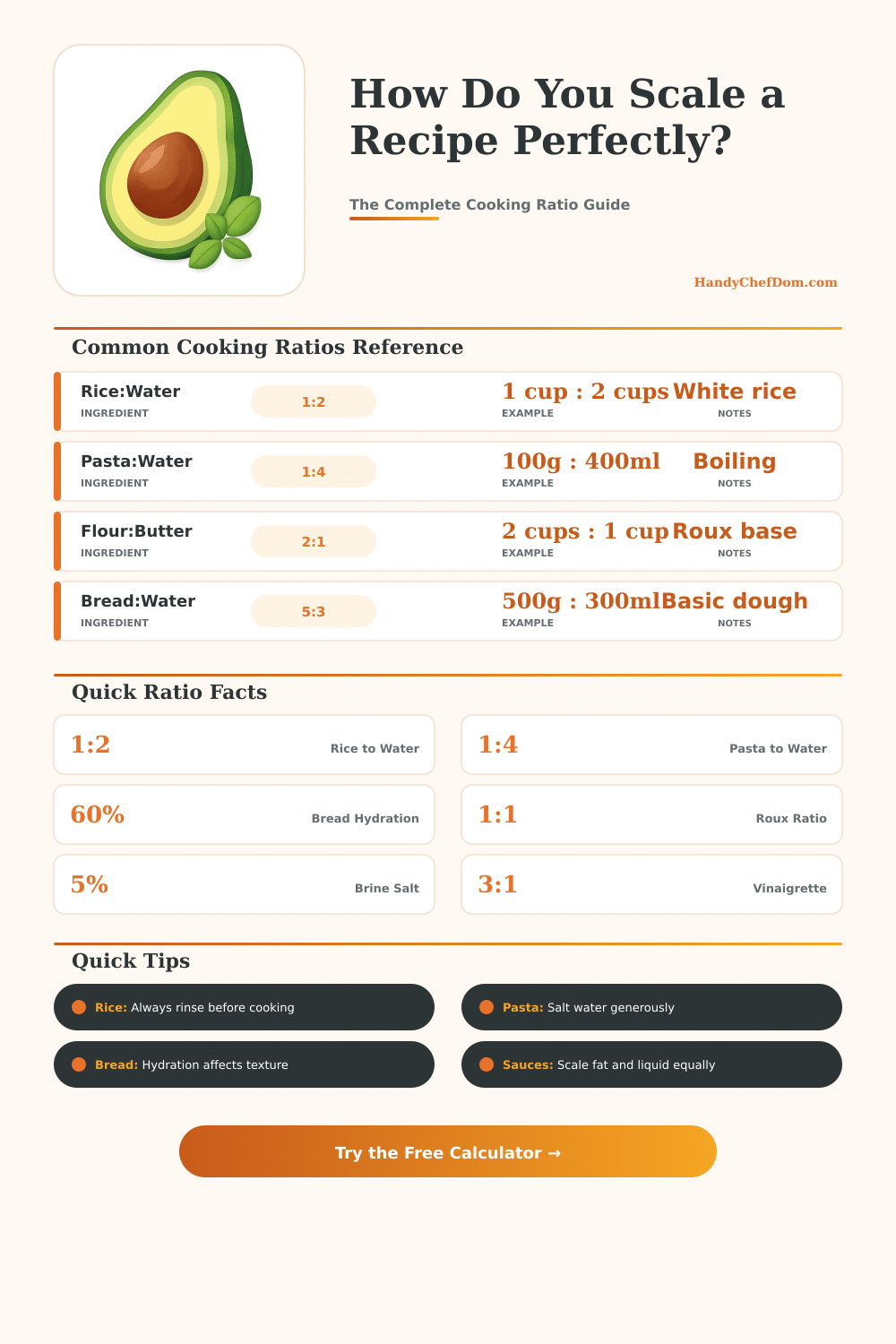
| Recipe / Dish | Ratio | Imperial Example | Metric Example |
|---|---|---|---|
| White Rice : Water | 1 : 2 | 1 cup rice : 2 cups water | 200g rice : 400ml water |
| Brown Rice : Water | 1 : 2.5 | 1 cup rice : 2.5 cups water | 200g rice : 500ml water |
| Pasta : Water | 1 : 4 | 4 oz pasta : 16 fl oz water | 100g pasta : 400ml water |
| Oatmeal : Water | 1 : 2 | 0.5 cup oats : 1 cup water | 80g oats : 160ml water |
| Bread Dough (hydration) | 5 : 3 | 2.5 cups flour : 1.5 cups water | 500g flour : 300ml water |
| Roux (Butter : Flour) | 1 : 1 | 2 tbsp butter : 2 tbsp flour | 30g butter : 30g flour |
| Vinaigrette (Oil : Vinegar) | 3 : 1 | 3 tbsp oil : 1 tbsp vinegar | 45ml oil : 15ml vinegar |
| Brine (Water : Salt) | 20 : 1 | 4 cups water : 3.5 tbsp salt | 1000ml water : 50g salt |
| Polenta : Water | 1 : 4 | 1 cup polenta : 4 cups water | 150g polenta : 600ml water |
| Pancake (Flour : Milk) | 1 : 1 | 1 cup flour : 1 cup milk | 120g flour : 240ml milk |
| Imperial Unit | Metric Equivalent | Common Use | Notes |
|---|---|---|---|
| 1 cup | 240 ml / 128g (flour) | Dry & liquid | Varies by ingredient |
| 1 tablespoon | 15 ml | Small quantities | 3 tsp = 1 tbsp |
| 1 teaspoon | 5 ml | Spices, salt | Standard measure |
| 1 fluid ounce | 29.57 ml | Liquids | US fl oz |
| 1 ounce (dry) | 28.35 g | Dry ingredients | Avoirdupois |
| 1 pound | 453.6 g | Meat, produce | 16 oz = 1 lb |
| 1 quart | 946 ml | Large liquids | 4 cups = 1 quart |
| 1 gallon | 3785 ml | Bulk recipes | 16 cups = 1 gallon |
| Scale Factor | Fraction | Example (Base = 1 cup) | Scaled Amount |
|---|---|---|---|
| Half recipe | 0.5x | 1 cup flour | 0.5 cup / 64g |
| Double recipe | 2x | 1 cup flour | 2 cups / 256g |
| Triple recipe | 3x | 1 cup flour | 3 cups / 384g |
| 1.5x recipe | 1.5x | 1 cup flour | 1.5 cups / 192g |
| Quarter recipe | 0.25x | 1 cup flour | 0.25 cup / 32g |
| 4x recipe | 4x | 1 cup flour | 4 cups / 512g |
I reckon that cooking by proportions is like a mental growth. Instead of diving every morning in difficult recipes while you prepare foods, those proportions allow you to dig out the essence of causes, simply basic relations, that always work. Here what matters: almost all recipes that you ever followed, indeed are only slightly changed forms of key proportions.
When you well grasp the key proportion, right away you feel freedom to modify, improvise and experiment in the kitchen.
Easy Cooking Proportions
Michael Ruhlman wrote a book, that became a genuinely great bible for this theme about proportions: Proportion: The Simple Codes Behind the Art of Everyday Kitchen. It explores thirty-three different proportions with many variations and little changes everywhere. The author digs deep into the basic kitchen elements, water, flour, butter and oils, milk and cream, eggs, that all work by expected ways.
The book genuinely helps to strip the skeleton of the kitchen, and it carries also practical recipes. After the release of the book, Ruhlman worked with other folk and created a calculator for proportion types on iPhone. That app helps to cook without need of classical recipes.
When you start to observe, you find proportions everywhere. Take the dough for cookies… It bases on 3:2:1 relation, so three parts flour, two parts fat and one part sugar.
For biscuit the mass flips to three parts flour, one part fat and two parts liquid. Dough for cakes hits the right balance in three parts flour, two parts fat and one part water. And here what is interesting: the order, in which you list them, commonly matches teh order, in which you mix them.
Pound cake is surprisingly simple. Equal amounts of butter, sugar, eggs and flour work together. For vinaigrette it deals about three parts oil balanced against one part vinegar.
Roux starts by means of equal parts thickener and flour. Simple syrup could not be more basic (only equal parts water and sugar), measured by volume.
Rice prepares differently by the kind, what matters more then many folks know. White rice cooks well between 1:1.5 and 1:2 proportion of rice to water. Brown rice requires a bit more liquid, around 1:1.75 to 1:2.
Basmati or jasmine rice likes 1:1.5. Medium grain rice handles well 1:1 relation. For rice pilaf the cause differs, here you require two parts liquid for one part rice.
Baking is the place, where proportions stop being advice and become strict rules. If you mess them, your results fail. The world of kitchen splits between loose guides and rigid demand, and baking belongs flatly to the second group.
Soups have their own base formula… One part protein, two parts vegetables and four parts broth gives good base. For salt and pepper, around three parts salt to one part pepper works well.
For kitchen oats you need two parts liquid for one part oats. Some grains require precise 3:1 relation of liquid to grains.
Whether you measure by weight or volume genuinely matters. More than one thinks. The difference between volume and heavy measures can change your ingredients quite a lot.
Most American recipes use volume measures. Even so, weighing ingredients, especially eggs in baking, ensures more steady results. By my experience, one egg eachfolk is a good guess when one builds proportions.