🌡️ Cooking Temperature & Time Converter
Convert between °F, °C, Gas Mark and adjust cooking times for different temperatures
| Description | °F | °C | Gas Mark |
|---|---|---|---|
| Very Cool | 225 | 110 | ¼ |
| Cool | 250 | 120 | ½ |
| Cool/Slow | 275 | 135 | 1 |
| Warm | 300 | 150 | 2 |
| Moderate Low | 325 | 165 | 3 |
| Moderate | 350 | 175 | 4 |
| Moderate Hot | 375 | 190 | 5 |
| Hot | 400 | 200 | 6 |
| Hot | 425 | 220 | 7 |
| Very Hot | 450 | 230 | 8 |
| Very Hot | 475 | 245 | 9 |
| Extremely Hot | 500 | 260 | 10 |
| Temp Change | Time Adjustment | Example: 60 min at 350°F |
|---|---|---|
| +50°F / +28°C higher | Reduce time ~25–30% | ~42–45 min |
| +25°F / +14°C higher | Reduce time ~12–15% | ~51–53 min |
| Same temperature | No change | 60 min |
| −25°F / −14°C lower | Increase time ~15–18% | ~69–71 min |
| −50°F / −28°C lower | Increase time ~33–40% | ~80–84 min |
| Conventional °F | Conventional °C | Fan/Convection °F | Fan/Convection °C |
|---|---|---|---|
| 300 | 150 | 275 | 130 |
| 325 | 165 | 300 | 145 |
| 350 | 175 | 325 | 155 |
| 375 | 190 | 350 | 170 |
| 400 | 200 | 375 | 180 |
| 425 | 220 | 400 | 200 |
| 450 | 230 | 425 | 210 |
| 475 | 245 | 450 | 225 |
| Food Item | Doneness | °F | °C |
|---|---|---|---|
| Chicken / Poultry | Done | 165 | 74 |
| Ground Beef | Done | 160 | 71 |
| Beef Steak | Rare | 125 | 52 |
| Beef Steak | Medium Rare | 135 | 57 |
| Beef Steak | Medium | 145 | 63 |
| Beef Steak | Well Done | 160 | 71 |
| Pork | Done | 145 | 63 |
| Fish | Done | 145 | 63 |
| Lamb | Medium Rare | 135 | 57 |
| Bread | Done | 190–210 | 88–99 |
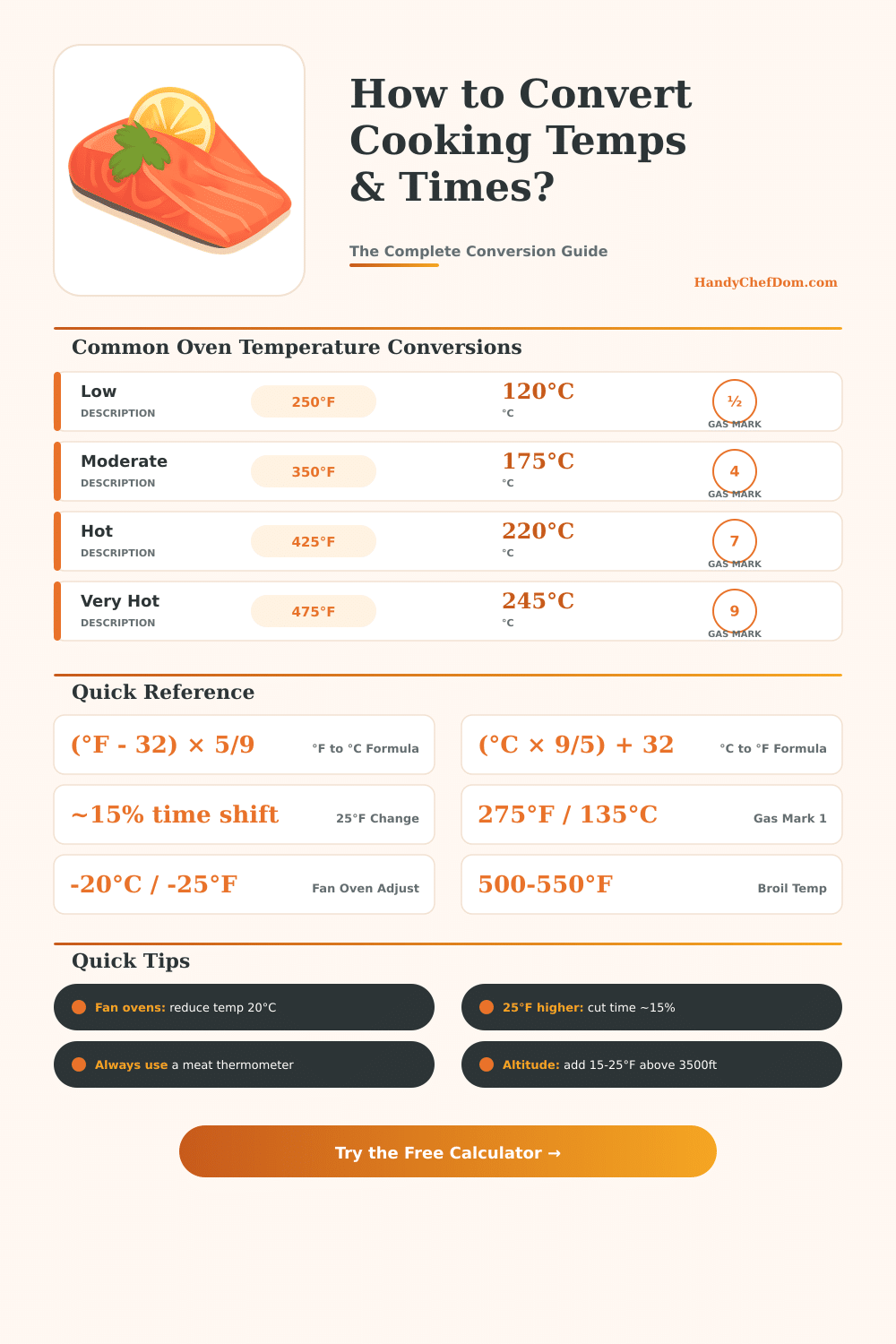
The most common formula I use is (F minus 32) times 5 and divided by 9, because it helps to convert to Celsius. 350 degrees Fahrenheit match around 175 Celsius, what matches Gas Mark 4. It does not seem logical at first.
Fan ovens about 20 degrees hotter than usual, so one must lower the Time, what commonly means around 15 percent shorter duration.
How Oven Heat Changes Cooking Time and Keeps Food Safe
If one raises the oven Temperature by 25 degrees F, the cooking Time reduce by 12 to 15 percent. And if 50 degrees higher? Then you find drop 25 to 30 percent from the entire time.
I tested it with roasts at 325 against 375, and the results stay quite stable. A dish of 60 minutes at 350F last about 42 to 45 minutes at 400F.
The data in this article do not come from a calculator or tool online. They are based on real experience, forum talks and cooking groups spread across the net.
Cooking Temperature sets the exact heat, in which one prepares certain food. It changes according to the kind of food and the way you cook. Various meats require different advised internal heats, and each food item maybe requires a different degree because of things like thickness or structure.
A thermometer for foods stays the most reliable tool, to check, did the meat reach the safe internal heat. Those levels must be warm enough, to kill dangerous germs, which prevents food poisoning. Some meats especially require rest Time after cooking.
Because folks like their meat in various degrees, and the process directly depends on the internal Temperature, this thermometer soon will show, whether steak is medium cooked, medium-more, or simply not ready to eat.
Checking the heat really matters, to create foods, that are both safe and delicious. Warm whether expands the dangers of food disease, especially if foods are left too long outside or do not cook at the right heat. With the right tools one cooks food evenly and avoids under- or overcooked parts, that could become ground for bacteria.
Recall three main heats, when you cook meat or eggs at home. Eggs and all ground meats must reach 160 degrees. Birds and chicken require 165 degrees.
Fresh steaks, cut meats and roasts should arrive at 145 degrees. For fresh pork slices the safe internal cooking heat is also 145 degrees. Today’s pork is very lean, so it matters to not overdo it.
All reheated foods, regardless of the prior cooking heat, must reach 165 degrees to be safe, because foods, that stood outside, can attract bacteria.
Steak medium-rare should have 130 to 135 degrees Fahrenheit inside. For rare the target lays around 120 degrees Fahrenheit. Medium cooking is around 160 degrees, and well done reaches 170 degrees.
Low Temperature cooking usually means anything at or under 325 degrees Fahrenheit. At those levels you lack the Maillard browning, so the flavor of the meat stays only its own. Cooking pork loin at 300 degrees Fahrenheit gives very moist meat.
Lower heat during more Time also destroys dangerous bacteria, with the bonus of better texture. One can do that easily with sous-vide gear. Slow cookers normally work between 190 and 200 degrees Fahrenheit on low, around 300 on high and about 165 on warm.
Many cooks happen at 350 degrees Fahrenheit. That heat is so common, that it almost becomes thedefault in many kitchens. Even deep fryers and ovens set to the same 350-degree cooking work at very different speeds.