🍳 Cooking Unit Conversion Calculator
Instantly convert between cups, tablespoons, ounces, grams, liters, and more
| Unit | Teaspoons | Tablespoons | Cups | mL |
|---|---|---|---|---|
| 1 Teaspoon | 1 | 0.333 | 0.0208 | 4.929 |
| 1 Tablespoon | 3 | 1 | 0.0625 | 14.787 |
| 1 Fluid Ounce | 6 | 2 | 0.125 | 29.574 |
| ¼ Cup | 12 | 4 | 0.25 | 59.147 |
| ⅓ Cup | 16 | 5.333 | 0.333 | 78.863 |
| ½ Cup | 24 | 8 | 0.5 | 118.294 |
| 1 Cup | 48 | 16 | 1 | 236.588 |
| 1 Pint | 96 | 32 | 2 | 473.176 |
| 1 Quart | 192 | 64 | 4 | 946.353 |
| 1 Gallon | 768 | 256 | 16 | 3,785.41 |
| Unit | Ounces (oz) | Grams (g) | Pounds (lb) | Kilograms (kg) |
|---|---|---|---|---|
| 1 Ounce | 1 | 28.35 | 0.0625 | 0.02835 |
| 4 Ounces | 4 | 113.4 | 0.25 | 0.1134 |
| 8 Ounces (½ lb) | 8 | 226.8 | 0.5 | 0.2268 |
| 12 Ounces | 12 | 340.2 | 0.75 | 0.3402 |
| 1 Pound (16 oz) | 16 | 453.6 | 1 | 0.4536 |
| 2 Pounds | 32 | 907.2 | 2 | 0.9072 |
| 5 Pounds | 80 | 2,268 | 5 | 2.268 |
| 1 Kilogram | 35.27 | 1,000 | 2.205 | 1 |
| Ingredient | 1 Cup (g) | 1 Tbsp (g) | 1 Tsp (g) |
|---|---|---|---|
| All-Purpose Flour | 125 | 8 | 2.6 |
| Bread Flour | 130 | 8.1 | 2.7 |
| Granulated Sugar | 200 | 12.5 | 4.2 |
| Brown Sugar (packed) | 220 | 13.8 | 4.6 |
| Powdered Sugar | 120 | 7.5 | 2.5 |
| Butter | 227 | 14.2 | 4.7 |
| Honey / Maple Syrup | 340 | 21 | 7 |
| Milk | 245 | 15.3 | 5.1 |
| Heavy Cream | 238 | 14.9 | 5 |
| Olive Oil | 216 | 13.5 | 4.5 |
| Cocoa Powder | 86 | 5.4 | 1.8 |
| Salt (table) | 288 | 18 | 6 |
| Baking Powder | 230 | 14.4 | 4.8 |
| Rolled Oats | 90 | 5.6 | 1.9 |
| Rice (uncooked) | 185 | 11.6 | 3.9 |
| Imperial | Metric (Exact) | Metric (Rounded) | Notes |
|---|---|---|---|
| 1 tsp | 4.929 mL | 5 mL | Metric tsp = exactly 5 mL |
| 1 tbsp | 14.787 mL | 15 mL | Metric tbsp = exactly 15 mL |
| 1 fl oz | 29.574 mL | 30 mL | — |
| 1 cup | 236.588 mL | 240 mL | Often rounded in recipes |
| 1 pint | 473.176 mL | 475 mL | US pint, not UK (568 mL) |
| 1 quart | 946.353 mL | 950 mL | — |
| 1 gallon | 3,785.41 mL | 3.8 L | US gallon, not UK (4.546 L) |
| 1 oz | 28.3495 g | 28 g | Avoirdupois ounce |
| 1 lb | 453.592 g | 454 g | — |
One cup of flour weigh around 125 grams although I noticed, that it ranges between 110 and 150 grams according to the brand. That gives a 30-percent span. Weird, right?
One tablespoon of butter weighs about 14 grams, while a whole stick match half a cup, so around 113 grams. I did not understand, how those tiny differences add up, until when I started baking by weight.
Cooking Measurements and Unit Conversions
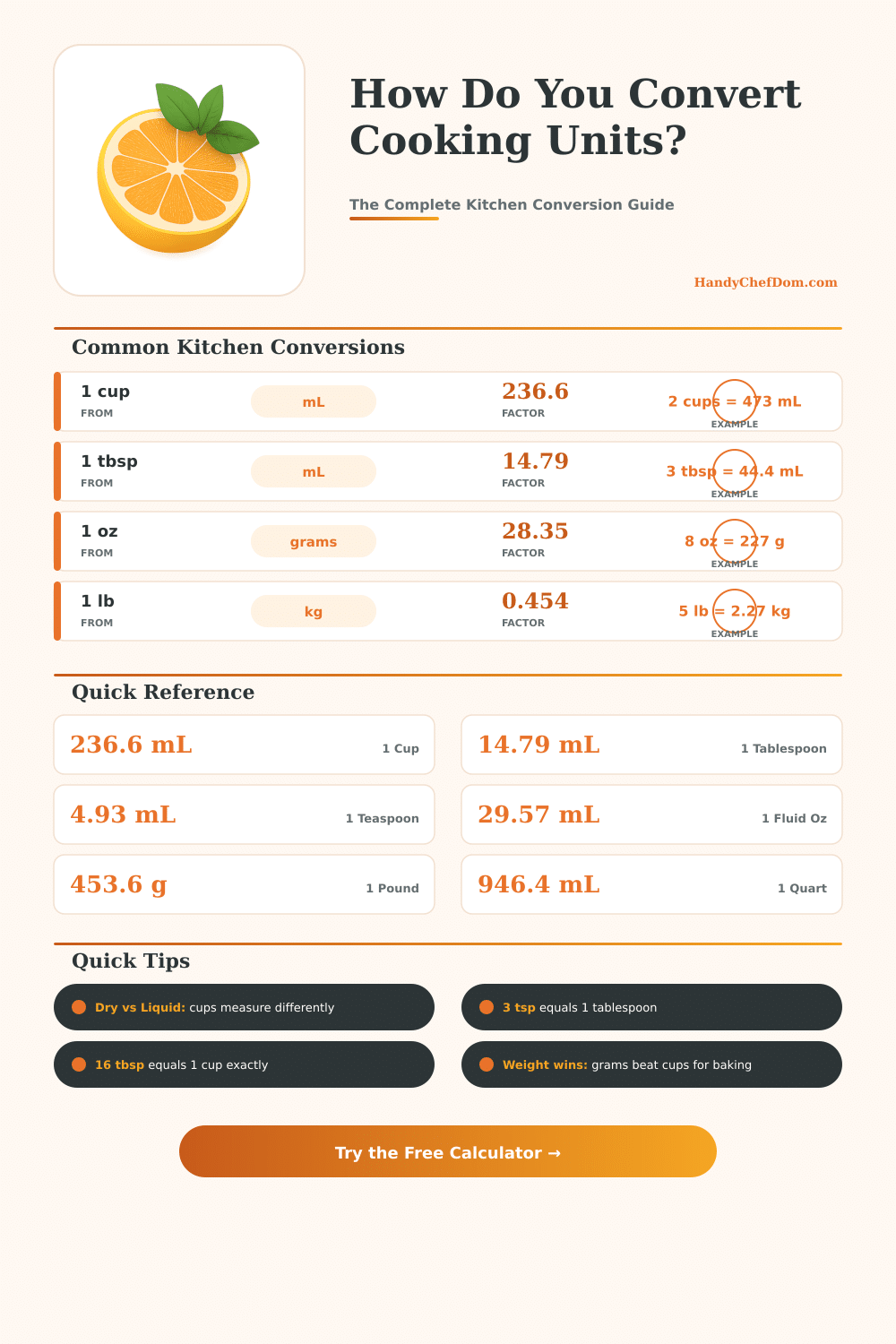
The ratio between teaspoon and tablespoon are 3:1, and 16 tablespoons form one cup. 236.6 mL exactly. An American liquid unit reaches around 29.6 mL, which quite closely matches 30, so that recipes usually round.
Metric teaspoons have exactly 5 mL, so less than 1.5 % more than the American type. One gallon stores 3 785 mL, that is 16 cups or 128 liquid untis. One pound matches 453.6 grams and 16 units, and I say, that I stopped keeping track of when I adapt so many European recipes.
The info below does not come from any converter tool. It builds on real usage, looking back, forum talks and experiences of cooking groups across the net.
A unit of measure forms a system, that explains the size of an object. Conversions take a value in one group of units and change it to an equal amount in another group. The basic thought is, that the physical size stays same, regardless of the used first system.
Only the way, as one says it, adjusts.
One can think about conversion easily by means of multiplying by means of a “clever form of 1”. Every number divided by itself match one. Because 12 inches form won foot, the fraction 12 inches divided by 1 foot matches one.
Multiplying by means of that fraction changes the units, but not the real amount. One sometimes calls this method dimensional analysis, where units work as algebraic factors, that cancel each other in tops and bottoms.
For example, if one measures something in grams and milliliters and wants kilos and liters, one multiplies by means of a fraction with grams in the bottom, which removes grams. That fraction is the conversion factor, and because it matches one, the number not truly changes. Same thinking counts for change between metric prefixes.
“Centi” means one hundredth, and “milli” one thousandth, so converting between deciliters and milliliters gets simple, when one understands those prefixes. Also, 1 cubic centimeter matches 1 milliliter, and common prefixes as milli-, micro-, nano-, kilo-, mega- and giga appear commonly.
Not every country uses pounds, inches and units. Most of the world use metric units. People in places with both imperial and metric systems can find conversions truly painful.
Typing conversions directly in Google commonly gives fast results, for example “10 miles in km.”. Programs as Wolfram Alpha even handle complex mixed first expressions and give the result in any wanted unit.
Free online converters for units exist for length, temperature, area, volume, mass and time. One of them covers more than 77 different types of conversions and has suggestion tools, that offer possible changes according to the input. Others handle currency, density, energy, force, mass, power, pressure, speed and bits.
Some calculators include first conversions and allow to switch between imperial and metric system on the screen of the device.
In cooking it matters a lot to convert kitchen measures, when one scales recipes upward or down. Cups, teaspoons, tablespoons, pints, quarts, units and grams are all common. A teaspoon is a volume unit, so its weight depends on the ingredient.
International recipes use grams, milliliters and Celsius degrees instead of units, cups and Fahrenheit. Some items, especially bakedproducts, do not scale simply in a line.