🥩 Corned Beef Brine Calculator
Calculate exact salt, curing salt, sugar & spice amounts for your brine
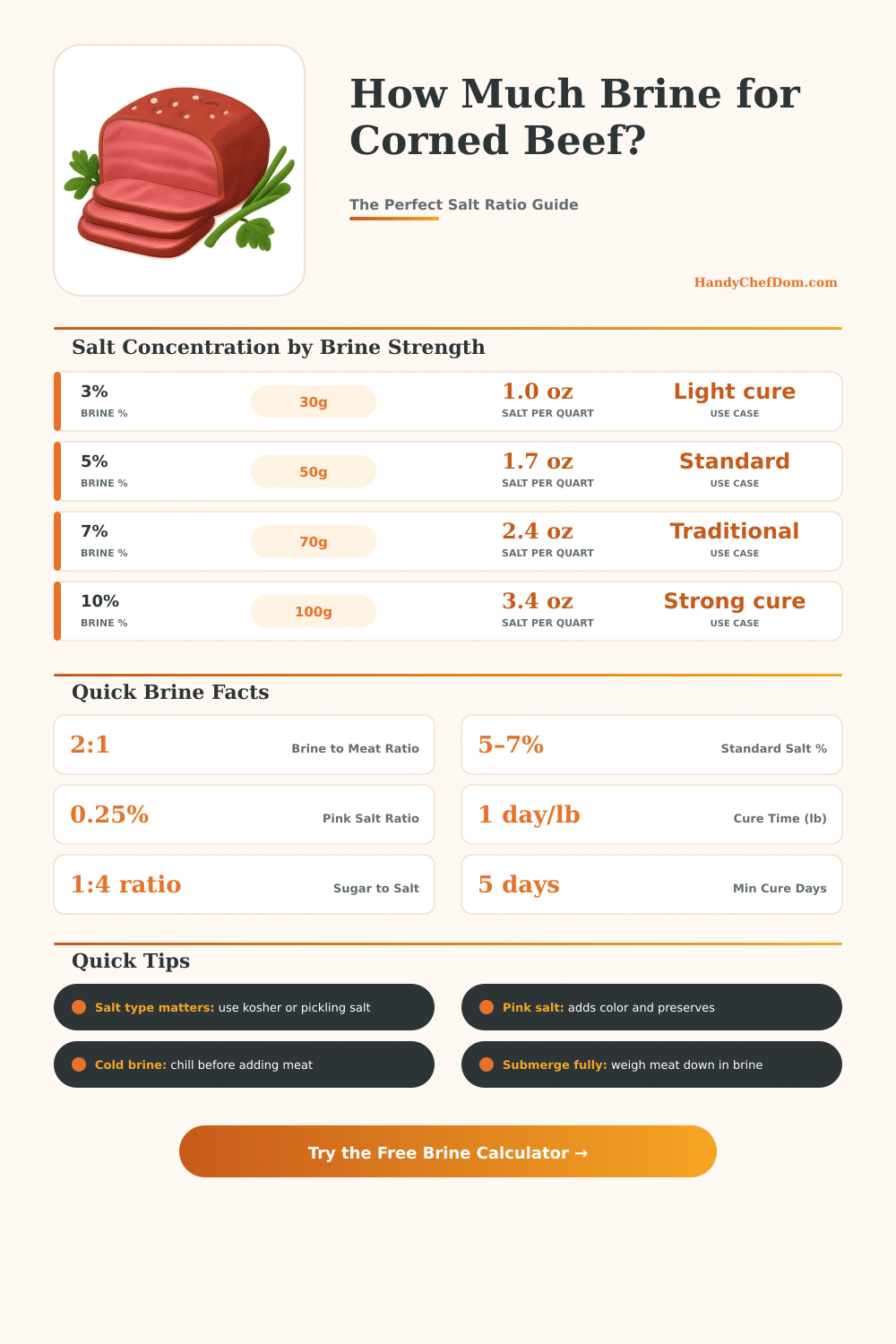
| Brine % | Salt per Liter | Salt per Quart | Salt per Gallon | Best Use |
|---|---|---|---|---|
| 3% | 30g | 1.0 oz (28g) | 4.0 oz (113g) | Light, mild cure |
| 4% | 40g | 1.3 oz (37g) | 5.3 oz (151g) | Mild flavor |
| 5% | 50g | 1.7 oz (47g) | 6.7 oz (190g) | Standard corned beef |
| 6% | 60g | 2.0 oz (57g) | 8.0 oz (227g) | Medium-strong |
| 7% | 70g | 2.4 oz (66g) | 9.5 oz (270g) | Traditional deli-style |
| 8% | 80g | 2.7 oz (76g) | 10.8 oz (306g) | Strong, assertive |
| 10% | 100g | 3.4 oz (95g) | 13.4 oz (380g) | Quick cure, short time |
| Meat Weight | Min. Cure Days | Recommended Days | Max Days |
|---|---|---|---|
| 1–2 lbs (0.5–1 kg) | 3 days | 5 days | 7 days |
| 3–4 lbs (1.4–1.8 kg) | 5 days | 7 days | 10 days |
| 5–6 lbs (2.3–2.7 kg) | 7 days | 10 days | 14 days |
| 7–10 lbs (3.2–4.5 kg) | 8 days | 12 days | 16 days |
| 11–14 lbs (5–6.4 kg) | 10 days | 14 days | 18 days |
| Salt Type | 1 tsp Weight | 1 tbsp Weight | 1 cup Weight | Notes |
|---|---|---|---|---|
| Kosher Salt (Diamond) | 2.8g | 8.4g | 135g | Best for brining |
| Kosher Salt (Morton) | 4.8g | 14.4g | 230g | Coarser grain |
| Pickling Salt | 6g | 18g | 290g | No iodine, fine grain |
| Table Salt (iodized) | 6g | 18g | 288g | Avoid — can discolor |
| Prague Powder #1 | 5g | 15g | 240g | 6.25% sodium nitrite |
| Spice | Amount / Quart | Amount / Liter | Amount / Gallon |
|---|---|---|---|
| Black Peppercorns | 1 tsp (3g) | 1.1 tsp (3.2g) | 4 tsp (12g) |
| Mustard Seeds | 1 tsp (3g) | 1.1 tsp (3.2g) | 4 tsp (12g) |
| Coriander Seeds | 1 tsp (2g) | 1.1 tsp (2.1g) | 4 tsp (8g) |
| Bay Leaves | 2 leaves | 2 leaves | 8 leaves |
| Whole Cloves | 4 cloves | 4 cloves | 16 cloves |
| Allspice Berries | 4 berries | 4 berries | 16 berries |
| Red Pepper Flakes | 1/4 tsp (0.5g) | 0.3 tsp (0.5g) | 1 tsp (2g) |
Corned beef is made of beef kept fresh by means of salt, that probably started in the 17th century when folks needed to save meat. The word itself does not have relation to corn. It comes from an old English expression for the big crystals of rock salt that one used to protect the meat.
One called those crystals “corns” and rubbed them on the beef so that it stay fresh. That happened already in the Anglo-Saxon era long before fridges existed.
Corned Beef: What It Is and How to Cook It
Typical meat for that is brisket, but sometimes one uses round bit or other cuts. The beef cooks in salt-based brine, that usually carries sugar and spices like pepper grains, mustard seeds, bay sheets, allspice and dill. During the brisket stay in that mix for days or even weeks, the salt and flavors well enter the meat.
Every bit results like this rich in taste that one does not need to add a lot during the cook.
Corned beef feels more like ham than like regular beef, when deal about taste and make-up. It bears typical salty flavor and same softness. The red color comes from the keeping salts, while the gray or brown look after cook simply comes form the reaction of those salts with heat.
There is no reason to care about that.
In the 17th and 18th centuries the green Irish fields served to feed livestock, from that one prepared corned beef. It provided food for British citizens, soldiers and crewmen. Thanks to his long lasting time it worked great for journeys abroad and trade with France.
Corned beef became important canned meat because of good supplies, progress in keeping and set trade routes. No other meats, like chicken or pig, could replace it so well.
Corned beef bought in stores already are pre-salted and ready to cook. Well washing it before laying on fire helps to stop too much salt. The thick fat cap on the brisket will not fully go away during roasting, so removing extra is a wise idea.
The flat slice has usually rectangular form and works best for thick cuts, for instance for sandwiches or breakfast hash.
Methods for cooking it differ a lot. A slow cooker works well to reach wet, falling-apart meat. A bit of boiling in a jar with salted spices for around 50 minutes each pound is another reliable way.
One can use beer as cooking liquid. Stout or ale soften the salty taste while it adds deep richness. Some even try frying by means of air, wrapped in mustard.
Traditional sides are cabbage, potatoes, carrots, turnips and parsnips. For a classic sandwich one takes rye bread with mustard. Add sauerkraut and Swiss cheese to make it really tasty.
From leftovers of corned beef one makes wonderful hash with onions and potatoes, covered with eggs. It stronglyconnects with the festive meals of Saint Patrick and also New Year foods, that intend to bring wealth.