💪 Protein Consumption Calculator
Calculate your optimal daily protein intake based on body weight, activity level, and fitness goals
| Food Source | Serving Size | Protein (g) | Calories |
|---|---|---|---|
| Chicken Breast (cooked) | 6 oz / 170g | 54g | 281 |
| Salmon Fillet (cooked) | 6 oz / 170g | 40g | 350 |
| Lean Ground Beef 93% | 4 oz / 113g | 24g | 170 |
| Large Egg | 1 egg / 50g | 6g | 72 |
| Greek Yogurt (nonfat) | 1 cup / 245g | 20g | 130 |
| Cottage Cheese (low fat) | 1 cup / 226g | 28g | 183 |
| Whey Protein Powder | 1 scoop / 30g | 25g | 120 |
| Tofu (firm) | 1/2 block / 126g | 15g | 117 |
| Black Beans (cooked) | 1 cup / 172g | 15g | 227 |
| Almonds | 1 oz / 28g | 6g | 164 |
| Lentils (cooked) | 1 cup / 198g | 18g | 230 |
| Tuna (canned in water) | 1 can / 142g | 33g | 145 |
| Goal / Scenario | g per lb | g per kg | Range for 170 lb / 77 kg |
|---|---|---|---|
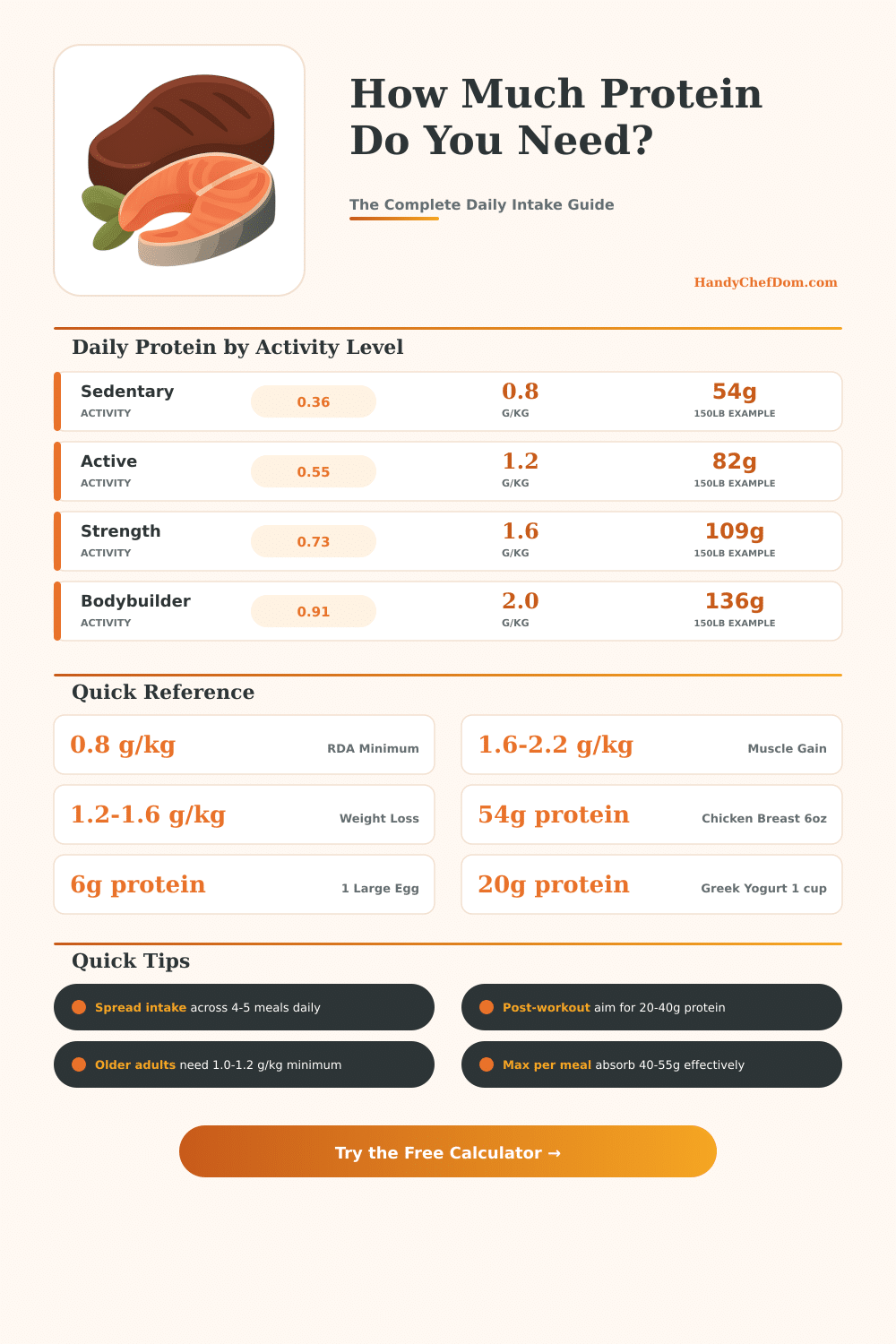
| Sedentary Maintenance (RDA) | 0.36 | 0.8 | 54 – 62g |
| Active Maintenance | 0.55 | 1.2 | 82 – 94g |
| Weight Loss / Calorie Deficit | 0.55 – 0.73 | 1.2 – 1.6 | 94 – 123g |
| Muscle Gain / Strength | 0.73 – 1.0 | 1.6 – 2.2 | 123 – 170g |
| Bodybuilding / Contest Prep | 0.91 – 1.2 | 2.0 – 2.6 | 155 – 200g |
| Endurance Athlete | 0.55 – 0.82 | 1.2 – 1.8 | 94 – 139g |
| Older Adult (65+) | 0.45 – 0.64 | 1.0 – 1.4 | 77 – 108g |
| Pregnant / Nursing | 0.50 – 0.64 | 1.1 – 1.4 | 85 – 108g |
| Teen Athlete | 0.68 – 0.91 | 1.5 – 2.0 | 116 – 154g |
| Daily Target | 3 Meals | 4 Meals | 5 Meals | 6 Meals |
|---|---|---|---|---|
| 80g/day | 27g | 20g | 16g | 13g |
| 100g/day | 33g | 25g | 20g | 17g |
| 120g/day | 40g | 30g | 24g | 20g |
| 150g/day | 50g | 38g | 30g | 25g |
| 180g/day | 60g | 45g | 36g | 30g |
| 200g/day | 67g | 50g | 40g | 33g |
| Food | Serving | Protein | Complete Protein? |
|---|---|---|---|
| Tempeh | 3 oz / 85g | 16g | Yes |
| Edamame | 1 cup / 155g | 18g | Yes |
| Seitan | 3 oz / 85g | 21g | No (low lysine) |
| Chickpeas (cooked) | 1 cup / 164g | 15g | No |
| Pea Protein Powder | 1 scoop / 33g | 24g | Nearly |
| Quinoa (cooked) | 1 cup / 185g | 8g | Yes |
| Hemp Seeds | 3 tbsp / 30g | 10g | Yes |
| Peanut Butter | 2 tbsp / 32g | 7g | No |
protein is in your muscles, bones, skin, hair and actually in every part of your body. It forms part of the enzymes that start many chemical processes, and also of the hemoglobin that carries oxygen through your blood. So people call proteins the basic elements of life.
If you eat them they split into amino acids, that allows your body to grow, fix itself and work well.
Why Protein Is Important
Around 20 different amino acids can combine in endless ways to form new proteins. Your body ties them to build muscles and bones, along with many other body structures. In the cells proteins do important tasks: they start body processes, help with the copying of DNA, react to surroundings and give cells their real form.
In meats like chicken, fish, beef, as well as in beans, lentils, eggs, nuts, seeds and tofu you find protein. Those foods also give B-vitamins, vitamin E, iron, zinc and magnesium, all together. A three-ounce piece of chicken breast gives about 26 grams of protein, which beats half of your daily minimal need.
A serving of tofu the size of your palm, a handful of unsalted nuts or a spoon of seeds each works as a good protein serving. And the advnatage? Some sources of protein fill you up a lot.
Getting 15 to 30 grams of protein in a meal really is not hard. Add a bit of variety to every meal and a serving of meet big as a double card for lunch and dinner, and you already have everything covered, even during hard training.
The usual advice for most adults is 0.8 grams for every kilo of body weight, or around 0.36 grams per pound. So a person weighing 165 pounds would need around 60 grams daily. If your kidneys do not work well, stay at those 0.8 grams per kilo, to not overload them.
Healthy kidneys? They handle bigger amounts without problems.
Athletes that lift weights often choose higher amounts. Combine high protein food with good carbs on training days, along with tough exercises and good sleep, is the way to really build muscles. Protein powder usually carries 20 to 30 grams per serving, while shakes can reach 40 grams or more.
Tofu, beans, lentils and mixes like rice with beans workwell also, if you skip meat entirely.