💪 Protein Calculator to Lose Weight
Find your personalized daily protein target to burn fat & preserve muscle
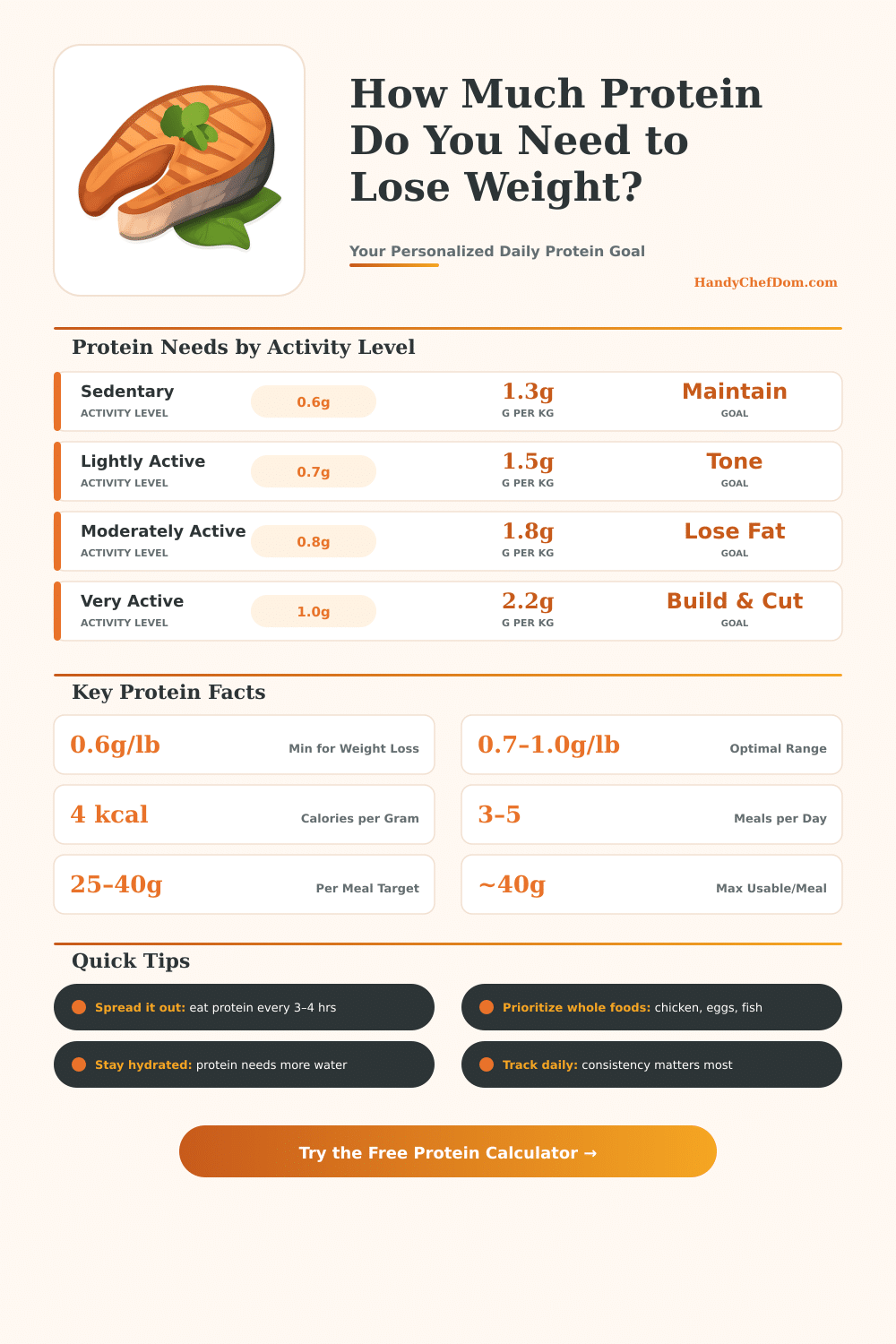
| Activity Level | g per lb body wt | g per kg body wt | Primary Goal | Diet Suitability |
|---|---|---|---|---|
| Sedentary | 0.54–0.64g | 1.2–1.4g | Preserve muscle | All types |
| Lightly Active | 0.64–0.73g | 1.4–1.6g | Tone & trim | All types |
| Moderately Active | 0.73–0.82g | 1.6–1.8g | Fat loss + retain muscle | Standard, Keto |
| Very Active | 0.82–1.0g | 1.8–2.2g | Cut fat, build strength | High Protein, IF |
| Athlete | 1.0–1.2g | 2.2–2.6g | Performance + recomposition | High Protein |
| Meal | Serving | Protein | Approx. Calories |
|---|---|---|---|
| Grilled Chicken Breast | 170g / 6oz | ~53g | ~280 kcal |
| Salmon Fillet | 170g / 6oz | ~34g | ~350 kcal |
| 2 Whole Eggs + 3 Egg Whites | ~200g | ~27g | ~200 kcal |
| Greek Yogurt (plain, 0% fat) | 200g / 7oz | ~20g | ~110 kcal |
| Canned Tuna in Water | 140g / 5oz | ~33g | ~140 kcal |
| Whey Protein Shake | 1 scoop + water | ~25g | ~120 kcal |
| Lentil & Veggie Bowl | 300g cooked | ~27g | ~370 kcal |
| Tofu Stir-Fry (firm tofu) | 200g / 7oz | ~16g | ~180 kcal |
| Cottage Cheese (low-fat) | 200g / 7oz | ~24g | ~160 kcal |
| Shrimp (cooked) | 170g / 6oz | ~34g | ~160 kcal |
| Body Weight | Est. Lean Mass (avg) | Min Protein/day | Optimal Protein/day |
|---|---|---|---|
| 120 lbs / 54 kg | ~84–96 lbs | 65–77g | 86–120g |
| 140 lbs / 64 kg | ~98–112 lbs | 76–90g | 100–140g |
| 160 lbs / 73 kg | ~112–128 lbs | 87–102g | 115–160g |
| 180 lbs / 82 kg | ~126–144 lbs | 97–115g | 130–180g |
| 200 lbs / 91 kg | ~140–160 lbs | 108–128g | 145–200g |
| 220 lbs / 100 kg | ~154–176 lbs | 119–141g | 159–220g |
Your body is full of protein, it runs through your muscles, bones, skin, hair and pretty much everywhere else. Beyond its structural role, protein does the most important chemical tasks. It powers the enzymes that drive reactions in your body and forms hemoglobin that carries oxygen through your blood.
That is why people call human proteins the basic building blocks of life. Your body breaks it into amino acids that later rebuild and fix the tissues as needed.
What Protein Does and Where to Find It
How does it work so well? Chains of proteins are made up of amino acids tied one to another. Around 20 different amino acids move around in the body, and they combine in endless ways to create various proteins.
If your body requires some new element; muscle fibers, bone density or whatever, it arranges those amino acids in long chains that hold togehter with peptide links.
Where do you get protein? Meat, poultry, fish, beans, peas, lentils, eggs, nuts, seeds and soy all give large amounts. Beyond just protein, you get B-vitamins, vitamin E, iron, zinc and magnesium.
Animal sources usually provide complete proteins rich in minerals, although there is debate about the content of packed fat compared too plant options. Not every protein food is innocent when it comes to levels of fat.
The choice of good sources depends on your eating style. Egg whites, chicken and dairy rank among the purest options. For vegetarians the task becomes a bit harder…
Most plant-based proteins come with many carbs. Tofu works well stir-fried or air-fried or crumbled in burritos. Textured plant protein works well in tacos and sauces.
Beans and lentils shine in stews and broths. Combine grains with vegetables. For instance beans with rice or quinoa, and you will have a firm nutritious base.
Cheese, lentils, vegetables and mushrooms all bring protein to thetable without too much cost.
How much do you truly need? The standard advice for a sitting adult moves around 0.8 grams for every kilo of body weight. Folk weighing 165 pounds, which matches around 75 kilos, aim for about 60 grams a day.
For growing children and pregnant or nursing women the need rises, because their bodies build extra tissue. If you have kidney problems, stay at that 0.8-gram standard per kilo (your kidneys will thank you for it). Athletes and lifters who train hard commonly aim for higher amounts.
Getting enough is not as hard as it sounds. A normal three-ounce piece of chicken gives around 26 grams of protein, more than half of your daily minimum. Most folks reach 15 to 30 grams each meal without big effort.
Protein powders provide about 20 to 30 grams each serving, while bars can reach 40 or more. Whey protein is the favorite for muscle growth. Plain soy protein stays neutral in taste and blends well into smoothies or broths.
Pure powder stores usually 70 to 80 percent of protein per weight.