🍬 Daily Sugar Intake Calculator
Find your personalized daily sugar limit based on age, sex, weight & activity level
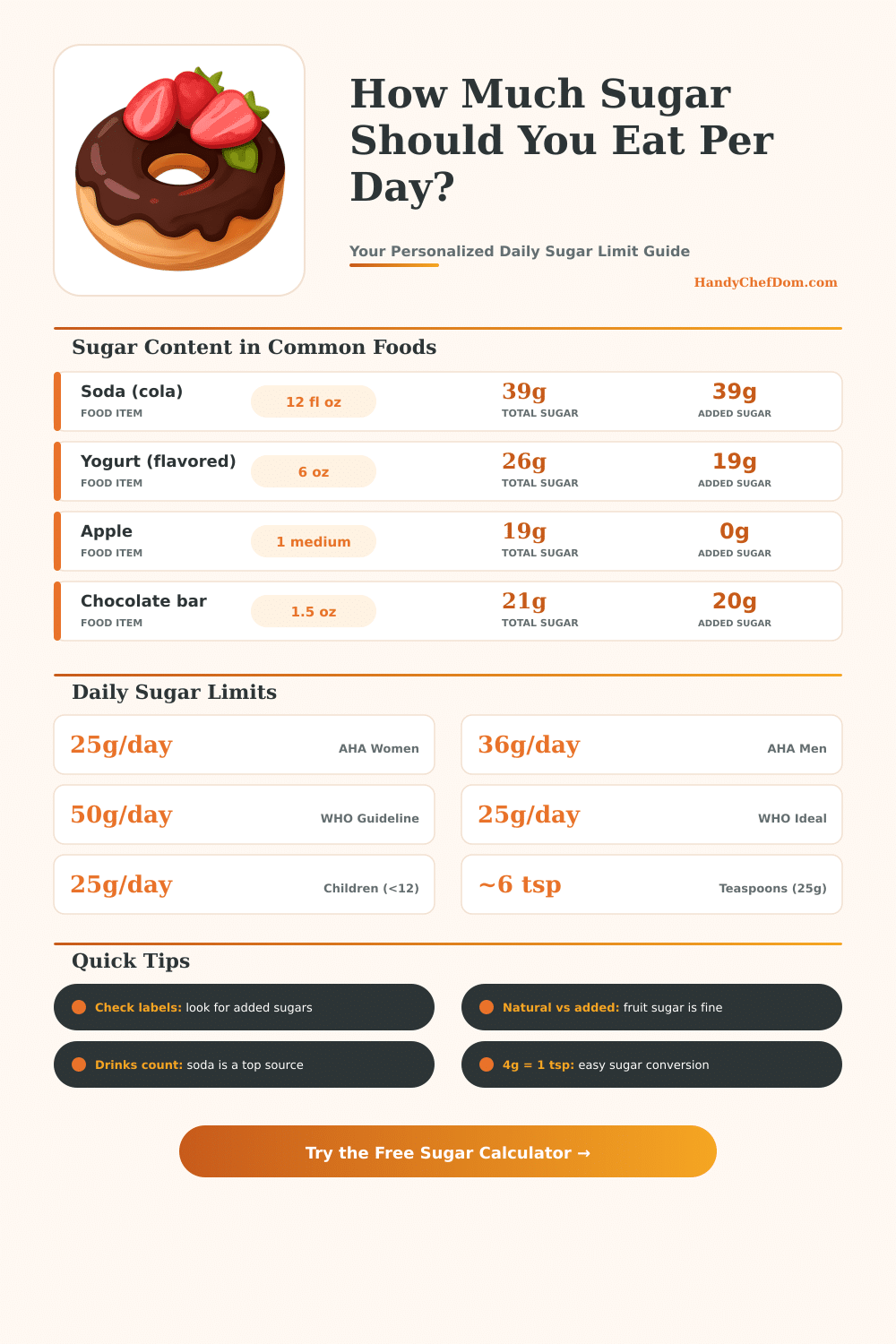
| Organization | Group | Max Added Sugar | Teaspoons |
|---|---|---|---|
| AHA | Adult Women | 25g / day | ~6 tsp |
| AHA | Adult Men | 36g / day | ~9 tsp |
| AHA | Children (2–18) | 25g / day | ~6 tsp |
| AHA | Children under 2 | 0g / day | 0 tsp |
| WHO | All Adults | 50g / day | ~12 tsp |
| WHO (ideal) | All Adults | 25g / day | ~6 tsp |
| FDA (DV) | General (2000 cal) | 50g / day | ~12 tsp |
| ADA | Diabetics | <25g / day | <6 tsp |
| Food / Drink | Serving Size | Total Sugar | Added Sugar |
|---|---|---|---|
| Cola soda | 12 fl oz (355ml) | 39g | 39g |
| Orange juice (100%) | 8 fl oz (240ml) | 22g | 0g |
| Flavored yogurt | 6 oz (170g) | 26g | 19g |
| Granola bar | 1 bar (47g) | 12g | 8g |
| Apple | 1 medium (182g) | 19g | 0g |
| Banana | 1 medium (118g) | 14g | 0g |
| Chocolate bar (milk) | 1.5 oz (43g) | 21g | 20g |
| Ketchup | 1 tbsp (17g) | 4g | 4g |
| Breakfast cereal (sugared) | 1 cup (30g) | 12g | 12g |
| Energy drink | 8.4 fl oz (250ml) | 27g | 27g |
| Vanilla ice cream | 1/2 cup (66g) | 14g | 13g |
| Tomato pasta sauce | 1/2 cup (125g) | 10g | 6g |
| Daily Calories | 10% Max (WHO) | 5% Ideal (WHO) | AHA Limit |
|---|---|---|---|
| 1,200 cal/day | 30g | 15g | 25g |
| 1,500 cal/day | 37.5g | 18.75g | 25–36g |
| 1,800 cal/day | 45g | 22.5g | 25–36g |
| 2,000 cal/day | 50g | 25g | 25–36g |
| 2,200 cal/day | 55g | 27.5g | 36g |
| 2,500 cal/day | 62.5g | 31.25g | 36g |
| 3,000 cal/day | 75g | 37.5g | 36g |
| Daily Added Sugar | Teaspoons | Assessment | Notes |
|---|---|---|---|
| 0 – 15g | 0 – 3.75 tsp | ✅ Excellent | Well below all guidelines |
| 16 – 25g | 4 – 6.25 tsp | 🟢 Very Good | Within AHA limits |
| 26 – 36g | 6.5 – 9 tsp | 🟡 Acceptable | Within AHA limit for men |
| 37 – 50g | 9.25 – 12.5 tsp | 🟠 Moderate | Exceeds AHA, within WHO |
| 51 – 75g | 12.75 – 18.75 tsp | 🔴 High | Exceeds all guidelines |
| 75g+ | 18.75+ tsp | ⚠ Very High | Significantly above limits |
Sugar forms a group of nice tasting carbohydrates, and many types of it are used daily in foods. Simple sugars are made up of glucose, fructose and galactose. Double sugars are made up of two simple sugars bound together.
Usually the word “Sugar” points to sucrose so table Sugar. The body breaks carbohydrates into basic sugars, for instance glucose, that it right away uses for energy.
Sugar: Types, Uses and Health
Sugar does not just sweeten foods. It works also as a preservative in foods. Here is a fun fact about Sugar: it keeps bouquets of flowers fresh, extending their life by days or even weeks.
In cooking and baking, there are many types of Sugar for adding exact sweetness to any food. Sweetened flavors, drinks, sauces for staek and grilled fish benefit from a bit of Sugar.
In the body glucose takes part in a process that makes energy. Not all sugars are bad, if one uses them for the right use. Fructose from fruits recharges the glycogen in the liver, which helps sleep and recovery after long exercise.
Sugar triggers brain chemicals and creates dopamine, the receptor of pleasure.
So, it matters to no the everyday limits. Free sugars should not pass five percent of the whole calories daily. The advised amount of added Sugar matches around 25 grams for either sex and 36 grams for men.
A typical American consumes more than 17 spoons of added Sugar daily, which almost doubles the wanted standard. Sweetened drinks should be kept to under one serving weekly.
Serving size matters also a lot. The serving size on a label of food commonly differs from what one truly eats. Double servings double the Sugar intake.
Now labels of foods must point out added sugars in grams and percent of everyday value, while the font for calories and serving info grew to improve readability.
During baking Sugar commonly gets misunderstood as an ingredient. Some believe that it feeds yeast in bread, but yeast can eat flour on its own. Bread bakes fine without any extra Sugar.
For light brown Sugar mix a tablespoon of molasses with a cup of white Sugar. For dark brown Sugar goes two tablespoons of molasses for a cup of white Sugar. Turbinado Sugar, rough and least processed, gives a pleasant crunch to baked goods.
Brown Sugar brings richness that white does not have. Muscovado Sugar naturally works great, because it keeps its original molasses, rather than usual dark brown Sugar, from which molasses one removes and later puts back. Warm Sugar is very risky, and one should never eat it before it cools.
A good thermometer for candies is needed toreach the wanted hardness while making Sugar.