🌾 Grams to Cups Flour Calculator
Accurately convert between grams and cups for any flour type
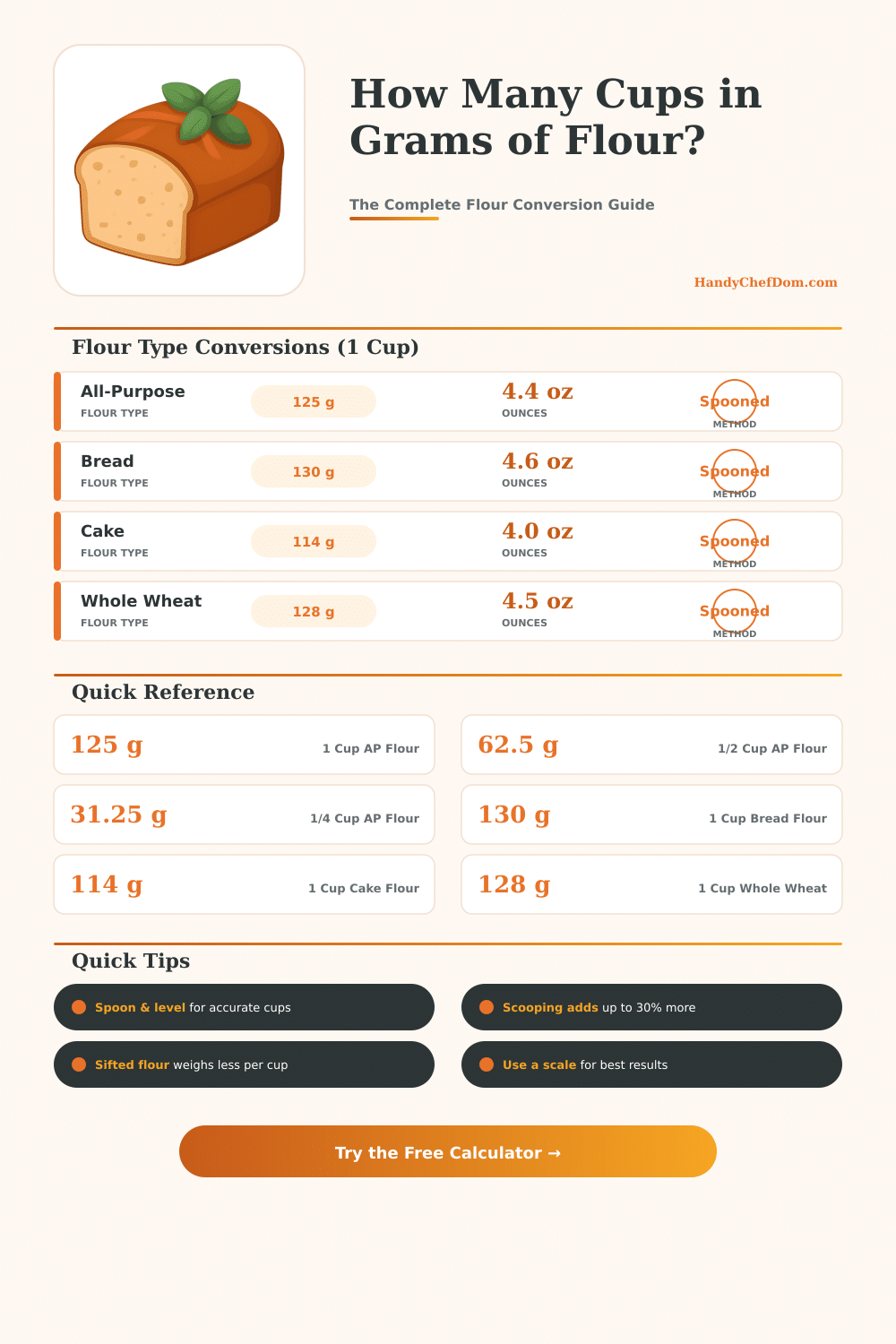
| Flour Type | Spooned (g) | Scooped (g) | Sifted (g) |
|---|---|---|---|
| All-Purpose | 125 | 150 | 112 |
| Bread Flour | 130 | 155 | 117 |
| Cake Flour | 114 | 140 | 100 |
| Whole Wheat | 128 | 153 | 113 |
| Self-Rising | 125 | 150 | 112 |
| Almond Flour | 96 | 112 | 84 |
| Coconut Flour | 128 | 150 | 112 |
| Rye Flour | 102 | 125 | 90 |
| Grams | Cups | Tablespoons | Ounces |
|---|---|---|---|
| 25 g | 3 Tbsp + 1 tsp | 3.2 Tbsp | 0.88 oz |
| 50 g | ⅔ cup (approx.) | 6.4 Tbsp | 1.76 oz |
| 100 g | ⅔ cup + 2 Tbsp | 12.8 Tbsp | 3.53 oz |
| 125 g | 1 cup | 16 Tbsp | 4.41 oz |
| 200 g | 1⅓ cups + 2 Tbsp | 25.6 Tbsp | 7.05 oz |
| 250 g | 2 cups | 32 Tbsp | 8.82 oz |
| 300 g | 2⅓ cups + 1 Tbsp | 38.4 Tbsp | 10.58 oz |
| 500 g | 4 cups | 64 Tbsp | 17.64 oz |
| Flour Type | Calories | Protein | Fat | Carbs |
|---|---|---|---|---|
| All-Purpose | 364 kcal | 10.3g | 1.0g | 76.3g |
| Bread Flour | 361 kcal | 12.0g | 1.7g | 72.5g |
| Cake Flour | 362 kcal | 8.0g | 0.8g | 78.0g |
| Whole Wheat | 340 kcal | 13.2g | 2.5g | 72.0g |
| Almond Flour | 571 kcal | 21.4g | 50.0g | 21.4g |
| Coconut Flour | 400 kcal | 19.3g | 13.6g | 60.0g |
| Rye Flour | 325 kcal | 10.9g | 1.5g | 68.7g |
One cup filled with flour weighs around 125 grams if one scoops it with a spoon and levels the surface, but if one pours it straight from the bag, one finds something close to 150 grams. That presents a gap of 20 percent. Such a big difference!
Plain flour reaches around 130 grams for one cup, while cake flour is much more light with 114 grams. I did not expect that almond flour will be this light, only 96 grams are enough to fully fill a cup, which is almost 77 percent of the weight of regular flour.
Flour Types, Cup Weights and Uses
Whole wheat flour weighs around 128 grams for a cup filled with a spoon, while rye flour is really lighter with around 102 grams. Strained flour lowers the weight by 10 to 12 percent for all types. For 500 grams of regular flour you need four cups filled with a spoon, but only three and a half, if one pours.
In nutrition, 100 grams of regular flour stores 364 caolries together with 10.3 grams of protein and almost one gram of fat. Coconut flour surprisingly reaches 19.3 grams of protein for 100 grams… Much more than I assumed.
The information below does not come from any calculator or converter. It is based on actual users, forum talks and experiences of cooking communities across the net.
flour is made up of powder, that one makes by milling of grains, beans, nuts, seeds, roots or vegetables in a mill. One uses it too prepare many different foods, between that is baked goods, and it well helps to thicken dishes. Especially wheat flour forms the main ingredient of bread, that stays basic food everywhere in the world.
No real harm happens with flour. Everything depends on the way one processes it, and on the amount that one eats. Flour ranges from almost raw, for instance home ground, to extremely processed, as in many store-bought baked goods.
Unbleached, whole grain and stone-ground flour commonly turns out better than enriched and bleached flour, although not regarding carb content. Carbs themselves are not bad.
When buying flour in the grocery stores, one finds a range of types from different wheats for various goals. Plain flour is a white type from hard, protein-rich wheat. Its protein level can reach even 14 percent, but usually stays around 12 or 13.
Cake flour has between five and eight percent of protein, pastry flour sits at eight to nine percent, and regular flour moves between nine and 12 percent. Pastry flour and different regular flours best work for pie crusts. Cake flour is too wet for such a task.
No single flour works for every everyday cooking and baking. Each has its own traits and uses. Flours from rice, soy, rye, pea and oat all work for breads, cookies and cake.
But only wheat flour has the gluten, that must activate by means of yeast gas, to bind cookies and give to cake lift in its structure. Cornstarch comes from corn, while regular flour from wheat, and one cannot exchange them in recipes.
King Arthur flour enjoys big popularity. Its plain flour stores around 12.7 percent of protein, and regular version has 11.7 percent. Trying various flours helps to understand, how baking adjusts with each of them.
A mix of oat flour with whole wheat and white flour can create a cake with incredibly good texture.
A plain flour taste sometimes shows in baked goods. Adding a bit of salt helps to remove it, even in sweet recipes. Extra flavors in the mix or batter also help.
Acids break starch in thickened sauces during long cook times, and starch gives clarity to sauce, while flour does not. Both workwell, if one uses them right. Toasting flour before using it can improve the taste of recipes.