🍞 Focaccia Dough Calculator
Calculate exact ingredient amounts for any pan size or batch using baker's percentages
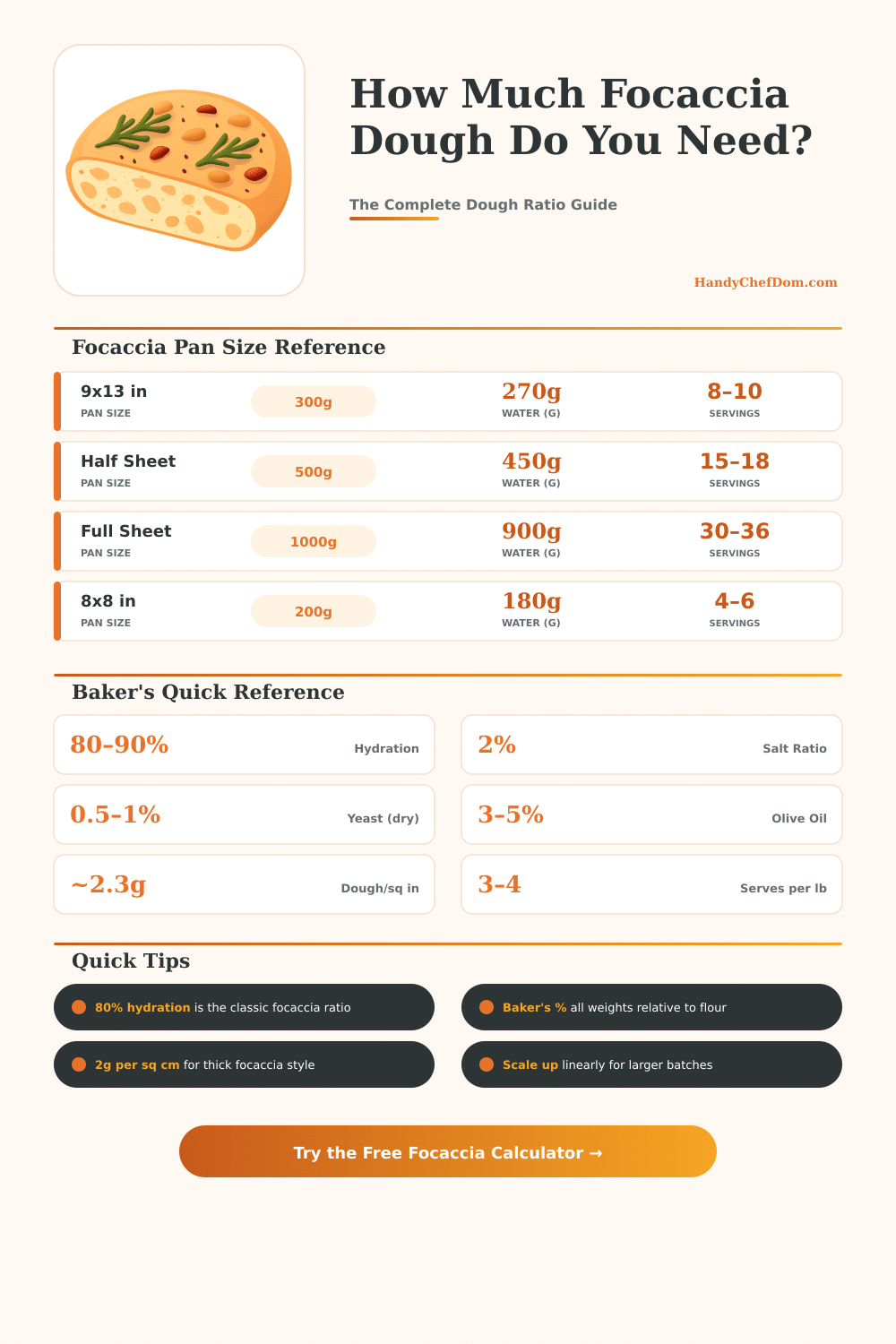
| Pan Size | Area (sq in) | Flour (g) | Total Dough (g) | Servings (med) | Hydration |
|---|---|---|---|---|---|
| 8×8 in (20×20 cm) | 64 sq in | 200g | ~378g | 4–5 | 80% |
| 9×9 in (23×23 cm) | 81 sq in | 250g | ~472g | 5–6 | 80% |
| 9×13 in (23×33 cm) | 117 sq in | 320g | ~605g | 8–10 | 80% |
| 11×15 in (28×38 cm) | 165 sq in | 450g | ~851g | 12–14 | 80% |
| Half Sheet 13×18 in | 234 sq in | 500g | ~945g | 15–18 | 80% |
| Full Sheet 18×26 in | 468 sq in | 1000g | ~1890g | 30–36 | 80% |
| 12 in Round | 113 sq in | 300g | ~567g | 7–9 | 80% |
| 10 in Round | 79 sq in | 220g | ~416g | 5–7 | 80% |
| Ingredient | Baker's % | Per 500g Flour | Per 1000g Flour | Notes |
|---|---|---|---|---|
| Bread Flour | 100% | 500g / 17.6 oz | 1000g / 35.3 oz | Base ingredient |
| Water (classic) | 80% | 400g / 1.69 cups | 800g / 3.38 cups | Use warm water |
| Water (Ligurian) | 90% | 450g / 1.90 cups | 900g / 3.80 cups | Very slack dough |
| Olive Oil (dough) | 4% | 20g / 1.4 tbsp | 40g / 2.8 tbsp | Plus pan oiling |
| Salt | 2% | 10g / 1.75 tsp | 20g / 3.5 tsp | Fine sea salt |
| Instant Dry Yeast | 0.7% | 3.5g / 1 tsp | 7g / 2 tsp | 1 packet ≈ 7g |
| Active Dry Yeast | 1% | 5g / 1.5 tsp | 10g / 3 tsp | Proof before use |
| Fresh Yeast | 2% | 10g / 0.35 oz | 20g / 0.7 oz | 3x of instant |
| Sugar (optional) | 1% | 5g / 1 tsp | 10g / 2 tsp | Aids browning |
| Style | Hydration % | Texture | Handling | Best For |
|---|---|---|---|---|
| Thin & Crispy | 70–75% | Firm, less airy | Easy to handle | Toppings-heavy |
| Classic | 78–82% | Soft, pillowy | Slightly sticky | Everyday focaccia |
| Thick & Fluffy | 83–87% | Very open crumb | Sticky, stretch & fold | Sandwiches |
| Ligurian Style | 88–92% | Extremely open | Very wet, use oiled pan | Traditional Genovese |
| Instant Dry (g) | Active Dry (g) | Fresh Yeast (g) | Teaspoons (Instant) |
|---|---|---|---|
| 1g | 1.5g | 3g | ¼ tsp |
| 2g | 3g | 6g | ½ tsp |
| 3.5g | 5.25g | 10.5g | 1 tsp |
| 7g (1 packet) | 10.5g | 21g | 2¼ tsp |
| 10g | 15g | 30g | 3 tsp |
focaccia dough is seen as between the best starts for each, that starts with bread baking. It has high value according to the relation between effort and result The mass itself is easy, usually needing only four basic items, and mixing takes around five minutes. No kneading is needed, and even a stand blender is not required.
Simply care to give enough time for two rounds of rise.
How to Make Focaccia Dough
Basic items in the most many recipes for focaccia dough are flour, water, salt, oil and yeast. They are very like to those in pizza mass. Focaccia dough itself is quite a lot like pizza dough, so that shopped pizza dough can serve as fast replacement, without losing lot of flavor or structure.
Key trait of focaccia dough is the use of high water content, so high ratio between water and flour. Masses with more water allow, that items spread more evenly, what eases rising and fatser rise. Some recipes reach even 93 percent water content, where the mass becomes almost like batter.
When the dough seems too dry, it is good to add more water, because various flours absorb water differently.
focaccia dough must be a lot wet and not meant for kneading. On the other hand, one folds it every twenty-eight minutes during several rises. That means around two hours of rising time in about 70 degrees.
Also it is possible to cool the dough in the fridge during at least eight hours or until next day. Rising in room temperature happens more quickly, but cold pause lasts more long with richer flavor. Yeast works more fast in warmer conditions.
If you use too little yeast with short rising, the bread can stay without flavor. While twelve hours or more rising in the fridge, the yeast creates nice smell mixes. Combined with the right salt, the bread really shines.
Covering the mass by means of plastic sheet or wet fabric during rising, you help too prevent dry skin from forming.
Finger pressing of the dough by means of oiled fingers before baking has clear benefit. The dents keep toppings and olive oil, what helps the browning. Oil poured on during the baking also stops the crust from getting too hard.
Typical toppings include rosemary, flaky sea salt, olives and tomatoes. Garlic and herb olive oil mixed in the mass and poured on creates a real difference.
Baking at 450 degrees Fahrenheit during 20 until 25 minutes works well, but exact time depends on the oven and dough thickness. The done bread should have deep golden color with crisp edges. Pizza stone under the baking sheet helps to make crisp golden-brown edges.
Then one getscrips outer crust, that inside stays soft and light.