🗑 Food Waste Calculator
Track and quantify your household food waste by category and frequency
| Food Category | % of Total Waste | Avg lbs/Person/Week | Avg kg/Person/Week |
|---|---|---|---|
| Fruits & Vegetables | 39% | 1.64 | 0.74 |
| Dairy Products | 17% | 0.71 | 0.32 |
| Meat & Seafood | 14% | 0.59 | 0.27 |
| Bread & Grains | 18% | 0.76 | 0.34 |
| Prepared / Leftovers | 8% | 0.34 | 0.15 |
| Other (beverages, etc.) | 4% | 0.17 | 0.08 |
| Total | 100% | 4.21 | 1.91 |
| Household Size | Weekly (lbs) | Weekly (kg) | Yearly (lbs) | Yearly (kg) |
|---|---|---|---|---|
| 1 Person | 4.2 | 1.9 | 219 | 99 |
| 2 People | 7.6 | 3.4 | 394 | 179 |
| 3 People | 10.5 | 4.8 | 546 | 248 |
| 4 People | 13.2 | 6.0 | 686 | 311 |
| 5 People | 15.4 | 7.0 | 801 | 363 |
| 6 People | 17.3 | 7.8 | 900 | 408 |
| Category | Edible % | Inedible % (peels, bones, etc.) | Avoidable % |
|---|---|---|---|
| Fruits & Vegetables | 55% | 45% | 42% |
| Dairy | 85% | 15% | 78% |
| Meat & Seafood | 62% | 38% | 50% |
| Bread & Grains | 90% | 10% | 85% |
| Prepared Foods | 95% | 5% | 92% |
| All Categories Avg | 61% | 39% | 55% |
| Food Item | Trim / Peel Loss % | Usable Yield % | Spoilage Rate (avg) |
|---|---|---|---|
| Bananas | 36% | 64% | 25% before eaten |
| Lettuce / Leafy Greens | 24% | 76% | 40% of purchases |
| Apples | 10% | 90% | 20% of purchases |
| Bread (loaf) | 0% | 100% | 30% wasted per loaf |
| Chicken (whole) | 37% | 63% | 12% of purchases |
| Milk (gallon) | 0% | 100% | 17% poured out |
| Potatoes | 15% | 85% | 22% before use |
| Berries | 5% | 95% | 35% spoil in fridge |
| Rice (cooked) | 0% | 100% | 15% leftover discarded |
| Carrots | 11% | 89% | 18% before use |
| From | To | Multiply By | Example |
|---|---|---|---|
| Pounds (lbs) | Kilograms (kg) | 0.4536 | 10 lbs = 4.54 kg |
| Kilograms (kg) | Pounds (lbs) | 2.2046 | 5 kg = 11.02 lbs |
| Ounces (oz) | Grams (g) | 28.3495 | 8 oz = 226.8 g |
| Grams (g) | Ounces (oz) | 0.03527 | 500 g = 17.6 oz |
| Pounds (lbs) | Ounces (oz) | 16 | 2 lbs = 32 oz |
| Tons (short) | Pounds (lbs) | 2000 | 1 ton = 2000 lbs |
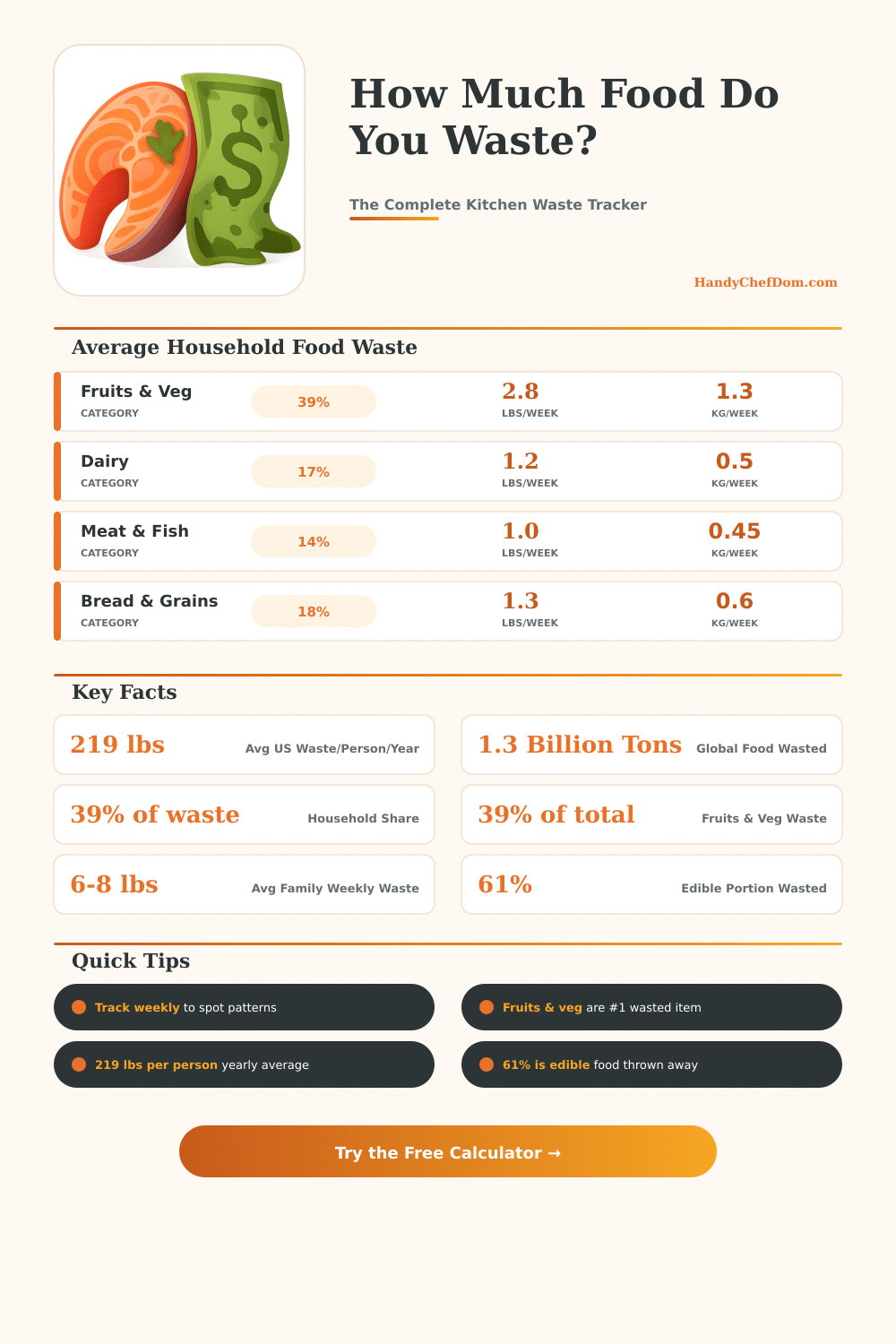
Around 219 lbs per person gets thrown out every year in the US alone. Thats roughly 99 kg. Fruits and vegetables account for 39% of that, which honestly blew me away.
Dairy sits at 17%, and bread and grains come in around 18%, with meat trailing at 14%. A family of 4 wastes about 13 lbs weekly. Bump that to 5 people and its closer to 15.4 lbs.
Why We Waste Food and How to Stop It
Of all waste generated, 61% is edible food and 55% is fully avoidable.
The information below does not come from some computer program or automatic translator. It is based on actual research, forum changes and cooking experiences of communities, that one finds everywhere on the net.
food waste is made up of edible food that ends dumped, lost or uneaten in some stage. Everything from the production until the process, selling and finish in the kitchen enters in that. United States dump more than some other land globally.
Around 60 millions of tons, or around 120 billions of pounds become dumped each year. That averages to almost 325 pounds of waste for every person. About 40 percent of the whole food supply of the land end wasted.
Around a third of the food around the world stays uneaten. In growing nations overuse causes a lot of the problem. In growing lands poor storage and sharing play a more important role.
The waste happens through the whole chain, since the farm, through the selling and retailers until the end user. Between the reasons are losses because of mold, pests, bad controlled climate, mistakes in cooking and simply purposeful disposal of food.
If food waste ends in a bucket, it receives only little oxygen. It breaks down without air and releases methane, that is much more mighty greenhouse gas than carbon dioxide. Only in Utah 600 000 tons of food gets wasted each year, what casts dangerous greenhouse gases and at the same time waste soil, water, work and resources, that one used to produce it.
Food waste also dumps almost a quarter of the water supply, what matches more then 172 billions of dollars in wasted water.
Big portions lead to more leftovers. Those leftovers commonly get forgotten in the refrigerator or seem wrong for eating again. Serving food in smaller portions helps to reduce the waste without cutting the delight of any.
Smaller plates of 24 cm to 21 cm, together with signs reminding folks, that they can ask more, caused a 20 percent decrease of wasted food in one event. Removing plates beside buffet lines helped average 3 until 5 units of waste for every guest in a meal.
Simple tracking of food waste over six weeks can really lower the household waste, even months later. Setting up an “eat me first” box beside the front part of the refrigerator is useful also. Everything, what needs to be eaten soon, enters hear in visible height.
Save skins of onions, tops of carrots, bones of chickens and leftovers of vegetables for boiling in homemade broth is a good idea. Composting of leftovers converts ageing food in rich ground, that later helps to grow new food.
Traditional Indian cooking methods apply access with no waste except what cannot be avoided and offer real examples for cutting waste. There is also a growing movement in French speaking communities, called cook without waste, thatfocuses on making sure that every bit of food gets used by means of good sorting of refrigerator and food cabinet.