🥬 Food Yield Calculator
Find out exactly how much usable food you get after trimming, peeling & cooking
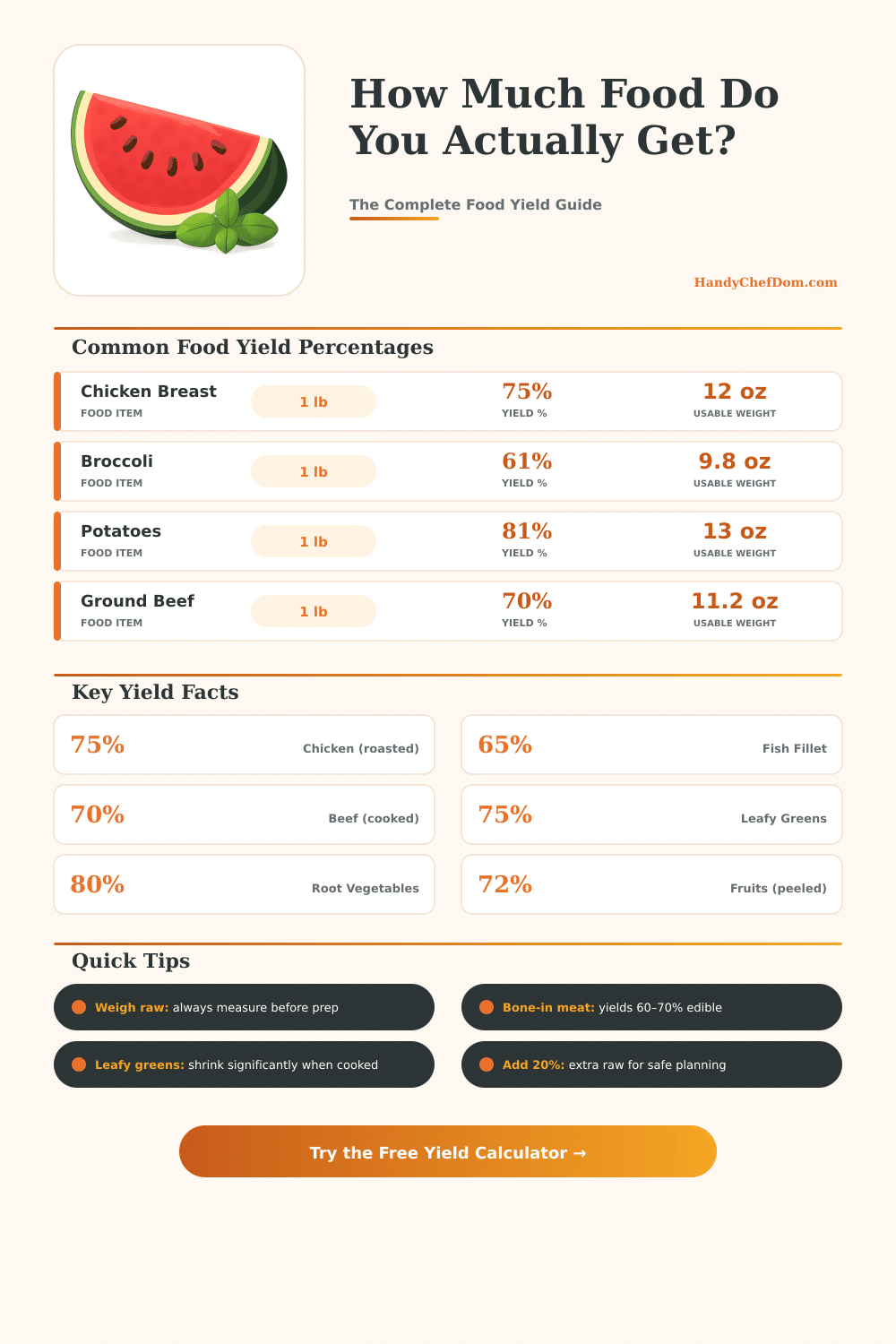
| Food Item | Yield % | 1 lb Raw → Usable | 1 kg Raw → Usable |
|---|---|---|---|
| Chicken Breast (boneless) | 75% | 12 oz | 750 g |
| Whole Chicken (roasted) | 67% | 10.7 oz | 670 g |
| Chicken Thighs (bone-in) | 63% | 10.1 oz | 630 g |
| Ground Beef (cooked) | 70% | 11.2 oz | 700 g |
| Beef Steak (trimmed) | 78% | 12.5 oz | 780 g |
| Pork Loin (roasted) | 72% | 11.5 oz | 720 g |
| Pork Ribs | 55% | 8.8 oz | 550 g |
| Turkey (whole, roasted) | 60% | 9.6 oz | 600 g |
| Food Item | Yield % | 1 lb Raw → Usable | 1 kg Raw → Usable |
|---|---|---|---|
| Salmon Fillet | 65% | 10.4 oz | 650 g |
| Shrimp (shell-on) | 50% | 8 oz | 500 g |
| Shrimp (peeled, deveined) | 87% | 13.9 oz | 870 g |
| Whole Fish | 45% | 7.2 oz | 450 g |
| Tilapia Fillet | 76% | 12.2 oz | 760 g |
| Crab (whole) | 25% | 4 oz | 250 g |
| Lobster (whole) | 30% | 4.8 oz | 300 g |
| Scallops | 90% | 14.4 oz | 900 g |
| Food Item | Yield % | 1 lb Raw → Usable | 1 kg Raw → Usable |
|---|---|---|---|
| Broccoli (trimmed) | 61% | 9.8 oz | 610 g |
| Carrots (peeled) | 82% | 13.1 oz | 820 g |
| Potatoes (peeled) | 81% | 13 oz | 810 g |
| Onions (peeled) | 90% | 14.4 oz | 900 g |
| Spinach (raw) | 75% | 12 oz | 750 g |
| Lettuce (trimmed) | 74% | 11.8 oz | 740 g |
| Mango (peeled, pitted) | 67% | 10.7 oz | 670 g |
| Avocado (flesh only) | 74% | 11.8 oz | 740 g |
| Strawberries (hulled) | 88% | 14.1 oz | 880 g |
| Pineapple (peeled, cored) | 51% | 8.2 oz | 510 g |
food yield simply shows how many usable food stays for you after preparing or cooking something. It can point to the final weight of your creation, the number of servings or the whole amount of weights. For instance, a batch of cookies results in 500 grams or maybe 24 separate cookies.
A big jar of soup gives around 16 liquid ounces totally, while food is enough for 6 folks. Usually one talks about yield according to servings, as “that does four servings” or “nine servings”.
What Is Food Yield?
Here commonly happens the biggest part of the problem. During buying of foods in the store, you must understand that you buy the whole thing, but not everything is useful in your kitchen. Potatoes are a good sample.
A recipe requires 4 pounds of used potatoes. Actually you must buy more than 4 pounds to make up for the skins. After neat cleaning, those 4 pounds in your jar are your real yield.
And the skins? They become garbage.
The percentage of yield points to what parts of the original product you really use. Bananas have around 68% usable parts. The other 32%?
Garbage… That is the whole peel. Almost every fruit and vegetable has its own percentage of yield, and there are charts that detail them.
The waste toll includes everything that does not arrive on the plate: seeds, skins, shoots and such. A whole fish of 500 grams can shrink too 400 grams after removal of bones and other waste. Those 400 grams form the edible part.
Testing of yield helps to guess how many food really lasts the early process. A recipe maybe requires 2 pounds of onions, but after cutting and cleaning you stay with 1.7 pounds. That is needed for sorting ingredients and controlling food costs.
If 20% is lost during preparation, the real cost of used parts is higher than the price points. Canned or ready products? They are almost perfect, with almost 100% yield, because almost nothing goes to the trash.
In professional kitchens the main target is to reach yield as close to 100% as possible. More finished food, less waste in thetrash.
yield and serving size is not the same though. Yield relates to the whole result of the recipe. Serving size points to how much every person gets from that whole.
To count the number of servings, simply share your total yield by the serving size. Soup that gives 10 liters with 250-milliliter servings results in 40 servings. Sometimes one must adapt the yield of a recipe for unfair dryign during cooking.
Software for food costs really is useful here, because it guesses the real price per serving and per menu item. Well managing the yield helps to control real costs, reduce waste and protect the profit.