🍞 Fresh Yeast to Dry Yeast Conversion Calculator
Instantly convert between fresh yeast, active dry yeast, and instant yeast — in grams, ounces, or teaspoons
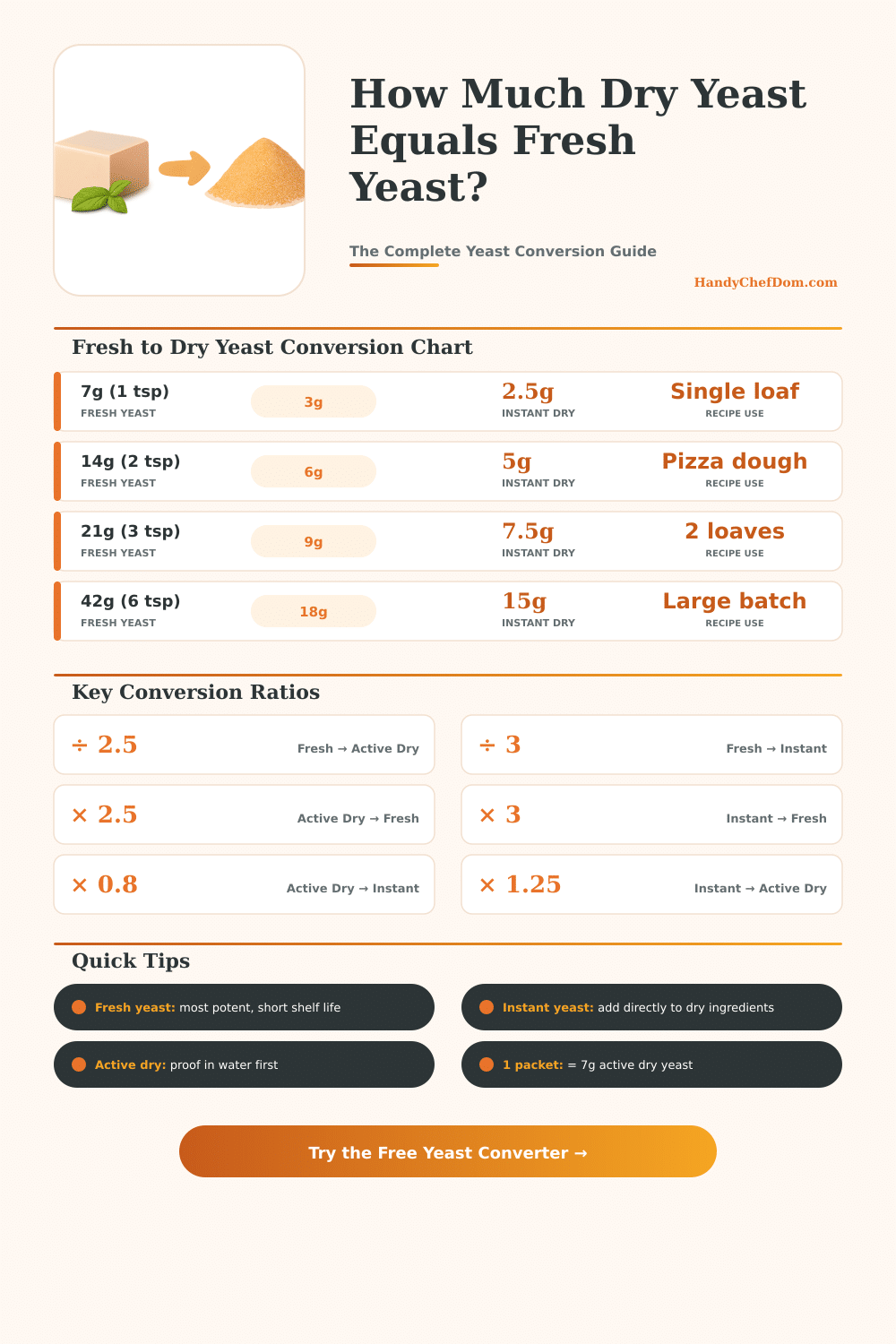
| Fresh Yeast | Active Dry (g) | Instant Yeast (g) | Active Dry (tsp) | Instant (tsp) |
|---|---|---|---|---|
| 3.5g (½ tsp) | 1.4g | 1.2g | ½ tsp | ¼ tsp |
| 7g (1 tsp) | 2.8g | 2.3g | ~1 tsp | ~¾ tsp |
| 14g | 5.6g | 4.7g | ~2 tsp | ~1½ tsp |
| 21g | 8.4g | 7g | ~3 tsp | ~2½ tsp |
| 25g (1 cube) | 10g | 8.3g | ~3½ tsp | ~2¾ tsp |
| 42g | 16.8g | 14g | ~6 tsp | ~5 tsp |
| 50g | 20g | 16.7g | ~7 tsp | ~5½ tsp |
| 100g | 40g | 33.3g | ~14 tsp | ~11 tsp |
| Packet / Size | Weight (g) | Weight (oz) | Volume (tsp) |
|---|---|---|---|
| 1 standard packet – Active Dry | 7g | 0.25 oz | 2.25 tsp |
| 1 standard packet – Instant | 7g | 0.25 oz | 2.25 tsp |
| Jar serving – Active Dry | 4g | 0.14 oz | 1.25 tsp |
| Bulk (1 lb) – Active Dry | 454g | 16 oz | ~160 tsp |
| Fresh yeast cube (standard EU) | 42g | 1.5 oz | ~6 tsp equiv |
| Fresh yeast cube (small US) | 17g | 0.6 oz | ~2.5 tsp equiv |
Yeast forms part of the fungi. It is made up of single-celled creatures that grow in single-cell state and multiply by means of budding or division. Those little life forms rank between the microscopic creatures that exist already during hundreds of millions of years.
One recognises at least 1 500 species currently and they involve more than 1 % of all described fungal species. One finds yeast everywhere in the world, in ground and on plant surfaces. Most commonly it appears in sugary places, for instance in nectar of flowers.
What Is Yeast
Saccharomyces cerevisiae is the most famous species of yeast. Folks apply it during thousands of years to prepare bread, beer and wine. Even one called it the first tamed organism.
Candida albicans, another species, is dangerous, because it causes infections from yeast.
During baking yeast works as an agent for rising, that requires sugar, starch, heat and humidity to make carbon dioxide. In warm and wet setting, full of food, yeast starts to feed and multiply. By means of a process called anaerobic fermentation it breaks down sugar.
From that activity happens alcohol and carbon dixoide as results. Thanks to that gas, the thick mass of dough rises in an easily rising loaf. Moreover yeast helps to work the dough and add tastes, forming nice smells and hints of flavors.
Active Dry yeast probably is the most used type in food stores. It has a grainy form, with texture like cornmeal. That alive creature stays asleep, until one tests it or dissolves it in warm water.
Instant yeast differs a bit. SAF Instant yeast sells the most globally and professionals usually use it. Rather than active Dry yeast, instant yeast one must not dissolve before.
Instant yeast and fast rise yeast is basically the same, only various names of different makers.
Fresh yeast one also calls cake yeast, compacted yeast ore moist yeast. It comes in various package sizes. Fresh yeast delivers rich, tasty flavor, that well works for donuts and pastries.
In United States standard packet of yeast stores two and half teaspoons by volume, what matches to a quarter ounce or seven grams. That measure stays same through almost all mainstream marks available in supermarket. One packet usually suffices for a recipe with three to four cups of flour.
To check whether yeast is still good, shed a bit warm water in a bowl, add a pinch of sugar, mix with a teaspoon of yeast and leave it ten to fifteen minutes. If it foams up and expands byvolume, the yeast is good.