🐟 Halibut Protein Calculator
Calculate exact protein content for any serving size of halibut
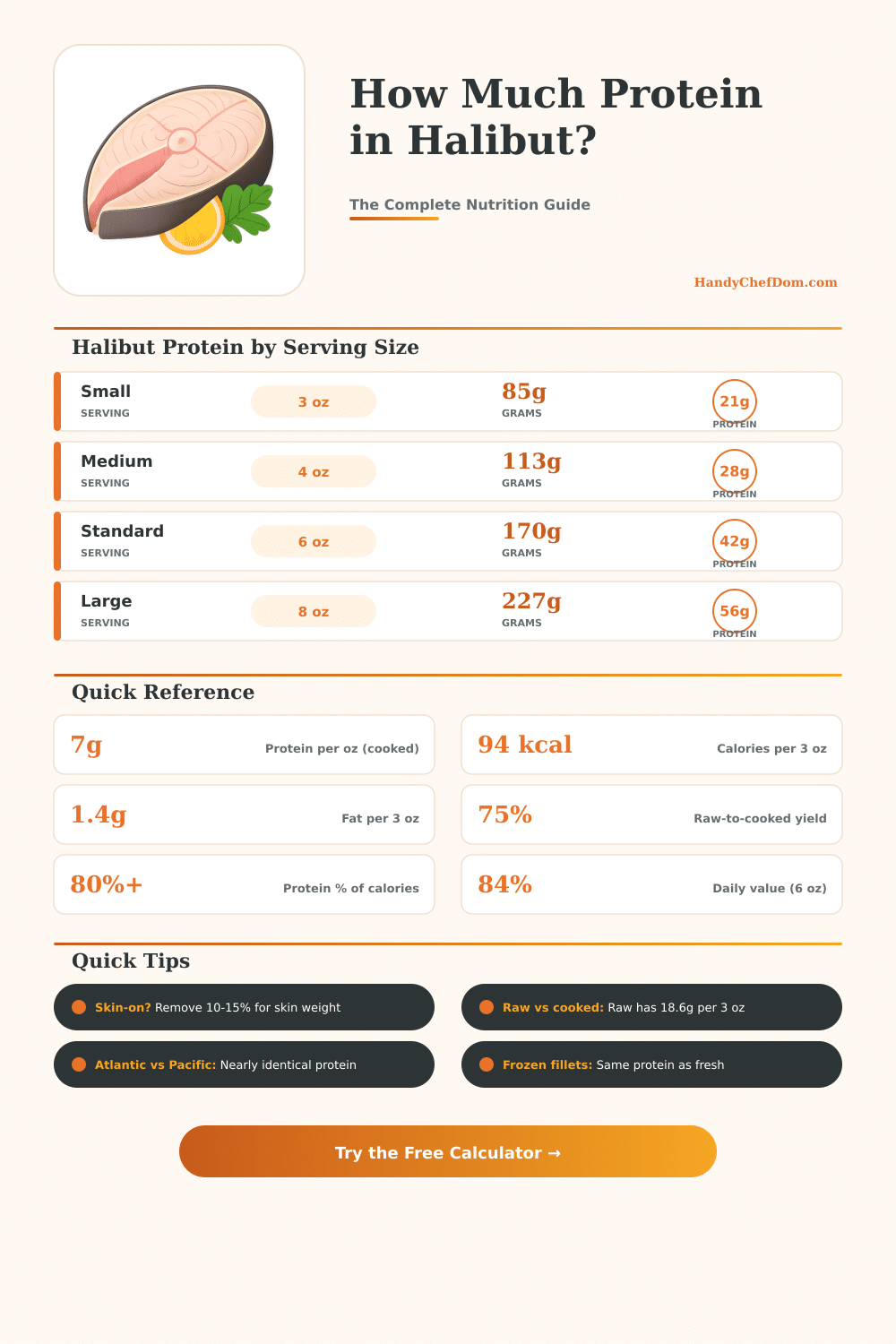
| Portion | Weight | Protein | Calories |
|---|---|---|---|
| Small fillet | 3 oz (85g) | 22.7g | 119 |
| Medium fillet | 4 oz (113g) | 30.3g | 158 |
| Standard fillet | 6 oz (170g) | 45.4g | 238 |
| Large fillet | 8 oz (227g) | 60.5g | 317 |
| Half pound | 8 oz (227g) | 60.5g | 317 |
| Full pound | 16 oz (454g) | 121.1g | 634 |
| Portion | Weight | Protein | Calories |
|---|---|---|---|
| Small fillet | 3 oz (85g) | 16.1g | 94 |
| Medium fillet | 4 oz (113g) | 21.5g | 125 |
| Standard fillet | 6 oz (170g) | 32.2g | 187 |
| Large fillet | 8 oz (227g) | 42.9g | 249 |
| Full pound | 16 oz (454g) | 85.9g | 498 |
| Raw Weight | Cooked Yield | Raw Protein | Cooked Protein |
|---|---|---|---|
| 4 oz (113g) | 3 oz (85g) | 21.5g | 22.7g |
| 6 oz (170g) | 4.5 oz (128g) | 32.2g | 34.2g |
| 8 oz (227g) | 6 oz (170g) | 42.9g | 45.4g |
| 12 oz (340g) | 9 oz (255g) | 64.4g | 68.1g |
| 16 oz (454g) | 12 oz (340g) | 85.9g | 90.9g |
| Fish (4 oz Cooked) | Protein | Calories | Fat |
|---|---|---|---|
| Halibut | 30.3g | 158 | 3.3g |
| Salmon (Atlantic) | 25.0g | 234 | 14.4g |
| Tilapia | 29.5g | 145 | 3.0g |
| Cod | 26.0g | 119 | 1.0g |
| Tuna (Yellowfin) | 33.4g | 157 | 1.4g |
| Mahi Mahi | 26.2g | 134 | 1.5g |
| Swordfish | 28.8g | 174 | 5.7g |
| Shrimp | 23.7g | 120 | 1.7g |
| Imperial | Metric | Cooked Protein | Raw Protein |
|---|---|---|---|
| 1 oz | 28.35g | 7.6g | 5.6g |
| 3 oz | 85g | 22.7g | 16.1g |
| 4 oz | 113g | 30.3g | 21.5g |
| 6 oz | 170g | 45.4g | 32.2g |
| 8 oz | 227g | 60.5g | 42.9g |
| 1 lb (16 oz) | 454g | 121.1g | 85.9g |
| 100g | 3.53 oz | 26.7g | 18.9g |
Cooked Halibut delivers around 26.7 grams of Protein for every 100 grams, what really puts it almost at the top of the list for fish Protein amounts. For a 4-ounce piece, so around 113 grams, you get a bit more than 30 grams of Protein. Not bad for something like that.
The fat is only 3.3 grams for that serving and the calories stay at 158. No carbs, what first surprised me, but it fully makes sense for lean white fish.
How Much Protein Is in Halibut and How to Cook It
Raw Halibut shows a fully different picture. You find about 18.9 grams of Protein for 100 grams, before cooking. I almost always forget about the 25-percent loss of water, so 8 ounces raw fish shrinks to around 6 ounces cooked.
During cooking the Protein indeed thickens, and so the numbers per gram jump upward. When I prepare meals, I found that buying 7 to 8 ounces raw for one plate gives a firm 6-ounce cookde part with around 45 grams of Protein.
The info below does not come from any calculator or converter tool on this page. It is based on real research, forum talks and experiences from cooking groups, that one finds across the net.
Halibut is the usual name for three species of flatfish in the family of right-eyed flounders. The word comes from “haly”, what means saint, and “butte”, what means flat fish, because it was liked during Catholic holidays. In some regions, other big flatfish also get that name.
There is also the California Halibut, that actually belongs to the family of left-eyed flounders. Like this the name covers different fishes.
Halibut are flat and swim sideways, with one side up and the other below. When they are very young, the left eye moves upward to the write side of the fish. Because of that one calls them right-eyed flatfish.
The Pacific Halibut is the biggest species of flatfish. It lives in the North Pacific Ocean and it is caught by commercial, hobby and food fishers. Very big Pacific Halibut sometimes get called “barn doors”.
The Atlantic Halibut can reach up to 15 feet long and live up to 50 years. The record Atlantic Halibut, weighing 244 pounds, was caught in Saguenay, Quebec. Halibut can grow to 5 to 8 feet long and weigh from 50 to 350 pounds.
Pacific and Atlantic Halibut are actually two different species. The Pacific tend to be a bit bigger. For cooking purposes, the meat of both is very alike.
The pieces of Halibut have gentle, sweet flavor with flat, but firm texture. It is thick white fish flesh with pink shades along the center line of whole fish. Halibut usually sells with skin, while cod is commonly skinless.
It is boneless, gentle white meat, and one sometimes calls it the “steak” of the American white fish.
Halibut has quite a unique texture, that is hard to copy with other fish. Half of a cooked piece carries around 176 calories, with no carbs, 14 percent fat and 86 percent Protein. A three-ounce serving gives 16 grams of Protein, what is 32 percent of the daily standard.
The suggested serving sizes are around six to eight ounces of raw weight for one person.
One can cook Halibut in many ways. Pan-searing works well, when one dries the pieces, salts and peppers them, and fries in oil until golden crust forms. An easy way is to soak in lemon juice, olive oil, basil, salt and pepper, then grill on medium-high heat for around three minutes for every side.
Also baking at 400 degrees works. It cooks well, if one avoids overdoing it. Overcooking makes it thick and tough.
The fish is ready, when it is opaque andeasy to pull apart with a fork.