🍺 Homebrew Efficiency Calculator
Calculate mash efficiency, brewhouse efficiency & points per pound per gallon
| Grain / Malt | PPG (US) | PKG (Metric) | Max Eff. % | Type |
|---|---|---|---|---|
| 2-Row Pale Malt | 36 | 300 | 100% | Base |
| 6-Row Pale Malt | 35 | 292 | 100% | Base |
| Maris Otter | 37 | 308 | 100% | Base |
| Munich Malt | 35 | 292 | 100% | Base |
| Vienna Malt | 36 | 300 | 100% | Base |
| Wheat Malt | 35 | 292 | 100% | Base |
| Crystal 60L | 34 | 283 | 100% | Crystal |
| Crystal 120L | 33 | 275 | 100% | Crystal |
| Chocolate Malt | 34 | 283 | 100% | Roasted |
| Black Patent | 25 | 208 | 100% | Roasted |
| Roasted Barley | 33 | 275 | 100% | Roasted |
| Flaked Oats | 33 | 275 | 100% | Adjunct |
| Flaked Barley | 32 | 267 | 100% | Adjunct |
| Corn Sugar (DME) | 46 | 383 | 100% | Sugar |
| Dry Malt Extract | 44 | 367 | 100% | Extract |
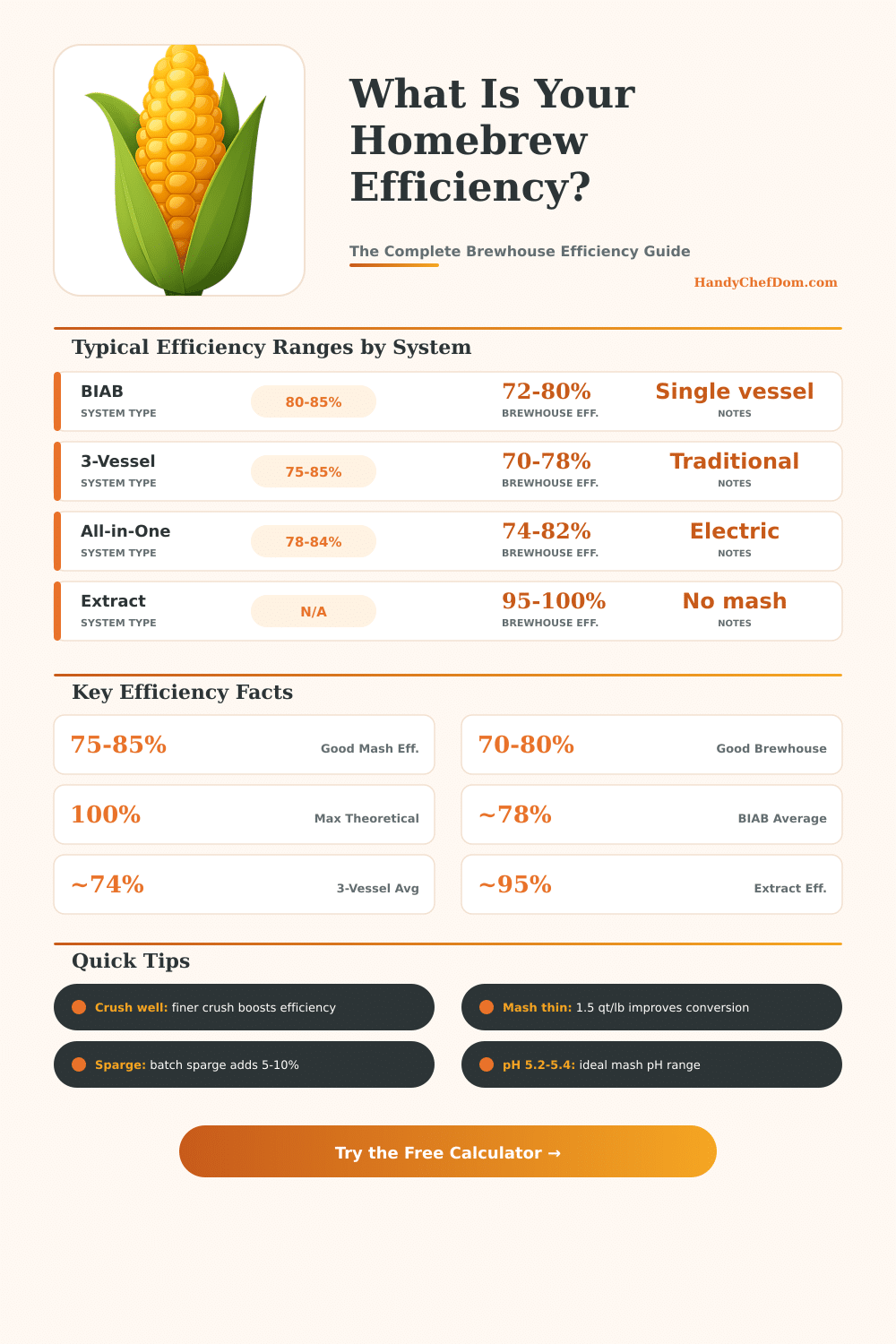
| Brewing System | Mash Eff. | Brewhouse Eff. | Notes |
|---|---|---|---|
| BIAB (Bag-in-a-Bag) | 78–88% | 72–80% | Squeeze bag for best results |
| 3-Vessel (Cooler MT) | 75–85% | 68–78% | Batch or fly sparge |
| All-in-One (Robobrew etc.) | 78–85% | 74–82% | Electric recirculating |
| Herms / RIMS System | 80–88% | 75–83% | Recirculating mash |
| Extract Brewing | N/A | 95–100% | No mash losses |
| Commercial System | 90–97% | 88–95% | Optimized equipment |
| SG (Specific Gravity) | Gravity Points | °Brix (approx) | °Plato (approx) |
|---|---|---|---|
| 1.020 | 20 | 5.0 | 5.0 |
| 1.030 | 30 | 7.5 | 7.6 |
| 1.040 | 40 | 10.0 | 10.0 |
| 1.050 | 50 | 12.4 | 12.4 |
| 1.060 | 60 | 14.7 | 14.7 |
| 1.070 | 70 | 17.0 | 17.1 |
| 1.080 | 80 | 19.3 | 19.3 |
| 1.090 | 90 | 21.6 | 21.5 |
| 1.100 | 100 | 23.8 | 23.8 |
| 1.120 | 120 | 28.1 | 27.9 |
The term “homebrew” has various meanings according to the circumstances. It commonly relates to the process of making beer in the home, to programs for computers or to own created material for tabletop games and rules of video games. Every use forms its own group of fans with own tradition.
In the software world, Homebrew works as a free and open-source manager for packages. It helps to install programs on macOS and Linux. In short words, it adds what the system of Apple or Linux does not carry.
Homebrew: Beer, Computer Programs and Games
The name itself shows the idea of building programs for Mac according to the needs of the user. Imagine it as a store for apps that developers and expert users could use.
Homebrew stands on the base of Git and Ruby. After the first installation, it arranges itself in a standard directory as a Git repository. It takes less than 100 MB on Mac, if nothing else is installed.
The project is nonprofit and works thanks to volunteers without salary, that requires money for programs, servers and hosting for continuous merging and coming changes. It is reliable for use on Mac. One can install it by means of one single line in the command line, found on GitHub, and it works for both macOS and Linux.
Some commonly used packages, that one installs by means of homebrew, are awscli for services of Amazon website, bash-completion for faster automatic completion, calc for calculations, ccrypt for security of files and dos2unix for changing of file formats. The command tap allows users to add own repositories from GitHub or other places by means of various protocols for transport.
We turn to the beer side. Homebrew of beer, wine, cider and mead is the mainstream theme. Most commonly one prepares recipes for 19 liters or 5 American gallons, because many home brewers like to put the beer in Cornelius kegs, that exactly takes that amount.
For a start in that hobby, less then 100 dollars is enough. Many newcomers start by means of malt extract, which gives truly good results. Complete starter kits are sold in various stores for brewing.
Making beer at home can save a lot of money, although prices of hops and malt continuously grow.
Making beer at home was not legal according to federal law until 1978. Before the time of ban, it was allowed, and even George Washington made beer in his home. The vision of homebrew is that every neighbourhood has its brewer and every community its club for that.
Tools like calculators for fermentation pitch help thebrewers prepare the fermentation properly.
Homebrew shows also in video games. Players of Dungeons & Dragons created own backgrounds, magic objects, monsters and spells. Own content for old video game systems is another kind of homebrew in play, where folks play fresh games on older consoles.