🍺 Homebrew Recipe Calculator
Calculate OG, FG, ABV, IBU & your full grain bill for any beer style
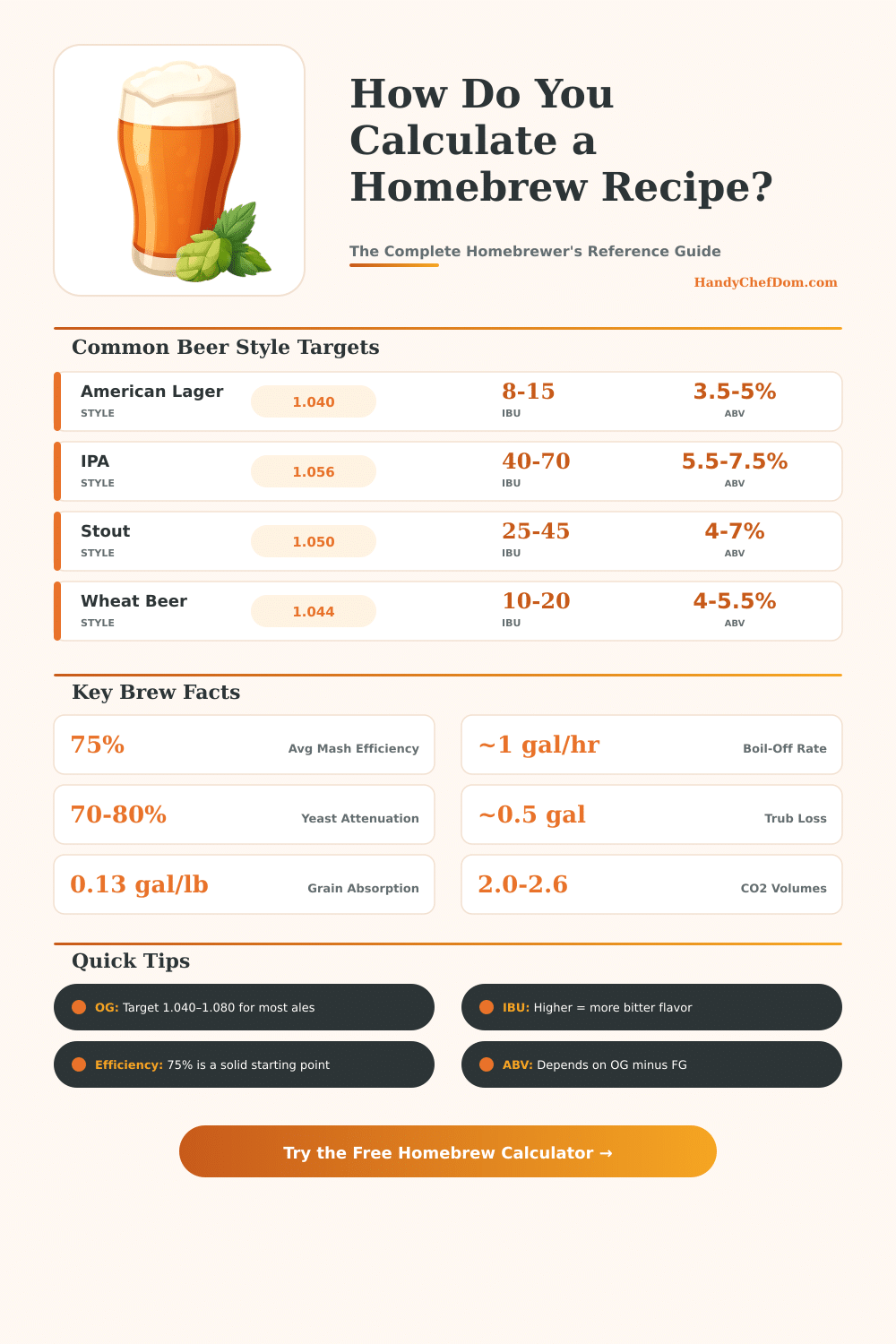
| Style | OG Range | FG Range | IBU | ABV | SRM (Color) |
|---|---|---|---|---|---|
| American Light Lager | 1.028–1.040 | 1.006–1.010 | 8–12 | 2.8–4.2% | 2–3 |
| American Pale Ale | 1.045–1.060 | 1.010–1.015 | 30–50 | 4.5–6.2% | 5–10 |
| West Coast IPA | 1.056–1.075 | 1.008–1.014 | 40–70 | 5.5–7.5% | 6–14 |
| NEIPA | 1.060–1.085 | 1.010–1.020 | 25–60 | 6.0–9.0% | 3–7 |
| American Wheat | 1.040–1.055 | 1.008–1.013 | 15–30 | 4.0–5.5% | 3–6 |
| Hefeweizen | 1.044–1.052 | 1.008–1.012 | 8–15 | 4.9–5.6% | 2–8 |
| Belgian Saison | 1.048–1.065 | 1.002–1.012 | 20–35 | 5.0–7.0% | 5–14 |
| Dry Irish Stout | 1.036–1.050 | 1.007–1.011 | 25–45 | 4.0–5.0% | 25–40 |
| Robust Porter | 1.048–1.065 | 1.012–1.016 | 25–40 | 4.8–6.5% | 22–35 |
| Scottish 80/- | 1.040–1.054 | 1.010–1.016 | 15–30 | 3.9–5.0% | 9–17 |
| Grain / Fermentable | PPG (Points/lb/gal) | Color (°L) | Max Use % | Notes |
|---|---|---|---|---|
| 2-Row Pale Malt | 37 | 1.8 | 100% | Base malt, all-grain foundation |
| Pilsner Malt | 37 | 1.5 | 100% | Lighter, crisper base malt |
| Munich Malt | 35 | 9 | 80% | Malty, bread character |
| Vienna Malt | 36 | 3.5 | 100% | Light malty, slightly toasty |
| White Wheat Malt | 37 | 2 | 60% | Head retention, haze |
| Crystal / Caramel 60L | 34 | 60 | 15% | Sweetness, body, amber color |
| Crystal 120L | 33 | 120 | 10% | Dark caramel, raisin notes |
| Chocolate Malt | 29 | 350 | 10% | Roasty, coffee, dark color |
| Black Patent Malt | 28 | 500 | 5% | Dry roast, very dark |
| Roasted Barley | 25 | 300 | 10% | Dry, bitter roast — stouts |
| Flaked Oats | 33 | 1 | 20% | Silky body, haze (NEIPA) |
| Flaked Wheat | 35 | 2 | 40% | Body, haze, head retention |
| Corn (Flaked Maize) | 37 | 1 | 30% | Dry, light body — lagers |
| Light LME | 36 | 4 | 100% | Liquid Malt Extract — extract brewing |
| Light DME | 44 | 4 | 100% | Dry Malt Extract — extract brewing |
| Table Sugar (Sucrose) | 46 | 0 | 10% | Ferments fully dry; increases ABV |
| Hop Variety | Avg Alpha Acid % | Typical Use | Flavor / Aroma |
|---|---|---|---|
| Cascade | 5.5–8.0% | Bittering / Aroma | Floral, citrus, grapefruit |
| Centennial | 9.5–11.5% | Bittering / Aroma | Citrus, floral, piney |
| Chinook | 12–14% | Bittering | Pine, spice, grapefruit |
| Citra | 11–13% | Aroma / Flavor | Passionfruit, lime, tropical |
| Mosaic | 11.5–13.5% | Aroma / Flavor | Berry, tropical, earthy |
| Simcoe | 12–14% | Bittering / Aroma | Pine, passionfruit, dank |
| Amarillo | 8–11% | Aroma / Flavor | Orange, peach, tropical |
| Saaz | 2.5–4.5% | Aroma | Herbal, spicy, earthy — noble |
| Hallertau | 3.5–5.5% | Aroma | Mild spice, floral — noble |
| Magnum | 12–16% | Bittering | Clean, neutral bitterness |
| East Kent Goldings | 4–6% | Aroma | Honey, earthy, spice — English |
| Fuggle | 3.5–5.5% | Aroma | Mild earthy, grassy — English |
| Measurement | Imperial | Metric | Notes |
|---|---|---|---|
| Batch Size | 5 gallons | 18.93 L | Standard homebrew batch |
| Grain weight | 1 lb | 453.6 g | Use kitchen scale for accuracy |
| Hop weight | 1 oz | 28.35 g | Pellets vs. whole differ ~10% utilization |
| Boil-Off Rate | 1 gal/hr | 3.785 L/hr | Varies by kettle width & heat source |
| Grain Absorption | 0.125 gal/lb | 1.04 L/kg | Water absorbed by spent grain |
| Trub Loss | 0.5 gal | 1.89 L | Wort lost to hop/protein trub |
| PPG to FGDB | 46 ppg | 383 L·°P/kg | Points per pound per gallon |
| SRM to EBC | 1 SRM | 1.97 EBC | EBC = SRM x 1.97 (color units) |
“Homebrew” is used in very different situations, and each of them gives it its own meaning. One can hear the word when some talk about home-made beer at home, or it can point to a program for installing apps on a computer. There is also the side of video games.
Own content for board games and old video games. Those three areas have their separate groups, their cultures their whole world that lasts.
Homebrew: Beer, Software and Games
In the world of programs, Homebrew is a free and open-source tool that makes life easier on macOS and Linux. In short, it allows you to install programs that Apple or your Linux version did not include all along. The name fits well, everything deals about making programs your way, shaped to your real need.
Imagine it as a store of apps, but made for developers and expert users that search for tools not fuond elsewhere.
The whole system runs on Git and Ruby under the surface. When you install it for the first time, it forms a Git folder in your home folders. The basic setup involves less than 100 MB before you add anything on.
Here is the best part, it is a non-profit project, run fully by volunteers that do not receive pay. The money of the project serves to cover programs, servers and the base for ongoing testing and further growth. About security, it is strong, widely won considers it safe for Mac systems.
Through Homebrew you can download some tools, as awscli for services of Amazon, bash-completion for better auto-completion, calc for fast math, ccrypt for safe file encryption and dos2unix for converting between file types. There is also the command “tap”, that means to add outside formulas straight from GitHub by means of HTTPS.
Now we turn to the home-brewing of beer, that has its own active community. The goals here are simple, a home-brewer of beer on every street and a club for that in every city. What drives it is the joy of the art, the science and simply the fun of fermentation.
Many beginners choose the way of malt extract kits, and the results truly please. One can get into home-brewing of beer for less than a hundred dollars. About amounts, around 19 liters (or 5 American gallons) are usual in home recipes, mostly because storage in Cornelius kegs works great for that size.
Stores for home-brewing offer all kinds of malts; barley, wheat, rye, roasted. Brewers use calculators for yeast, to figure out their additions in fermentation as pros, whether they work with dry yeast, liquid, slurry or starters. There are also programs for brewing, with ranges of recipes, calculators, planners for brew days and tools madesspecial for that.
The world of video games has its scene of homebrew also. In Dungeons & Dragons, homebrew means own backgrounds, magic objects, monsters and spells created outside the official rules. Homebrew video games mean folks create and play fresh games on old consoles, keeping the classic hobby alive.
It became its own real hobby fully.