🌶️ Hot Sauce Brine Calculator
Calculate exact salt, water & brine ratios for fermenting homemade hot sauce
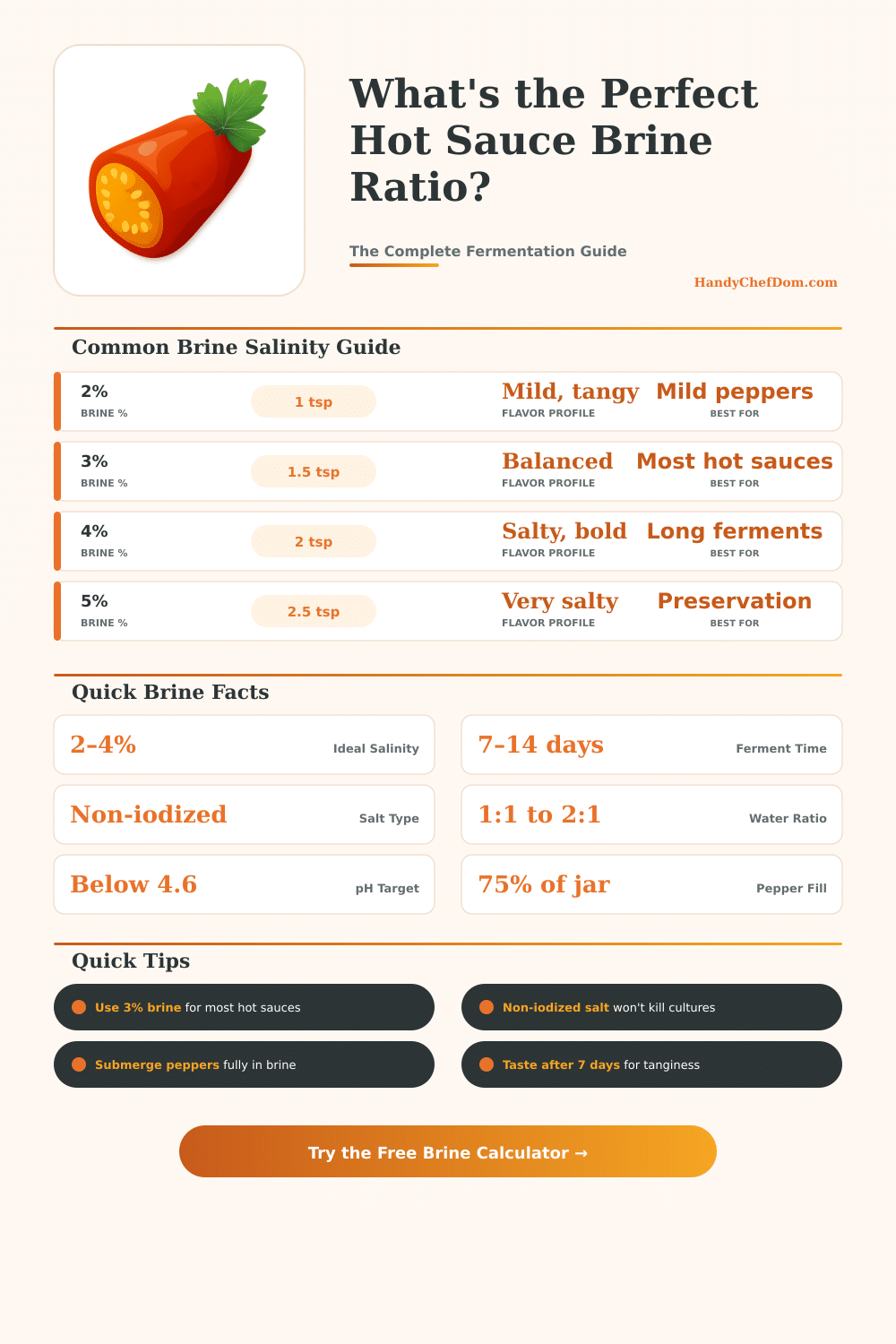
| Salinity % | Salt per 1 Cup Water | Salt per 500 ml Water | Best Use |
|---|---|---|---|
| 1% | ~½ tsp (2.8g) | 5g | Very mild, quick ferments |
| 2% | ~1 tsp (5.7g) | 10g | Mild sauces, short ferments |
| 3% | ~1½ tsp (8.5g) | 15g | Most hot sauces (recommended) |
| 4% | ~2 tsp (11.4g) | 20g | Bold flavor, longer ferments |
| 5% | ~2½ tsp (14.2g) | 25g | Preservation focus, salty |
| 8% | ~4 tsp (22.7g) | 40g | Long-term preservation |
| 10% | ~5 tsp (28.4g) | 50g | High preservation, very salty |
| Jar Size | Pepper Fill (75%) | Brine Needed (1:1) | Salt at 3% |
|---|---|---|---|
| Half-Pint (8 oz) | ~100g / 3.5 oz | ~100 ml / 3.4 fl oz | 3g / 0.5 tsp |
| Pint (16 oz) | ~200g / 7 oz | ~200 ml / 6.8 fl oz | 6g / 1 tsp |
| Quart (32 oz) | ~400g / 14 oz | ~400 ml / 13.5 fl oz | 12g / 2 tsp |
| Half-Gallon (64 oz) | ~800g / 28 oz | ~800 ml / 27 fl oz | 24g / 4 tsp |
| Gallon (128 oz) | ~1600g / 56 oz | ~1600 ml / 54 fl oz | 48g / 8 tsp |
| Salt Amount (g) | Fine Sea Salt | Diamond Crystal Kosher | Morton Kosher |
|---|---|---|---|
| 3g | ~½ tsp | ~¾ tsp | ~0.6 tsp |
| 6g | ~1 tsp | ~1½ tsp | ~1.2 tsp |
| 9g | ~1½ tsp | ~2¼ tsp | ~1.8 tsp |
| 12g | ~2 tsp | ~3 tsp (1 tbsp) | ~2.4 tsp |
| 24g | ~4 tsp | ~6 tsp (2 tbsp) | ~4.8 tsp |
| 48g | ~8 tsp | ~12 tsp (4 tbsp) | ~9.6 tsp |
hot sauce brine forms the base from salty liquid, that serves to prepare fermented hot sauces. In its simplest form, recipe for fermented hot sauce are made up of peppers and that brine. From that spot one can add flavors and spices to enrich the taste.
That brine itself is a mix of salt and water. One prepares fermented hot sauce by means of blending peppers, onions and spices in weak salty water, instead of using vinegar. During the peppers sit in that salty water during weeks or even more, the useful acid bacteria, that naturally happen on the peppers, grow.
How to Make Fermented Hot Sauce with Brine
This fermentation gives surprisingly rich taste, much more attractive than those from the stores.
hot sauces usually require brine with 3 to 5 percent of salt. Brine with 5 percent of salt works very well, and enough salt stays in itself. The amount of salt is quite a flexible number, especially when one ferments cut peppers.
However the salt is not the only element, that changes the result. Also the temprature and the used ingredients play role.
There are various ways to ferment. One of them is the brine fermentation, where one puts whole or cut peppers in the salty liquid. Besides that, one can chop the peppers finely before the fermentation, what involves less space.
Fermented peppers as mixed paste can give more marked sour character than with cut peppers. Whole peppers are more easily preserved in the start, before everything becomes bitter, because disease grows more quickly on the surface of paste.
Bell peppers help to soften stronger chilies to create less sharp variant. Stay in the same color range helps the sauce look nice. One way too choose peppers is use ripe chilies (jalapeño), habanero, anaheim, and lay them directly in the jar covered by 5 percent brine.
Ferment garlic together with the peppers can remove the fresh garlic smell, so more well add it later according to taste.
When the fermentation ends, one lays the peppers in the blender. Be careful to spill a bit or all brine before mixing. Otherwise the sauce risks to become too watery and light, without the wanted strength.
One way is add half glasses of brine and vinegar. More brine gives more sauce flavor. More vinegar adds more bitterness.
Also apple cider vinegar works. The most basic hot sauces consist only of fermented peppers mixed with a bit of brine. That sticks to the classic way to prepare hot sauces, except that here the ingredients ferment instead of simply blending.
Leftover brine has uses beyond the sauce. It can season chicken wings. One also can filter and bottle the brine as clear hot sauce alone.
While one prepares the sauce, one can add hot salsa with the brine and bits from skins and seeds, like this almost nothing goes to waste. Fruit juices can replace part of brine to soften the heat andrange the taste.