🍚 Jasmine Rice to Water Ratio Calculator
Get the perfect fluffy jasmine rice every time with precise water measurements
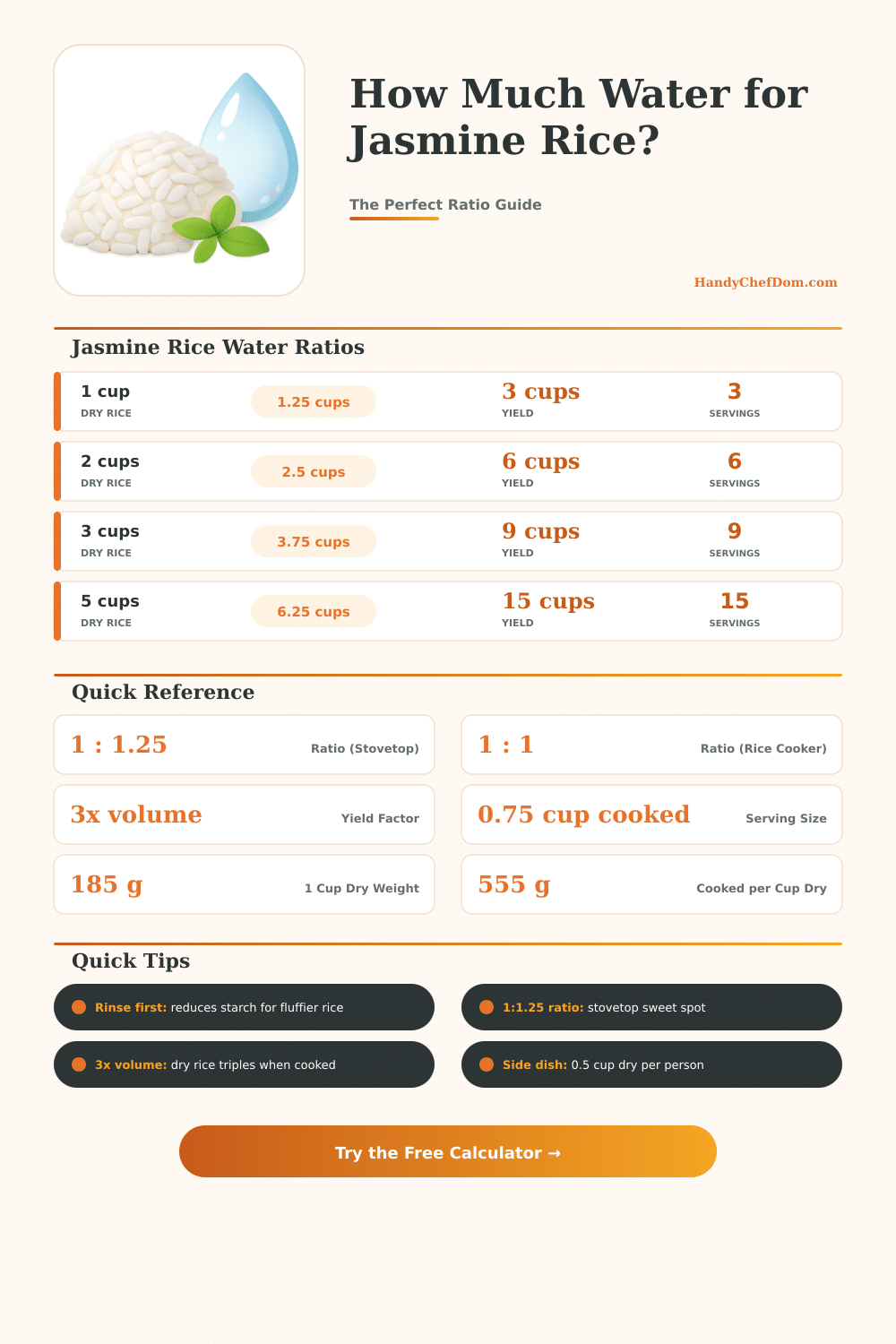
| Method | Rice : Water Ratio | Water per 1 Cup Rice | Water per 185g Rice |
|---|---|---|---|
| Stovetop | 1 : 1.25 | 1.25 cups (296 ml) | 231 ml |
| Rice Cooker | 1 : 1 | 1 cup (237 ml) | 185 ml |
| Instant Pot | 1 : 1 | 1 cup (237 ml) | 185 ml |
| Oven (Baked) | 1 : 1.5 | 1.5 cups (355 ml) | 278 ml |
| Serving Context | Cooked Rice | Dry Rice Needed | Metric (Dry) |
|---|---|---|---|
| Side dish (light) | 0.5 cup (90g) | 2.5 tbsp | 30g |
| Standard side | 0.75 cup (140g) | 0.25 cup | 46g |
| Main course | 1 cup (185g) | 0.33 cup | 62g |
| Generous / hungry adult | 1.5 cups (278g) | 0.5 cup | 93g |
| Child (4–10 yrs) | 0.5 cup (90g) | 2.5 tbsp | 30g |
| Buffet (per guest) | 0.75 cup (140g) | 0.25 cup | 46g |
| Guests | Dry Rice (Cups) | Dry Rice (Grams) | Water (Stovetop) |
|---|---|---|---|
| 4 | 1.33 cups | 246g | 1.67 cups (395 ml) |
| 6 | 2 cups | 370g | 2.5 cups (592 ml) |
| 10 | 3.33 cups | 616g | 4.17 cups (988 ml) |
| 15 | 5 cups | 925g | 6.25 cups (1.48 L) |
| 20 | 6.67 cups | 1.23 kg | 8.33 cups (1.97 L) |
| 25 | 8.33 cups | 1.54 kg | 10.42 cups (2.47 L) |
| 50 | 16.67 cups | 3.08 kg | 20.83 cups (4.93 L) |
| Measurement | Cups | Grams | Ounces |
|---|---|---|---|
| 1 cup dry jasmine rice | 1 cup | 185g | 6.5 oz |
| 1 cup cooked jasmine rice | 1 cup | 185g | 6.5 oz |
| 1 pound dry jasmine rice | 2.45 cups | 454g | 16 oz |
| 1 kg dry jasmine rice | 5.4 cups | 1000g | 35.3 oz |
| 1 cup water | 1 cup | 237g (ml) | 8 fl oz |
Jasmine rice uses a 1 to 1.25 water ratio on the stovetop, and Ive found that drops to 1 to 1 in a rice cooker. One cup dry (about 185 grams) yields roughly 3 cups cooked, which feeds around 3 people at 0.75 cups each. For 10 guests I grab about 3.3 cups dry with 4.2 cups water.
The information below does not come from a computer or some automatic translator. It is based on actual experiences of users, discussions in forums and tips from cooking communities on the net.
How to Cook Jasmine Rice: Water Ratios and Simple Tips
jasmine rice is made up of long-grain kind of fragrant rice. One also calls it Thai fragrant rice or Thai Hom Mali rice. Every grain is around four times longer than its width The good taste is commonly like that of pandan and popcorn, because it results from natural formation in the rice cell of special fragrances.
The main one of those is 2-acetyl-1-pyrroline.
One grows it mainly in Southeast Asia, also in Thailand, Cambodia and Laos. Cambodian special kind bears the name Phka Malis, which in the Khmer language means “nice petal” thanks to its tender floral smell. The place of farming seriously affects it.
The fields for rice, hills, height above sea level and even the seasonal quality all contirbute to real jasmine rice with fresh scents and rich taste.
White jasmine rice bears clear flowery aroma and buttery taste. After cooking it becomes soft, white and fluffy. Long grains connect during the process, but stay without sticking.
That suits it for Thai dishes, pilafs and sweets, that requires separate grains with fluffy structure. It serves also as basic white rice for Chinese foods and for making fried rice. Especially for fried rice jasmine rice perfectly suits.
jasmine rice has clearly better taste than many other rice types. It reminds of basmati rice, however the grains of jasmine rice stay a bit more soft and give natural chew after cooking. During the cooking it absorbs more water and ends more fluffy and solid then average long-grain rices.
One can cook it many ways. Whether on the stove, in a pressure cooker, in a slow cooker or in a special rice cooker. Second key point: avoid too much water and leave the ready rice rest and steam for fifteen to twenty minutes to reach ideal fluffiness.
The proportion of water to rice differs. Some favour 1:1, other 2:1 liquid against rice, while 1:1.1 give drier grains. Add a drop of oil and a bit of salt before is another method.
Rinsing jasmine rice before cooking is not required. Rinsing removes the outer starch, that can push grains to stick, but if a bit of clumping does not bother, one canskip the rinse.
Long-grain white jasmine rice is the most commonly available type. Medium-grain jasmine rice also exists. Brown jasmine rice requires a lot more water and longer cooking time, so it does not simply replace the other.
White jasmine rice is the favourite, although it carries little nourishment. Dry rice usually doubles its volume during cooking, so half a cup dry will serve for one cup cooked. Jasmine rice goes well with curries, biryani and various dishes from South Asia, Southeast Asia or East Asia.
It cooks easily and is truly versatile.