🌾 Long-Term Food Storage Calculator
Calculate exactly how much food your household needs for any storage duration — in pounds or kilograms.
| Food Item | Quantity | Unit | Calories |
|---|
| Food Item | lbs / Person / Year | kg / Person / Year | Calories / lb | Shelf Life |
|---|---|---|---|---|
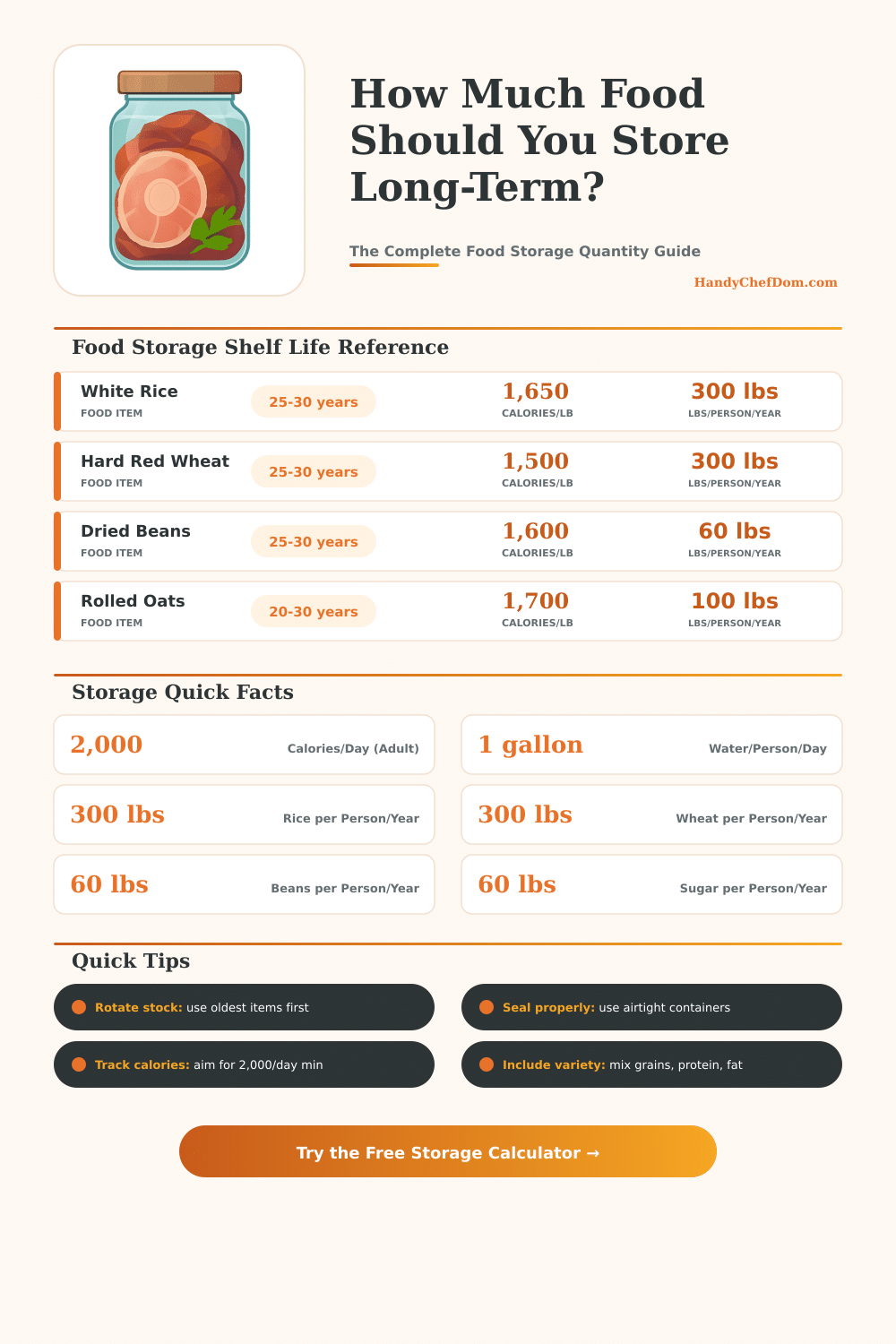
| White Rice | 300 lbs | 136 kg | 1,650 | 25–30 years |
| Hard Red Wheat / Flour | 300 lbs | 136 kg | 1,500 | 25–30 years |
| Rolled Oats | 100 lbs | 45 kg | 1,700 | 20–30 years |
| Pasta | 50 lbs | 23 kg | 1,600 | 8–30 years |
| Dried Beans (all types) | 60 lbs | 27 kg | 1,550 | 25–30 years |
| Lentils / Split Peas | 20 lbs | 9 kg | 1,550 | 25–30 years |
| Freeze-Dried Meat | 20 lbs | 9 kg | 900 | 25–30 years |
| Canned Tuna / Salmon | 12 lbs | 5 kg | 530 | 3–5 years |
| Powdered Milk | 16 lbs | 7 kg | 1,600 | 20–25 years |
| Sugar / Honey | 60 lbs | 27 kg | 1,750 | Indefinite |
| Salt | 8 lbs | 4 kg | 0 | Indefinite |
| Baking Powder / Soda | 2 lbs | 1 kg | — | 1–2 years |
| Vegetable Oil | 10 lbs | 5 kg | 3,530 | 2–4 years |
| Freeze-Dried Vegetables | 20 lbs | 9 kg | 250 | 25–30 years |
| Duration | Days | Adult Calories (2,000/day) | Grains (lbs) | Protein (lbs) |
|---|---|---|---|---|
| 72-Hour Kit | 3 days | 6,000 | 4 lbs | 1 lb |
| 2 Weeks | 14 days | 28,000 | 16 lbs | 4 lbs |
| 1 Month | 30 days | 60,000 | 35 lbs | 8 lbs |
| 3 Months | 90 days | 180,000 | 104 lbs | 25 lbs |
| 6 Months | 180 days | 360,000 | 207 lbs | 49 lbs |
| 1 Year | 365 days | 730,000 | 420 lbs | 100 lbs |
| 2 Years | 730 days | 1,460,000 | 840 lbs | 200 lbs |
The storage of foods turns around that, that one keeps them fit for eating during weeks or even months after purchase or harvest. Like this one reduces the useless expense in the kitchen by means of what unused or uneaten parts stay for later use. Because of that alone reason it starts to be practical custom in every home.
Very important the tins. Glass and plastic containers for foods do more than simply be average boxes. One designed them with attention to benefit and good quality.
How to Store Food Safely
Tight lids protect the freshness of the food, while glass tins allow to quickly glimpse the content. For instance Tupperware-tins use upper materials with strong sealing, that keeps the taste and stops mold. Whether big fair-festival or only tomorrow’s lunch, fit tin truly altres the results.
BPA-free tins show healthy and practical choice. They work for the pantry, refrigerator or freezer. Some of them are microwave-safe and dishwasher-safe, what makes cleanup easy.
Anchor Glass-tins form another reliable option, where some sets last around ten years without problems. Pyrex glass storage sets enjoy big popularity, and the glass does not brake or chip easily. Some systems of tins include several sizes with same lid, what really is a lot practical.
Also steel variants exist. Steel lunch boxes, bento boxes and portable tins work well for meals, soups or any warm or cold stuff. They well serve to fill snacks, bring lunch or store leftovers.
Stackable tins with lids and drawer inserts helps to use every part of the kitchen space. The organisation does form the base for joyous and working kitchen. For little portions of healthy snacks and vegetables, compact storage of food answers ideally for preparing meals.
Long-term storage forms entirely other topic. Food fit for shelves, as flour, rice, pasta, canned meat, oats, sugar, beans and potatoes, commonly come at low price. They keep pest-free.
Tightly closed storage tins well work for dry products. Mylar-bags with oxygen absorbers in food-grade crates with tight lids deliver another mode for long storage. Vacuum sealing by means of mason jars, with stock in dark fresh places, stays another method that indeed works.
The drying of food, pickling of vegetables and storage in jars stays traditional modes for keeping, that one yet uses today. Freezing works most simply for many kinds, although modern vertical refrigerators have defrost cycles, what makes them better for short-term cool storage. Chest freezer helps more for longer times.
Vacuum sealed meats and vegetables last much more than food simply enclosed in usual bag. Rendered fat last around three months in the refrigerator and almost forever whenfrozen.
Regular cooking from stored food helps to turn it and find recipes, that truly well taste from ingredients of the pantry.