🥗 Nutrition Calculator for Food
Instantly calculate calories, protein, carbs, fat & fiber for any food & serving size
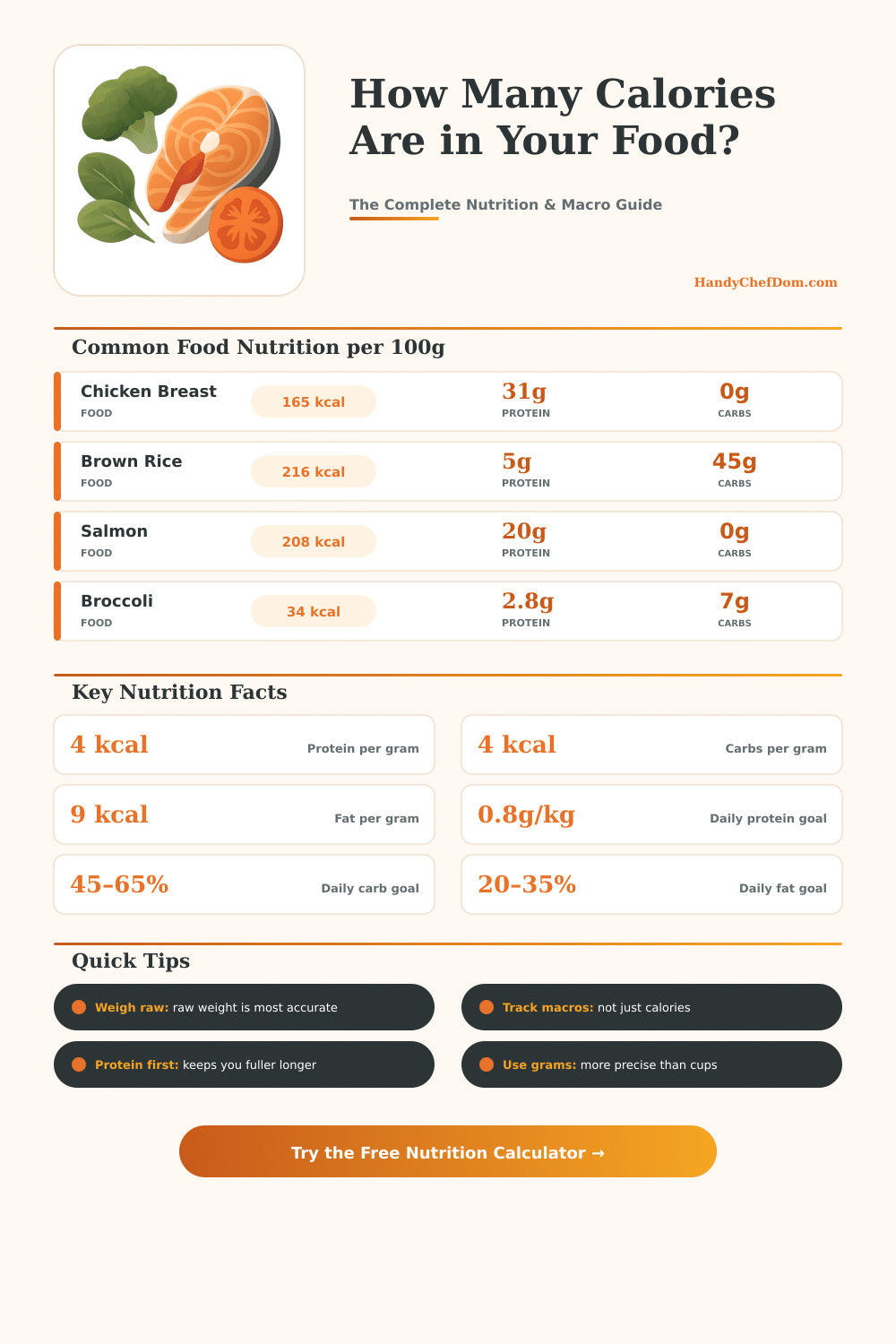
| Food | Calories | Protein | Carbs | Fat | Fiber |
|---|---|---|---|---|---|
| Chicken Breast (cooked) | 165 kcal | 31g | 0g | 3.6g | 0g |
| Salmon (cooked) | 208 kcal | 20g | 0g | 13g | 0g |
| Brown Rice (cooked) | 216 kcal | 5g | 45g | 1.8g | 3.5g |
| Rolled Oats (dry) | 389 kcal | 17g | 66g | 7g | 10.6g |
| Whole Egg (raw) | 143 kcal | 13g | 1g | 10g | 0g |
| Broccoli (raw) | 34 kcal | 2.8g | 7g | 0.4g | 2.6g |
| Banana (raw) | 89 kcal | 1.1g | 23g | 0.3g | 2.6g |
| Almonds (raw) | 579 kcal | 21g | 22g | 50g | 12.5g |
| Greek Yogurt (plain, 0% fat) | 59 kcal | 10g | 3.6g | 0.4g | 0g |
| Sweet Potato (cooked) | 86 kcal | 1.6g | 20g | 0.1g | 3g |
| White Rice (cooked) | 130 kcal | 2.7g | 28g | 0.3g | 0.4g |
| Ground Beef 80% lean | 254 kcal | 17g | 0g | 20g | 0g |
| Avocado | 160 kcal | 2g | 9g | 15g | 7g |
| Lentils (cooked) | 116 kcal | 9g | 20g | 0.4g | 7.9g |
| Food / Item | Common Serving | Grams | Ounces |
|---|---|---|---|
| Chicken Breast (1 medium) | 1 piece | 174g | 6.1 oz |
| Whole Egg (large) | 1 egg | 50g | 1.8 oz |
| Cooked Rice (1 cup) | 1 cup | 186g | 6.6 oz |
| Dry Oats (1 cup) | 1 cup | 80g | 2.8 oz |
| Banana (medium) | 1 banana | 118g | 4.2 oz |
| Almonds (1 oz / small handful) | ~23 nuts | 28g | 1 oz |
| Greek Yogurt (single serve) | 1 container | 170g | 6 oz |
| Salmon fillet | 1 fillet | 198g | 7 oz |
| Broccoli (1 cup chopped) | 1 cup | 91g | 3.2 oz |
| Avocado (half) | 1/2 fruit | 100g | 3.5 oz |
| Category | Kcal per gram | Example Foods | Density |
|---|---|---|---|
| Protein | 4 kcal/g | Chicken, fish, eggs | Medium |
| Carbohydrates | 4 kcal/g | Rice, oats, fruit | Medium |
| Dietary Fat | 9 kcal/g | Oils, nuts, avocado | High |
| Dietary Fiber | ~2 kcal/g | Vegetables, legumes | Low |
| Alcohol | 7 kcal/g | Beer, wine, spirits | High |
| Water | 0 kcal/g | All whole foods contain water | Zero |
Nutrition calculators help to estimate the calorie and other nutrition information for foods or recipes. Some of them work for finding home dishes, while others stress ready products or everyday nutrition needs. That kind of tools appears in various forms, from apps and phone programs to spreadsheets and each works a bit differently.
Recipe nutrition calculators rank between the most used kinds. It finds calorie and nutrition details for any recipe. To use it, simply enter the ingredients together with the serving size, and the tool cares about the rest.
Easy Guide to Nutrition Calculators
Some of those programs allow to copy and add ingredient lists from any page on the net. Others even can process recipes from photographs, links or manually written notes. Like this one receives personal and precise nutrition description for that recipe.
The information covers either the whole or only one serving.
Changing the serving size easily is an important advantage. Many calculators quickly count all nutrition numbers, including calories, macros, vitamins and minerals, when one changes the amount. So one has precise data for every serving, no matter the chosen part.
If you count serving size yourself, simply weigh the food and share it according to the number of servings.
Some programs go past recipes and help with everyday nutrition advice. For instance, one kind estimates daily nutrition entry according to the Dietary Reference Entries, that defined the Division of Health and Medicine of the National Academies of Sciences, Engineering and Medicine. Those data reflect the newest scientific knowledge about nutrition needs.
Also, a tool from Osteoporosis Canada allows to estimate everyday entry for every food, for keeping good bone health.
The USDA plays a big role in this field. The food Calorie Calculator, based on the National Nutrient Database of USDA, lets you choose from thousands of foods and brands. It points nutrition information as calories, fat, protein, carbohydrates, fiber and sugar.
Nutrition.Gov, that works under the Science Arm of USDA, gives reliable data for help in healthy food choices. MyPlate, the extra calculator of USDA, shows how much to eat from every food group during the day, according too age.
Apps form another common way to follow nutrition. Cronometer is a personal program for nutrition tracking, that follows macros and micros together with calorie counting. MyFitnessPal ranks between the most known calorie trackers, that also helps with macros and has a part for recipes, that one can enter manually.
The Samsung Health app, that comes with Galaxy phones, includes a food tracker, that estimates calories for almost any food according to the eaten amount. For iPhone there is also a simple nutrition tracking app called Lose It, designed to be fully natural and easy. It finds foods from photographs or fills in automatically while typing.
Some apps include an option for intermittent fasting together with a calorie calculator, that follows weekly weight loss and fat loss. Also there is a free online calorie calculator with nutrition data for more than two million foods. Even spreadsheets in Excel can follow daily calories and food nutrition, and all that is available for free.
Restaurants and ready food brands give their own tools. Papa Murphy’s has an interactive nutrition calculator for tracking calories, allergens and more. It gives information about products and answers to questions.
Other free nutrition calculators show full macros as calories, protein, fat and carbohydrates, with data for more than a hundred foods.
The nutrition facts labels of FDA on ready foods inform you, how many calories and fat, protein, carbohydrates and other nutrients are in one serving. Many ready foods have more than one serving. The updated labels show the calorie count bigger than before, to ease the reading.
The serving size one points by means of usual home measures as cup, spoon, bit, slice or glass, followed by grams. Whole foods as fresh vegetables or meat do not have labels, so those one must measure yourself.
The advised daily values for micros, minerals and vitamins differ a lot according to height, weight or personal nutrition needs. A good starting point for calorie targets is the Mifflin-St Jeor formula for estimating calories, then set macro ranges as 0.8 to 1.0 grams per pound of lean body mass for protein. Some serving calculators allow to choose food, number of people with their ages and number of meals, then they estimate the right amount for every ingredient.
Adjusting theserving size for children by means of right sized foods also forms part of that.
Recipe managers go even further. They break down every ingredient and estimate a full health score. Features as uploading recipes, scaling for production, sale price, menu cost and nutrition analysis appear in professional programs.
From amateur home cooking to nutrition business, anyone can find a nutrition calculator that works.