🌡 Oven Temperature & Time Converter
Convert between °F, °C, and Gas Mark. Adjust cooking times when changing temperatures.
| °F | °C | Gas Mark | Description |
|---|---|---|---|
| 225 | 110 | ¼ | Very Cool |
| 250 | 120 | ½ | Very Cool |
| 275 | 140 | 1 | Cool |
| 300 | 150 | 2 | Cool / Low |
| 325 | 160 | 3 | Moderately Low |
| 350 | 175 | 4 | Moderate |
| 375 | 190 | 5 | Moderately Hot |
| 400 | 200 | 6 | Hot |
| 425 | 220 | 7 | Hot |
| 450 | 230 | 8 | Very Hot |
| 475 | 245 | 9 | Very Hot |
| 500 | 260 | 10 | Extremely Hot |
| Temp Change | Direction | Time Factor | Example (60min) |
|---|---|---|---|
| 25°F / 14°C | ⬆ Increase | × 0.88 | 53 min |
| 50°F / 28°C | ⬆ Increase | × 0.77 | 46 min |
| 75°F / 42°C | ⬆ Increase | × 0.68 | 41 min |
| 100°F / 56°C | ⬆ Increase | × 0.60 | 36 min |
| 25°F / 14°C | ⬇ Decrease | × 1.15 | 69 min |
| 50°F / 28°C | ⬇ Decrease | × 1.33 | 80 min |
| 75°F / 42°C | ⬇ Decrease | × 1.54 | 92 min |
| 100°F / 56°C | ⬇ Decrease | × 1.78 | 107 min |
| Conventional °F | Conventional °C | Fan °F | Fan °C |
|---|---|---|---|
| 300 | 150 | 275 | 130 |
| 325 | 160 | 300 | 140 |
| 350 | 175 | 325 | 155 |
| 375 | 190 | 350 | 170 |
| 400 | 200 | 375 | 180 |
| 425 | 220 | 400 | 200 |
| 450 | 230 | 425 | 210 |
| 475 | 245 | 450 | 225 |
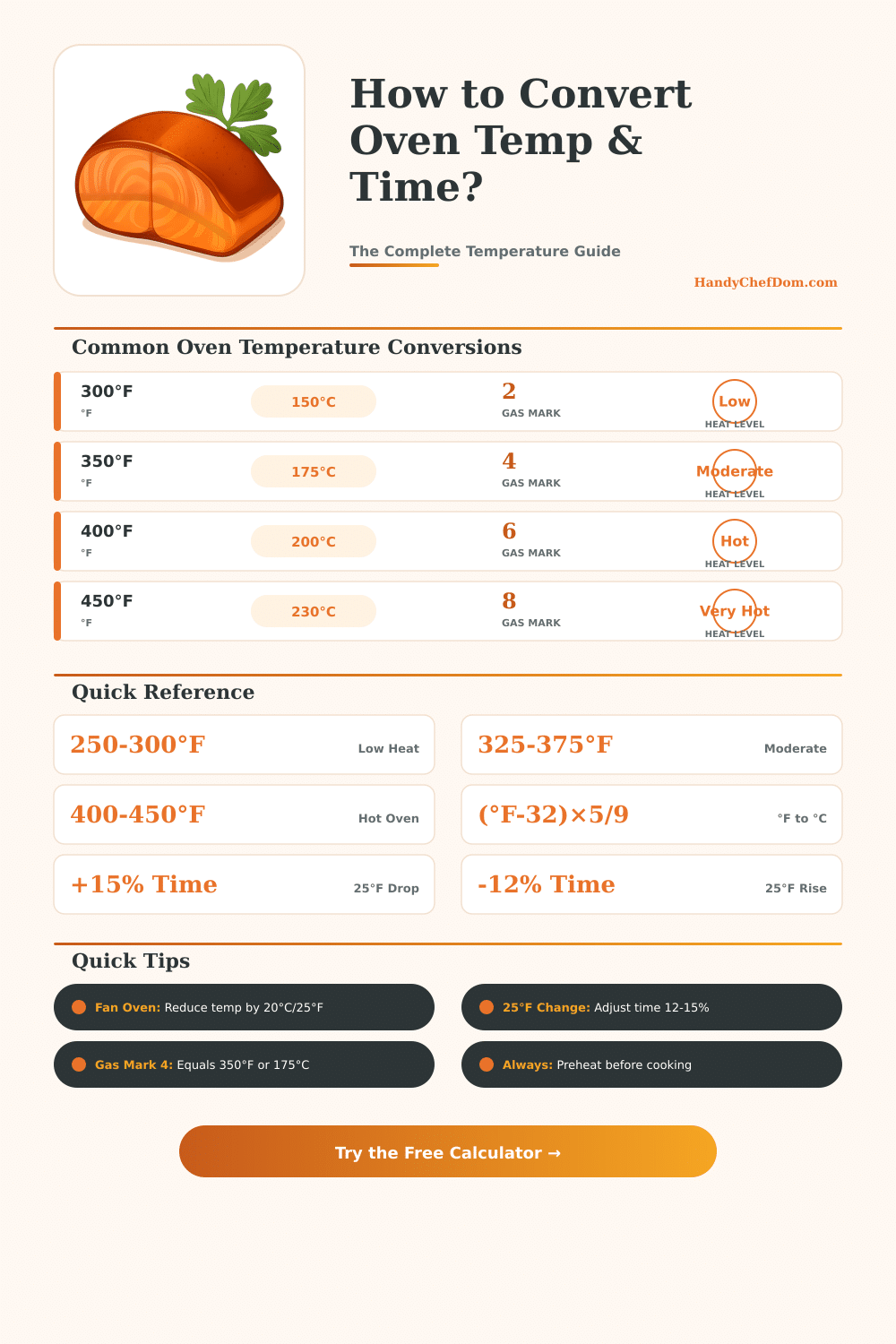
The formula for converting that I most use is made up of (°F, 32) × 5/9, because it always works well with Celsius and honest, it never fails. 350 °F match 175 °C, while 400 °F reach 200 °C, those two I well remember. Gas Mark 4 matches 350 °F, and Gas Mark 6 to 400 °F. Quite simple really, however the changes in time first surprised me a lot.
A higher temperature of 25 °F cuts the cooking time by around 12% roughly. Drop it by 25 °F, and you add almost 15%. Fan ovens indeed work at 25 °F more warm, so drop by 20 °C and remove 10 to 15% exactly.
Oven Temperatures and Cooking Time
A recipe of 60 minutes at 350 °F normally lasts around 46 minutse at 400 °F. It gives a factor of 0.77 for a change of 50 °F, quite surprisingly, in reality it is more close to 0.78.
Increase by 100 °F? You see a factor of 0.6. That is a big change.
The info below does not come from sum calculator or converter program. It is based on actual use, looking back, discussions in forums and experiences of cooking groups across the net.
When you hesitate, 350 °F is the basic temperature for oven. It is the most common picked value, especially for savory foods. Stories explain that this goes back to times before ovens had automatic controls.
Every oven with electrical measure uses 350 as standard starting point. That is a reliable roast temperature and good start for almost everything cookable.
Ovens tend to use fixed terms for describing ranges of heat. A cold oven stands at 200 °F (93 °C). Slow cooks happen between 300… 325 °F. Medium baking goes between 350, 375 °F. Hot run is at 400. 425 °F. Very hot sits between 450, 475 °F. And extremely hot reaches 500; 525 °F. All this is in Fahrenheit.
Most cookies bake at 375 °F. Bread in a form cooks at 400 °F. Pizza goes in the oven at 500 °F or more. Professional pizza ovens reach 800 °F or more. At home for pizza, simply turn the oven to the maximum.
American models commonly beat European, with 550 °F as common limit for new. Old or cheap versions only reach 500, 525 °F. European ovens usually max out around 250 °C.
Here the point about accuracy of ovens. Many of them drift by 25, 50 °F from the set value. Better ones stay more close to it, sometimes within 20 degrees.
Cheap ones can swing by 40 to 50 degrees all over. When an oven is set to 325 °F, but really reads 360 °F, the cooking results fail. Opening the door to put food in can drop the heat by 30, 50 °F. Some folks make up for this by heating to a higher level before putting the meal in.
A thermometer for the oven really is useful. Lay it in the center of the oven and set to 350 °F. After 20 minutes, check the reading. Knowing the real heat does a lot for good baking.
An extra trick is to lay a ball of sugar on aluminum foil at 375 °F, to check whether it caramelizes well.
For ovens with fan help, drop the temperature by 20 degrees Celsius is a good guess, if the fan can not be turned off. To change Celsius to Fahrenheit, multiply by 1.8 and add 32. The rule for keeping warmth usually moves between 170 and 200 °F. It does not cook foods or reheat leftovers, but it keeps finished dishes at safe serving temperature.
Warm food should stay above 140 °F to slowbacteriums.
Cooking stuffings at 170 °C instead of 200 °C will not change the time a lot. They do not need the same care as a tender cake. Some recipes start at high heat and later drop partly.
Control of temperature separates expert cooks from newcomers.