🧀 Parmesan Cheese Protein Calculator
Find out exactly how much protein is in your parmesan — by weight, serving size, or form
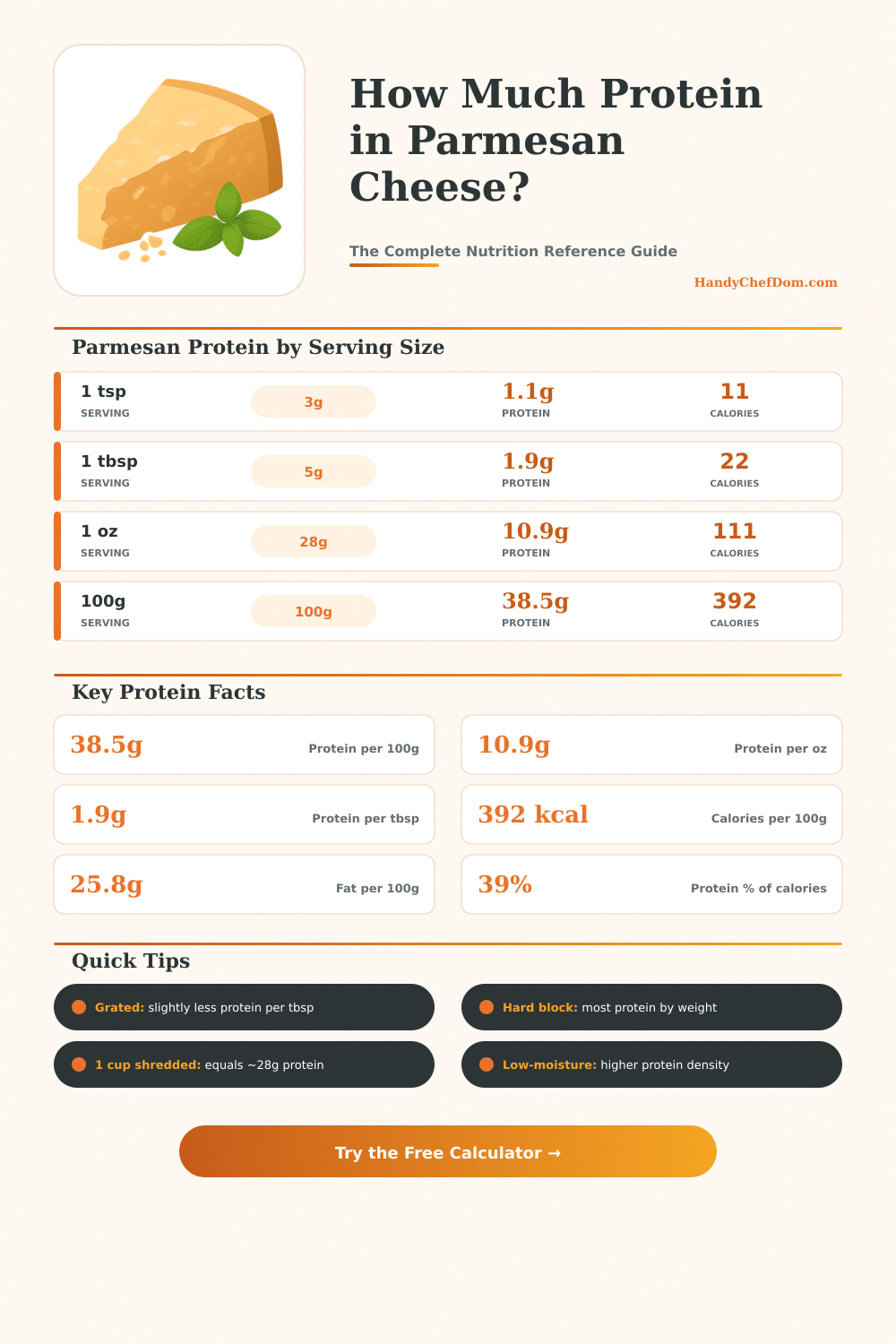
| Serving Size | Weight (g) | Protein (g) | Calories | Fat (g) |
|---|---|---|---|---|
| 1 teaspoon grated | 3 | 1.1 | 12 | 0.8 |
| 1 tablespoon grated | 5 | 1.9 | 20 | 1.3 |
| 2 tablespoons grated | 10 | 3.8 | 39 | 2.6 |
| 1 oz (block) | 28 | 10.9 | 111 | 7.3 |
| 1 oz (shredded) | 28 | 10.5 | 108 | 7.1 |
| 1/4 cup shredded | 25 | 9.6 | 99 | 6.5 |
| 1/2 cup shredded | 50 | 19.3 | 196 | 12.9 |
| 1 cup shredded | 100 | 38.5 | 392 | 25.8 |
| 1 cup grated (dry) | 80 | 30.8 | 314 | 20.6 |
| 100g block | 100 | 38.5 | 392 | 25.8 |
| Cheese Type | Protein / 100g | Calories / 100g | Moisture |
|---|---|---|---|
| Parmesan (hard) | 38.5g | 392 | ~29% |
| Pecorino Romano | 31.8g | 387 | ~31% |
| Gruyere | 29.8g | 413 | ~33% |
| Cheddar | 24.9g | 402 | ~37% |
| Mozzarella (low-fat) | 24.3g | 254 | ~54% |
| Feta | 14.2g | 264 | ~55% |
| Ricotta (whole milk) | 11.3g | 174 | ~72% |
| Cottage Cheese | 11.1g | 98 | ~79% |
| Measure | Form | Approx. Weight | Protein |
|---|---|---|---|
| 1 teaspoon | Grated | 3g / 0.11oz | 1.1g |
| 1 tablespoon | Grated | 5g / 0.18oz | 1.9g |
| 1 tablespoon | Shredded | 8g / 0.28oz | 3.1g |
| 1/4 cup | Grated | 20g / 0.7oz | 7.7g |
| 1/4 cup | Shredded | 25g / 0.88oz | 9.6g |
| 1 cup | Grated | 80g / 2.8oz | 30.8g |
| 1 cup | Shredded | 100g / 3.5oz | 38.5g |
| 1 oz | Block | 28g | 10.9g |
Parmesan Cheese is a thick, grainy cheese made from milk of cows and aged for at least one year. The official name in Italian is Parmigiano Reggiano. It forms part of a group of cheeses called grana-style together with Grana Padano and the more ancient Granone Lodigiano.
In Italy they call them grana, what means “grain”, and that hints to their grainy structure.
What is Parmesan Cheese?
Parmigiano Reggiano would not have its character without the influence of its origin. Real Parmesan Cheese is prepared in some nearby areas of Italy using raw milk. One mixes the morning milk with that of the prior night, that one left to naturally separate.
The cows eat grasses. The real Parmigiano Reggiano comes directly from the region Emilia-Romagna in Italy.
Folks rate that cheese because of its rich, nutty flavor and dense, crumbly make-up. During the time pass, it develops special grainy structure and strong taste, that shows hints of sweetness, salt, buttery and fruity tones. Parmesan Cheese requires much time to mature.
Even a little amount lasts long, because it is so full in flavor, so that you need not eat lot during won meal.
Parmigiano Reggiano is a branded name. It is not simply a label, but a precise type of dense cheese from a particular Italian area. Parmesan Cheese sold outside Italy commonly copies the original.
For real experience, choose Parmigiano Reggiano or Grana Padano, that both are Italian and have DOP status. Grana Padano is like Parmesan Cheese, made from milk of cows and aged shorter, around one year. Romano cheese serves as another excellent option.
It is cheese from sheep milk with a strong, bitter taste.
Even one ounce of dense Parmesan Cheese gives 10.1 grams of Protein. By comparison, Parmesan Cheese carries more Protein than chicken, that has only 8 grams each ounce.
Parmesan Cheese is used mainly for grating. It works well for spaghetti, garlic bread, pizza, soups and vegetables. It also forms a basic part in several starters.
Pasta dishes, risottos and Caesar salads are typical combos. One can bake Parmesan Cheese in dishes or sprinkle it on top. BelGioioso and Sargento work for cheap pre-grated Parmesan Cheese without extras.
One can freeze blocks of Parmesan Cheese and later grate them as needed, though from freezing cheese gets a bit extra crumbly. Freshly grated Parmesan Cheese always beats the dry product from a box. Some store-boughtgrated Parmesan Cheese products even hold wood fiber and cellulose as anti-clumping aids.