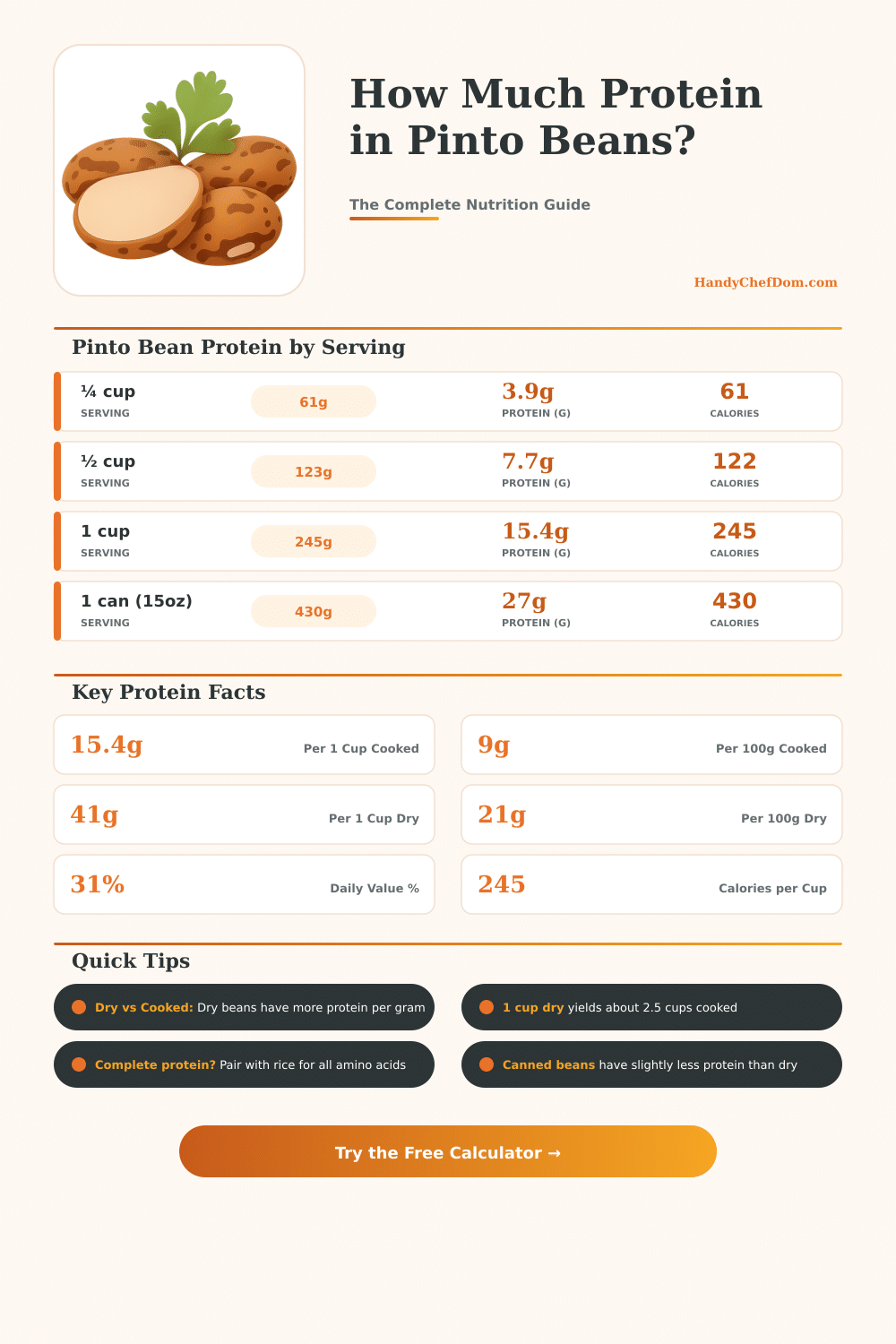
🟤 Pinto Bean Protein Calculator
Calculate exact protein content by serving size — cooked, dry, or canned
| Serving Size | Weight | Protein | Calories | % Daily Value |
|---|---|---|---|---|
| 1 tbsp cooked | 15g | 0.9g | 15 | 1.8% |
| ¼ cup cooked | 61g | 3.9g | 61 | 7.8% |
| ½ cup cooked | 123g | 7.7g | 122 | 15.4% |
| 1 cup cooked | 245g | 15.4g | 245 | 30.8% |
| 1.5 cups cooked | 368g | 23.1g | 368 | 46.2% |
| 2 cups cooked | 490g | 30.8g | 490 | 61.6% |
| 1 can (15 oz) drained | 430g | 27.0g | 430 | 54% |
| ½ cup dry | 96g | 20.2g | 336 | 40.4% |
| 1 cup dry | 193g | 40.5g | 671 | 81% |
| Form | Per 100g | Protein |
|---|---|---|
| Dry / Raw | 100g | 21.0g |
| Cooked / Boiled | 100g | 9.0g |
| Canned (drained) | 100g | 6.3g |
| Canned (with liquid) | 100g | 5.1g |
| Unit Conversion | Grams | Oz |
|---|---|---|
| 1 cup cooked | 245g | 8.6 oz |
| 1 cup dry | 193g | 6.8 oz |
| 1 can (15 oz) | 430g | 15.2 oz |
| 1 tbsp cooked | 15g | 0.5 oz |
When talking about the farming of beans in North Mexico and the Southwest United States, the pinto beans clearly dominate the image. The word “pinto” itself points to something marked what immediately comes to mind when one sees them. Those special spots on the skin of the bean look like the marks of a pinto pony.
But here is the interesting part: while one cooks them, those marks disappear entirely, and the beans turn a nice pink shade.
All About Pinto Beans
Pinto Beans show up in kitchens in many ways. One serves them whole in soups and broths, or one mashes them for refried beans. They shine in chili, burritos and wrapped in tortillas.
They go surprisingly well with huevos rancheros, and also well they cook on rice covered with eggs, salsa, cheese, cream and fresh cilantro. Recipes for tamales depned much on them. Even in Mediterranean style one uses Pinto Beans, usually boiled in olive oil together with carrots and potatoes.
Cooking dried Pinto Beans from scratch does not require big effort. It needs only ten basic ingredients and one pot. First, you wash the beans and sort them to remove possible stones or bad parts.
Soaking them overnight really is useful. That softens them, so they cook more quickly and evenly. After the soaking, boil them on the stove until they soften, which normally happens after two to three hours.
Here is good advice: add salt only in the final stage of cooking. If you add it too early, the beans stay tough and ultimately crack. Big beans like pinto, red and black require at least two ours, regardless of your method.
A pressure cooker changes everything greatly. Six pounds of Pinto Beans cook in almost twelve minutes with one of them.
Tasty mixes with cumin, oregano, onion, garlic, dried ancho chilis, cilantro and black pepper work well together. In southern styles one commonly cooks ham cubes together with the beans. One can add bacon, sonoran pepper, celery, carrots, tomatoes or even beer for deep flavor.
Mexican recipes stress cilantro and epazote, while Italian ones add bay leaf, thyme, parsley, garlic and rind of parmesan. A little vinegar gives the right shine and boosts the richness.
Nutrition wise, Pinto Beans prove their value fully. They fill you up with Protein, fiber, vitamins and minerals. One cup of cooked beans provides around fifteen grams of fiber and the same of Protein.
That mix helps to keep stable the blood sugar and care about heart health. The fiber, that is good for the belly, gives big satisfaction, and one does not worry about added fat.
From a cost view, cooking dried beans beats buying canned by a lot. One pound of dry Pinto Beans gives around twelve servings of half cup, while onecane delivers only three and a half.