🍕 Pizza Corner Dough Calculator
Get precise flour, water, yeast & salt amounts for any pizza size or quantity
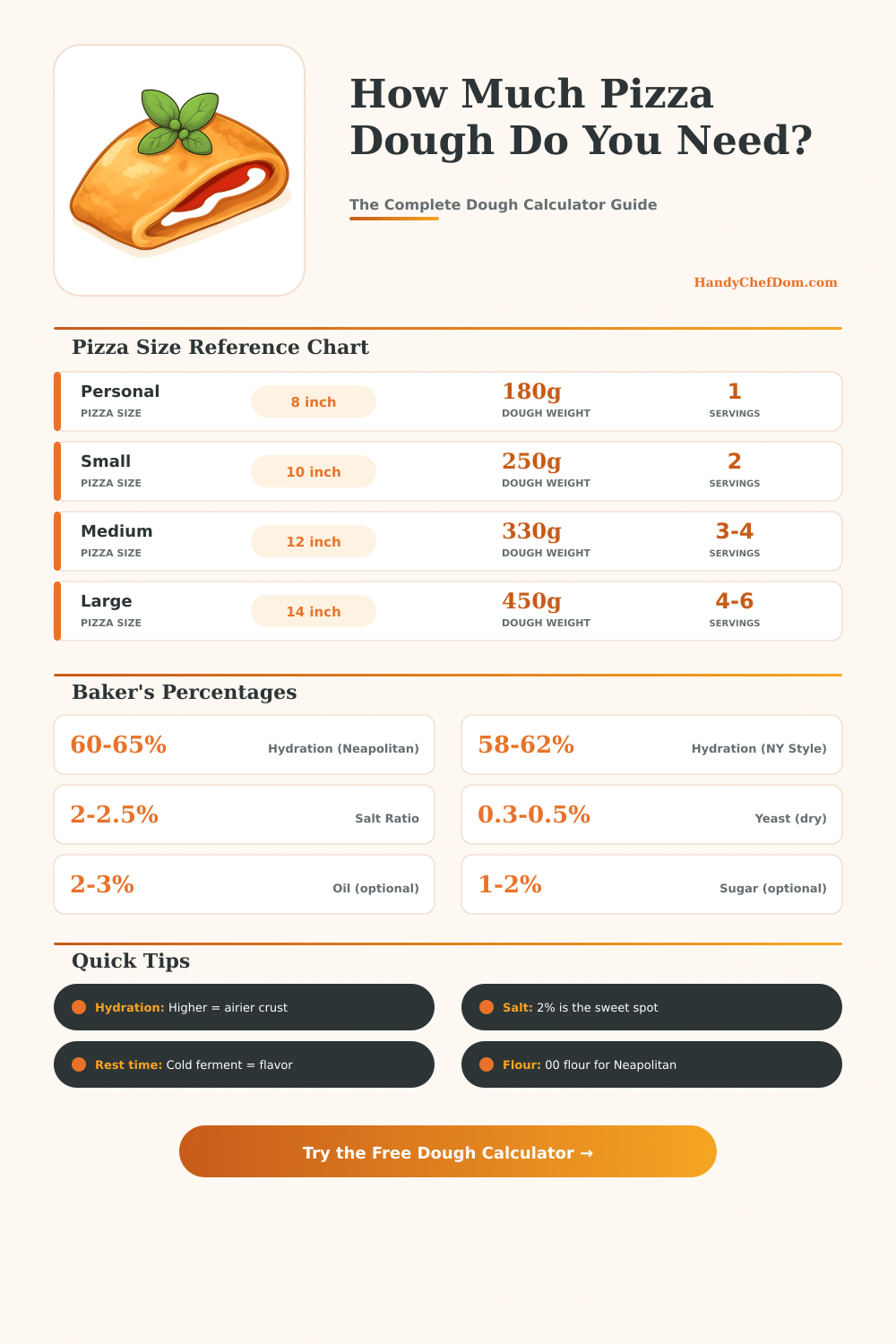
| Pizza Size | Diameter | Dough Weight (g) | Dough Weight (oz) | Servings | Flour Needed (g) |
|---|---|---|---|---|---|
| Personal | 8 in / 20 cm | 180 g | 6.3 oz | 1 | 112 g |
| Small | 10 in / 25 cm | 250 g | 8.8 oz | 2 | 156 g |
| Medium | 12 in / 30 cm | 330 g | 11.6 oz | 3–4 | 206 g |
| Large | 14 in / 35 cm | 450 g | 15.9 oz | 4–6 | 281 g |
| XL | 16 in / 40 cm | 600 g | 21.2 oz | 6–8 | 375 g |
| Sheet Pan | 13x18 in / 33x46 cm | 800 g | 28.2 oz | 8–10 | 500 g |
| Instant Yeast | Active Dry Yeast | Fresh Yeast | Equivalent Use |
|---|---|---|---|
| 1 g | 1.25 g | 3 g | ~200g flour |
| 2 g | 2.5 g | 6 g | ~400g flour |
| 3 g | 3.75 g | 9 g | ~600g flour |
| 5 g (1 tsp) | 6.25 g | 15 g | ~1000g flour |
| 7 g (1 packet) | 8.75 g | 21 g | ~1400g flour |
| Grams | Ounces | Cups (sifted) | Cups (packed) |
|---|---|---|---|
| 100 g | 3.5 oz | ~0.9 cups | ~0.8 cups |
| 150 g | 5.3 oz | ~1.25 cups | ~1.1 cups |
| 200 g | 7.1 oz | ~1.6 cups | ~1.4 cups |
| 250 g | 8.8 oz | ~2.1 cups | ~1.8 cups |
| 300 g | 10.6 oz | ~2.5 cups | ~2.2 cups |
| 500 g | 17.6 oz | ~4.2 cups | ~3.7 cups |
Pizza Dough is one of those things that seems hard, but actually it is not that difficult. A simple recipe requires only six basic ingredients and does not require special kinds of flour. Whole flour or bread-flour both work well.
The Dough one can prepare in one bowl without a stand blender, although one can use that tool if wanted. Kneading the Dough requires almost no time and it only must rise for around thirty minutes.
How to Make Easy Pizza Dough
First one must start the yeast. This means mix warm water with sugar and yeast, then leave it to stand for around ten minutes, until it becomes bubbly and foamy. Water should be quite warm, but not too warm.
Then one adds the flour, olive oil and salt to the mix. With a wooden spoon one can easily combine everything. No kneading is needed.
When one prepares Pizza Dough, the water content is very important. It seriously affects the final structure and the feel of the crust. Using a stand blender, one mixes the Dough for four to seven minutes, then leaves it to rest for five minutes, and finally mixes again for two to three minutes more, that works surprisingly.
The Dough should be a bit wet. It should not touch the bottom and sides of the bowl, but stay quite soft.
The weight of the Dough changes based on the size of the Pizza. For a 10-inch Pizza 180 grams of Dough is enough. A 12-inch Pizza requires around 260 grams.
A 14-inch Pizza needs about 350 grams. That amount helps to reach the write proportion between thickness and chew. For Pizzas with thin crust, 125 to 175 grams each piece is a good amount.
Cooling the Dough in the fridge simply improves it. Ideally one prepares the Pizza Dough at least two days before and keeps it in the fridge. Dough risen for 48 hours in cold gives richer flavor.
Even so, if it stays too long, the gluten breaks down and the Dough really can pour and spread. Leftover Pizza Dough also works well for a base of Pizzacrust.
A Pizza stone really changes the result of the crust. It gives more focused heat and a more crisp base. Sprinkle cornstarch or flour on the Pizza peel before laying the Dough to help it slide flat to the stone.
For bread-Pizza, a well oiled sheet pan works well and gives a thick, crisp, golden base with puffy soft part under the toppings. Mixing bread-flour with semolina or high-protein flour can change the texture in interesting ways. Mastering the Dough is the hardest step for making Pizza, but with a simple recipe and basic ingredients there really is hardly any error.