🍺 Pressure Fermentation Calculator
Calculate ideal PSI, CO₂ volumes, and carbonation levels for pressure fermentation of beer, cider & more.
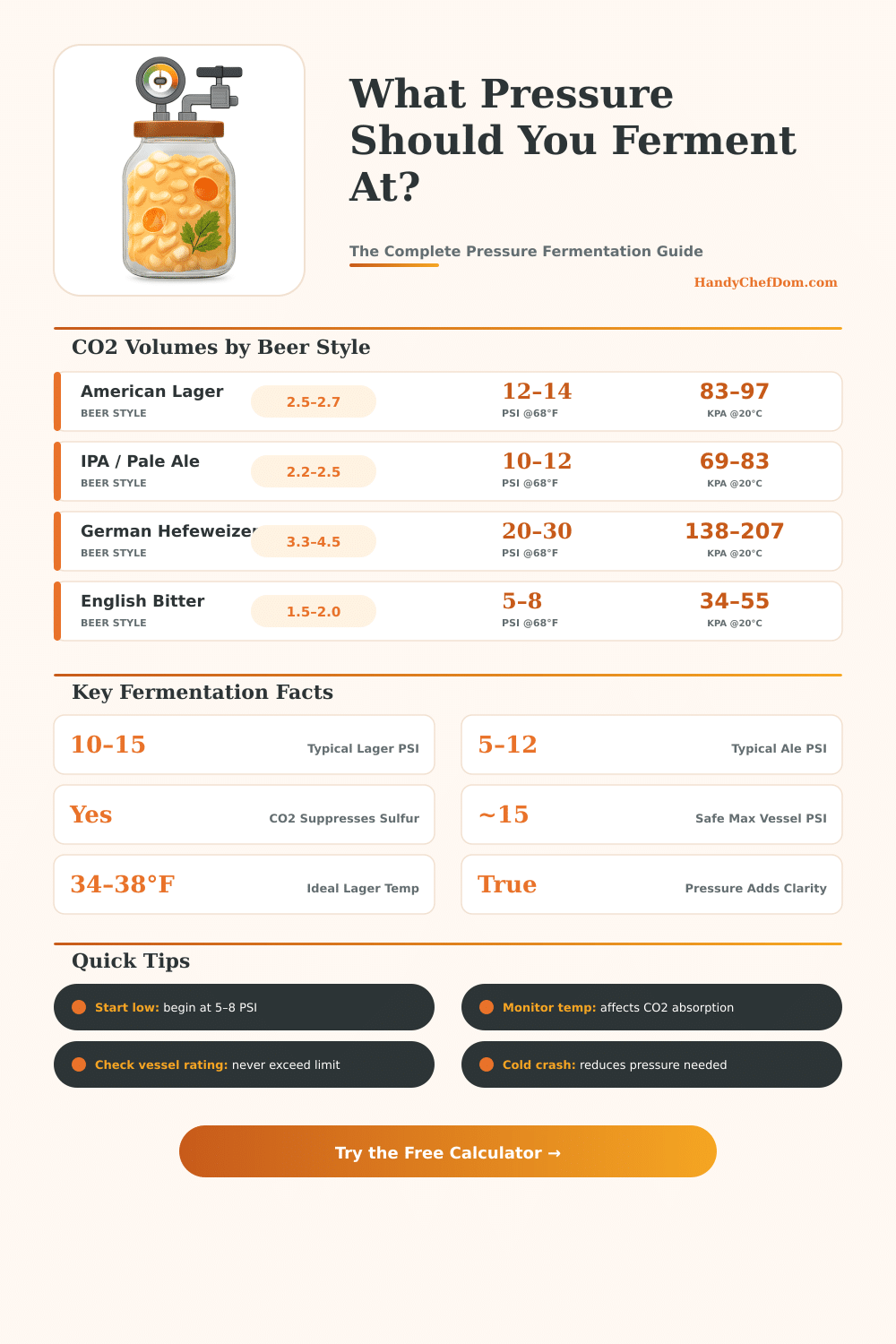
| Beer Style | CO₂ Volumes | PSI @ 68°F (20°C) | kPa @ 20°C |
|---|---|---|---|
| British Cask Ale | 1.0 – 1.5 | 2 – 4 | 14 – 28 |
| Dry Irish Stout | 1.6 – 2.0 | 5 – 8 | 34 – 55 |
| English Bitter / Mild | 1.5 – 2.2 | 4 – 10 | 28 – 69 |
| American Lager | 2.5 – 2.7 | 12 – 14 | 83 – 97 |
| IPA / American Pale Ale | 2.2 – 2.5 | 10 – 12 | 69 – 83 |
| Czech / German Pilsner | 2.3 – 2.6 | 11 – 13 | 76 – 90 |
| Saison / Farmhouse Ale | 3.0 – 4.5 | 18 – 30 | 124 – 207 |
| Hefeweizen / Wheat Beer | 3.3 – 4.5 | 20 – 30 | 138 – 207 |
| Belgian Tripel / Witbier | 3.0 – 4.0 | 18 – 26 | 124 – 179 |
| Berliner Weisse / Sour | 3.0 – 4.2 | 18 – 28 | 124 – 193 |
| Hard Cider (still) | 1.0 – 1.5 | 2 – 4 | 14 – 28 |
| Hard Cider (sparkling) | 2.5 – 3.5 | 12 – 22 | 83 – 152 |
| Kvass | 2.0 – 3.0 | 8 – 18 | 55 – 124 |
| Temp (°F) | Temp (°C) | kH Constant | Notes |
|---|---|---|---|
| 32°F | 0°C | 0.1030 | Freezing point — max solubility |
| 35°F | 1.7°C | 0.0985 | Cold crash / lagering range |
| 38°F | 3.3°C | 0.0943 | Typical serving / cold crash |
| 45°F | 7.2°C | 0.0866 | Ale cold conditioning |
| 50°F | 10°C | 0.0808 | Cool ferment / cold ale |
| 55°F | 12.8°C | 0.0754 | Lager ferment low end |
| 60°F | 15.6°C | 0.0704 | Ale ferment low range |
| 65°F | 18.3°C | 0.0659 | Normal ale ferment |
| 68°F | 20°C | 0.0621 | Standard ale temp |
| 72°F | 22.2°C | 0.0589 | Warm ale ferment |
| 77°F | 25°C | 0.0541 | Pressure ferm upper limit |
| 86°F | 30°C | 0.0476 | Rapid pressure ferm range |
| Yeast Type | Max Recommended PSI | Temp Range | Ester Suppression |
|---|---|---|---|
| Standard Ale (e.g. US-05) | 10 – 15 PSI | 65 – 75°F | High at >10 PSI |
| Kveik (e.g. Voss, Lutra) | 10 – 20 PSI | 75 – 95°F | Moderate |
| Lager (e.g. W-34/70) | 5 – 15 PSI | 34 – 55°F | Low naturally |
| Hefeweizen (e.g. WY3068) | 2 – 5 PSI only | 62 – 72°F | Preserves banana esters |
| Belgian (e.g. Abbaye) | 5 – 10 PSI | 65 – 80°F | Moderate — watch fruity esters |
| Saison (e.g. WY3724) | 3 – 8 PSI | 75 – 90°F | Low recommended |
| PSI | kPa | Bar | Common Use |
|---|---|---|---|
| 2 PSI | 13.8 kPa | 0.14 bar | Still cider / British ale |
| 5 PSI | 34.5 kPa | 0.34 bar | Low-pressure lager start |
| 8 PSI | 55.2 kPa | 0.55 bar | Dry stout / English porter |
| 10 PSI | 68.9 kPa | 0.69 bar | Standard ale pressure ferm |
| 12 PSI | 82.7 kPa | 0.83 bar | Lager / IPA range |
| 15 PSI | 103.4 kPa | 1.03 bar | Max for most PET fermenters |
| 20 PSI | 137.9 kPa | 1.38 bar | Saison / hefeweizen high |
| 30 PSI | 206.8 kPa | 2.07 bar | Max hefeweizen / keg limit |
Pressure Fermentation is popular among home brewers and even big and small professional breweries use this method. Its base is made up of the brewing of beer under pressure, that goes past the normal level. One reaches that by means of fermenting the beer in a sealed container and later adding pressure to it.
The idea is as simple as it seems. Simply find a way to seal the fermenter and adjust the pressure as needed. Even so, plastic or glass bottles will not work for such a task.
Pressure Fermentation: What It Is and Why Use It
You need a fermenter that holds pressure up to at least 25 PSI. Kegs from 5 gallons of type Corny work well, because they hold much higher pressure. Also a spunding valve and fermenter rated for 15 PSI rank among the needed tools.
There are ready available products for brewing, as the Fermzilla All Rounder that does not cost too much for its skills.
Ester production drops dramatically among the main benefits. The pressure reduces the creation of esters, what results in cleaner and fresh flavor. Because of that, lager styles ferment in higher heats, while ale styles give clearer, almost lager-like beer.
Pressure Fermentation stops the brewing process from creating esters in temperatures above the advised. Moreover, it means you can ferment in warmer grades without risk of bad alcoholic results.
The fermentation and conditioning can shorten a lot, especially for lager beers. Some types pass from starting density around 1.060 until final density in almost one week, in room heat and under 15 PSI. For instance, one home brewer prepared IPA with Kveik yeast from 1.060 until 1.013 almost immediately.
You can ferment, age, carbonate and serve from one same fermenter, which drives strong use of sealed containers. That means fewer gear to wash and care for. It reduces or almost removes contact with oxygen too, because oxygen is the main cause of failed home beer.
Beer under pressure lasts more long because the chance of oxygen contact drops compared to use of an airlock.
Pressure Fermentation sticks also for keeping the oils of hops, that otherwise wood escape because of the carbon dioxide from the fermentation. The pressure helps to control the foam on top, what is practical. Only because a fermenter can hold pressure does not mean that every time requires it.
Nothing stops a brewer from doing normal fermentation in a pressure-ready fermenter. Increase the pressure to 13 or 14 PSI soon before thefinish and it is possible to build the right amount of carbonation after the brewing process.