🥩 Prime Rib Per Person Calculator
Calculate the exact amount of prime rib you need for your gathering — bone-in or boneless
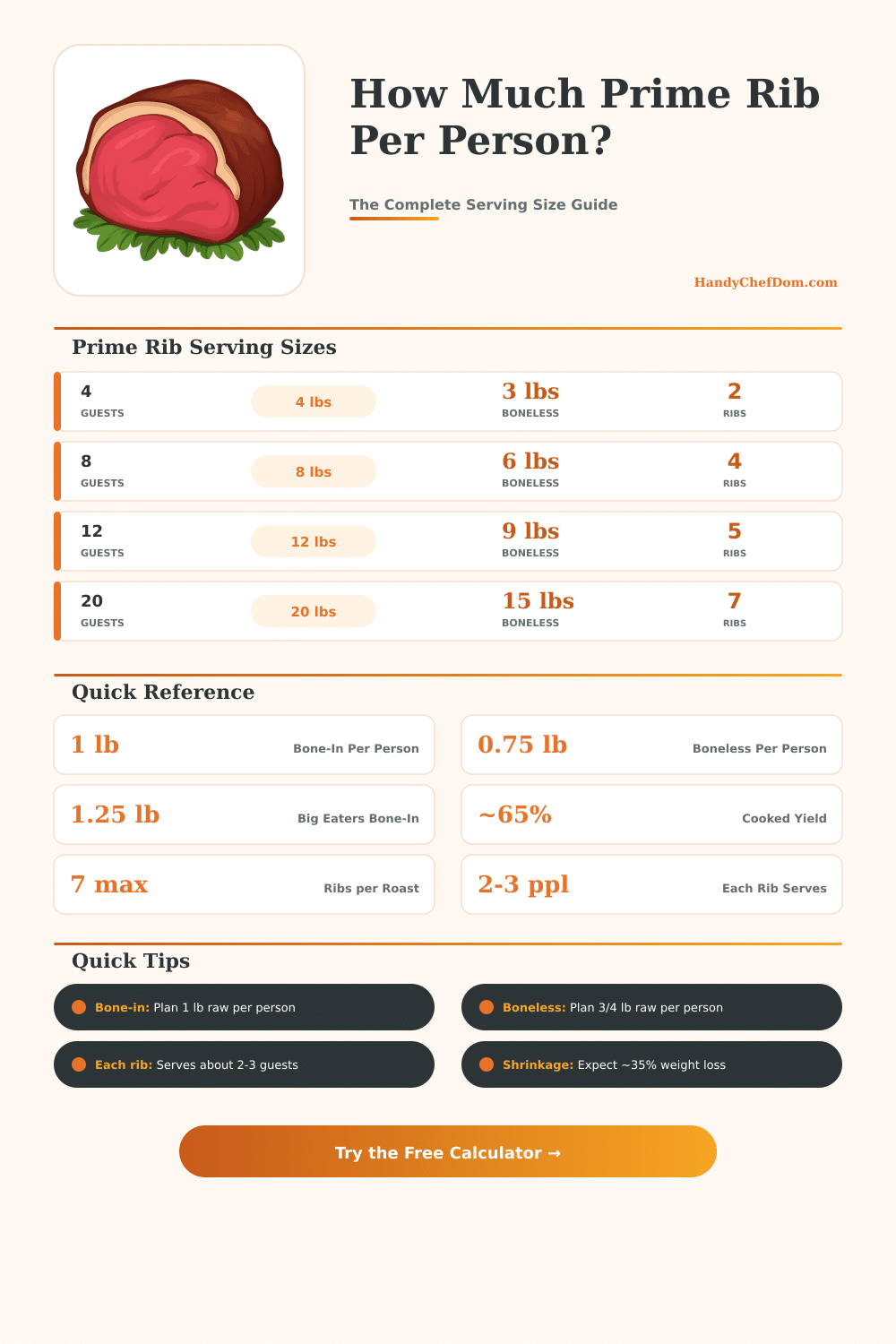
| Guests | Raw Weight (lbs) | Raw Weight (kg) | Rib Bones Needed |
|---|---|---|---|
| 2–3 | 3–4 lbs | 1.4–1.8 kg | 2 |
| 4–5 | 5–6 lbs | 2.3–2.7 kg | 2–3 |
| 6–7 | 7–8 lbs | 3.2–3.6 kg | 3–4 |
| 8–10 | 9–11 lbs | 4.1–5.0 kg | 4–5 |
| 12–14 | 13–15 lbs | 5.9–6.8 kg | 5–6 |
| 16–20 | 17–22 lbs | 7.7–10.0 kg | 6–7 |
| Guests | Raw Weight (lbs) | Raw Weight (kg) | Cooked Yield (approx) |
|---|---|---|---|
| 2–3 | 2–2.5 lbs | 0.9–1.1 kg | 1.3–1.6 lbs |
| 4–5 | 3.5–4.5 lbs | 1.6–2.0 kg | 2.3–2.9 lbs |
| 6–7 | 5–6 lbs | 2.3–2.7 kg | 3.3–3.9 lbs |
| 8–10 | 6.5–8 lbs | 2.9–3.6 kg | 4.2–5.2 lbs |
| 12–14 | 9.5–11 lbs | 4.3–5.0 kg | 6.2–7.2 lbs |
| 16–20 | 12.5–16 lbs | 5.7–7.3 kg | 8.1–10.4 lbs |
| Measurement | Value |
|---|---|
| Bone-in cooking shrinkage | ~35% weight loss |
| Boneless cooking shrinkage | ~30% weight loss |
| Bone weight (per rib bone) | ~0.25–0.4 lbs (0.1–0.2 kg) |
| Average weight per rib bone section | ~2–2.5 lbs (0.9–1.1 kg) |
| Each rib bone serves | 2–3 people |
| Full 7-bone roast weight | 14–18 lbs (6.4–8.2 kg) |
| 1 pound | 0.4536 kg / 16 oz |
| 1 kilogram | 2.2046 lbs / 35.27 oz |
Prime Rib brings a clear image to mind, although the name can sometimes mislead the truth. The term “prime” in Prime Rib does not imply that the meat has USDA Prime grade. It is the most superior most rare and costliest level of beef, determined by the marbling, even so not every bit of Prime Rib has that quality.
In restaurants one commonly uses the name as simply a nickname for that kind of roast. Usually one labels roasts as Prime or Choice, what helps to estimate the marbling, those nice streaks of fat through the meat. Maybe more fat adds more flavor and higher rank.
Prime Rib: What It Is and How to Cook It
From the most bottom until the most upper, the levels are USDA Choice, Choice and Prime.
Why so call it Prime Rib? It is simply roast from the ribs. Remove the rib bones turn it in ribeye.
If one cuts it up, it becomes rib steak. The ribeye steak comes from standnig rib, without bones and with the biggest and less usable muscles removed. Prime Rib is likewise the same slice as ribeye steak, only prepared otherwise for roast.
Bones matter a lot during the cook of that slice. They store marrow, that gives taste to the meat when it cooks. Moreover, they help to keep the meat more moist and protect the surface against heat and drying.
Best is to ask the butcher to cut the ribs and bind them back. Like this the roast cooks more easily and slices later. The vendor then prepares it well, removes the ribs, lays them under the roast as base for roasting and binds the whole thing.
Worth asking also is to remove the spine bone.
For spices, rub from garlic and herbs are traditional choice. Buttery soft interior together with garlic-crusted outside creates wonderful contrast. But problem is, that season only the surface leaves the internal parts without sum salt.
Getting good crust by means of the Maillard reaction matters too. Whether one addresses the outside, it does not do lot for the interior.
Cooking low and slowly, one gets the best makeup and result. Heavy slice, as ten-three-pound Prime Rib, requires more time, so that the center reaches the same heat as the edge. To medium-rare is the ideal.
Rich by means of fat, well marbled bit benefits from cook until the fat starts melting and dissolving, what gives juiciness and flavor. Carry the roast six degrees under the intended heat is clever method, because it still cooks after removal. After exit from the oven, it can add even ten degrees.
After the cook, leave it rest at least twenty minutes before slicing. Searing in the finish instead of initially helps with high heat, like this the meat is ready when required, without overdoing or drying. Searing in iron pan on gas or charcoal escapes the grey and smoke, that oven breeze does.
Smoking works for that same result. Dutch pot works well, braise above vegetables and flavors, later use the juice for sauce.
For portions, eight ounces of cooked Prime Rib for folk is good portion. Little serving is around six ounces. Plan half pound until one pound for person, or one rib for every two eaters.
Four-rib roasts commonly serve eight folks. In restaurants one usually offers portions of eight until sixteenounces.
Prime Rib goes well with homemade sauce from rough root, meat juice and sauce. It works perfectly as main dish for Christmas, New Years, Easter or some festive meal. Salt, heat control and patience is what it truly requires.
No trick needed.