🧬 Amino Acid Profile Calculator
Analyze your complete amino acid intake — check essential AAs against daily requirements & protein quality scores
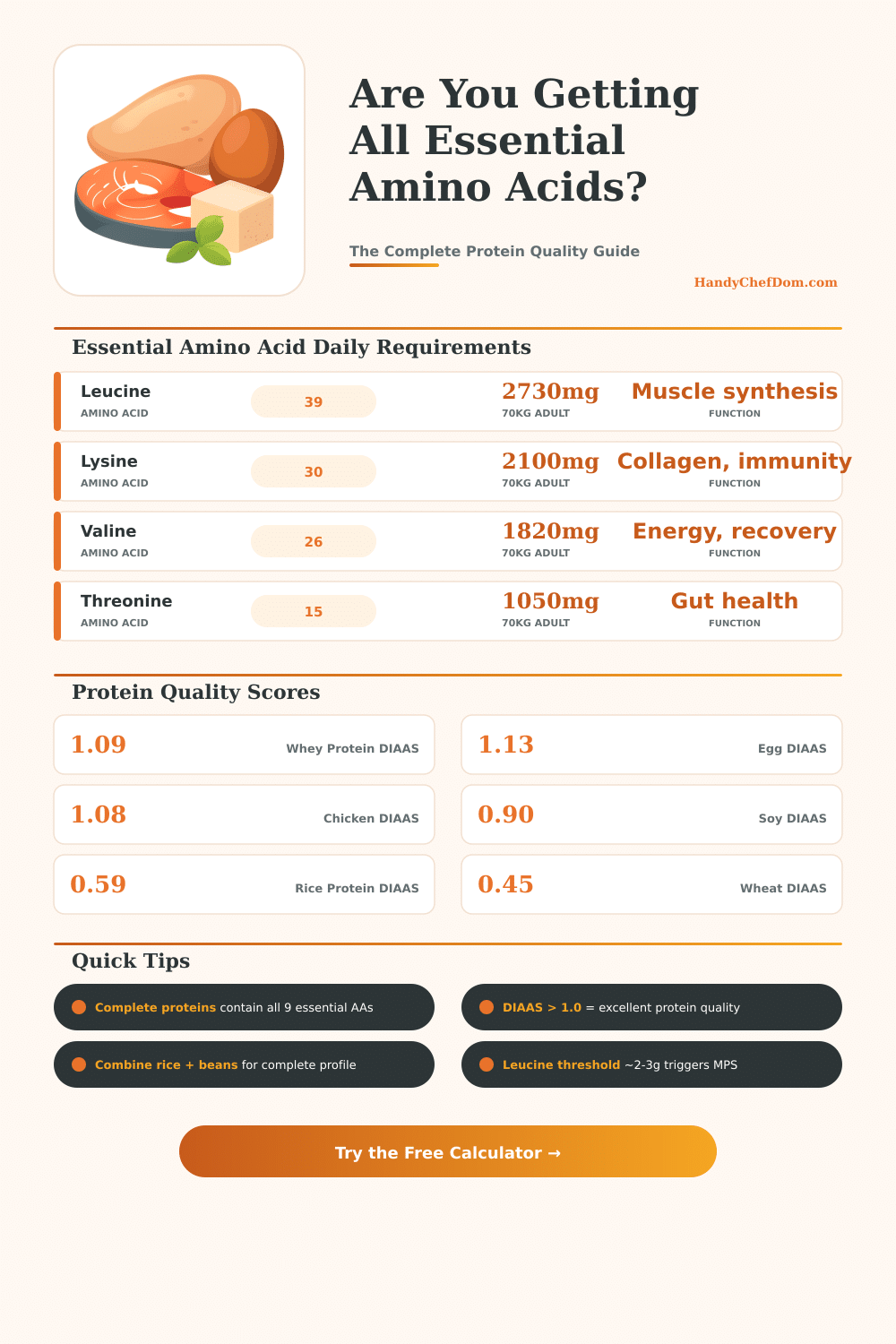
| Amino Acid | mg/kg BW/day | 70kg Adult (mg) | Role in Body |
|---|---|---|---|
| Histidine | 10 | 700 | Immune function, hemoglobin |
| Isoleucine | 20 | 1,400 | Muscle repair, energy |
| Leucine | 39 | 2,730 | Muscle protein synthesis (key BCAA) |
| Lysine | 30 | 2,100 | Collagen, calcium absorption |
| Methionine + Cysteine | 15 | 1,050 | Detox, hair, nails, antioxidant |
| Phenylalanine + Tyrosine | 25 | 1,750 | Neurotransmitters (dopamine) |
| Threonine | 15 | 1,050 | Gut integrity, glycine synthesis |
| Tryptophan | 4 | 280 | Serotonin, sleep, mood |
| Valine | 26 | 1,820 | Energy, cognitive function |
| Food | Protein (g) | Leucine (mg) | Lysine (mg) | DIAAS Score |
|---|---|---|---|---|
| Chicken Breast (cooked) | 31 | 2,460 | 2,790 | 1.08 |
| Whole Egg (raw) | 13 | 1,086 | 912 | 1.13 |
| Whey Protein (powder) | 80 | 8,200 | 7,200 | 1.09 |
| Salmon (cooked) | 25 | 2,025 | 2,350 | 1.04 |
| Greek Yogurt | 10 | 980 | 840 | 1.00 |
| Tofu (firm) | 17 | 1,310 | 1,060 | 0.74 |
| Lentils (cooked) | 9 | 676 | 630 | 0.60 |
| Brown Rice (cooked) | 2.7 | 195 | 84 | 0.59 |
| Black Beans (cooked) | 8.9 | 745 | 578 | 0.62 |
| Oats (dry) | 17 | 1,284 | 714 | 0.67 |
| Quinoa (cooked) | 4.4 | 297 | 239 | 0.82 |
| Beef (lean, cooked) | 26 | 2,130 | 2,320 | 1.10 |
| Cottage Cheese | 11 | 1,000 | 940 | 1.00 |
| Peanut Butter | 25 | 1,672 | 926 | 0.52 |
| Hemp Seeds | 32 | 2,163 | 1,276 | 0.66 |
| Score Range | Rating | Examples | Notes |
|---|---|---|---|
| >1.00 | Excellent | Eggs, whey, beef, chicken | Exceeds all amino acid needs |
| 0.75–1.00 | Good | Soy, quinoa, tofu | Meets most needs; combine foods |
| 0.50–0.74 | Moderate | Oats, lentils, hemp seeds | Pair with complementary proteins |
| <0.50 | Low | Wheat, corn, rice | Combine with legumes to complete |
The profile of Amino acid shows the types and amounts of every Amino acid in a protein source. Amino acid forms the basic units for proteins and for all tissues of the body, so that is important. All they are organic molecules with an amine group and a carboxyl group bound to a central atom of carbon.
In nature there are more than 500 such acids, however the most notable stay the 22 that join themselves in proteins.
Amino acids in food and why they matter
The body requires 20 Amino acid for working well. From those nine belong to the essential Amino acid. Because the body itself cannot produce them.
Between those nine essential Amino acid are histidine, isoleucine, leucine, lysine, methionine, phenylalanine, threonine, tryptophan and valine. By means of blood testing one can estimate the levels of thsoe essential Amino acid.
Biological value of protein estimates how far effectively the body can use it for its own proteins. Full and balanced composition of Amino acid help that work more well. Even so hear comes the trouble.
One lacking essential Amino acid in small amount limits the whole protein building in the body. Although all other Amino acid are plenty, that one weak spot brakes everything.
Plant protein commonly does not have some essential Amino acid. Even so mixing different plant foods, one can fix that. Grains usually lack lysine, but are rich in methionine.
Vegetables are vice versa: they have a lot of lysine, but little methionine. Like this, tying grains with vegetables gives more whole Amino acid composition. For instance, wheat owns a poor Amino acid structure and lacks lysine, threonine and methionine.
Chickpeas are rich in lysine, hence eating hummus with whole wheat bread simply ensures more whole protein.
Proteins from buckwheat have better Amino acid composition than typical grains. They are rich in arginine and lysine, so they cover exactly the gaps of cereals. A ratio of 80 to 20 between pea protein and rice protein ranks among the best Amino acid profiles from plant sources.
Cooking also affects the situation. Boiling apparently does not change the content of Amino acid in common foods. But frying and grilling can reduce the levels of Amino acid.
While roasting, the most free Amino acid actually grow, except threonine, serine, glutamic acid, histidine and arginine. Varied diet usually quite well meets the needs for Amino acid without big effort. Complete proteinpowders that include all nine essential Amino acid wellserve for that.