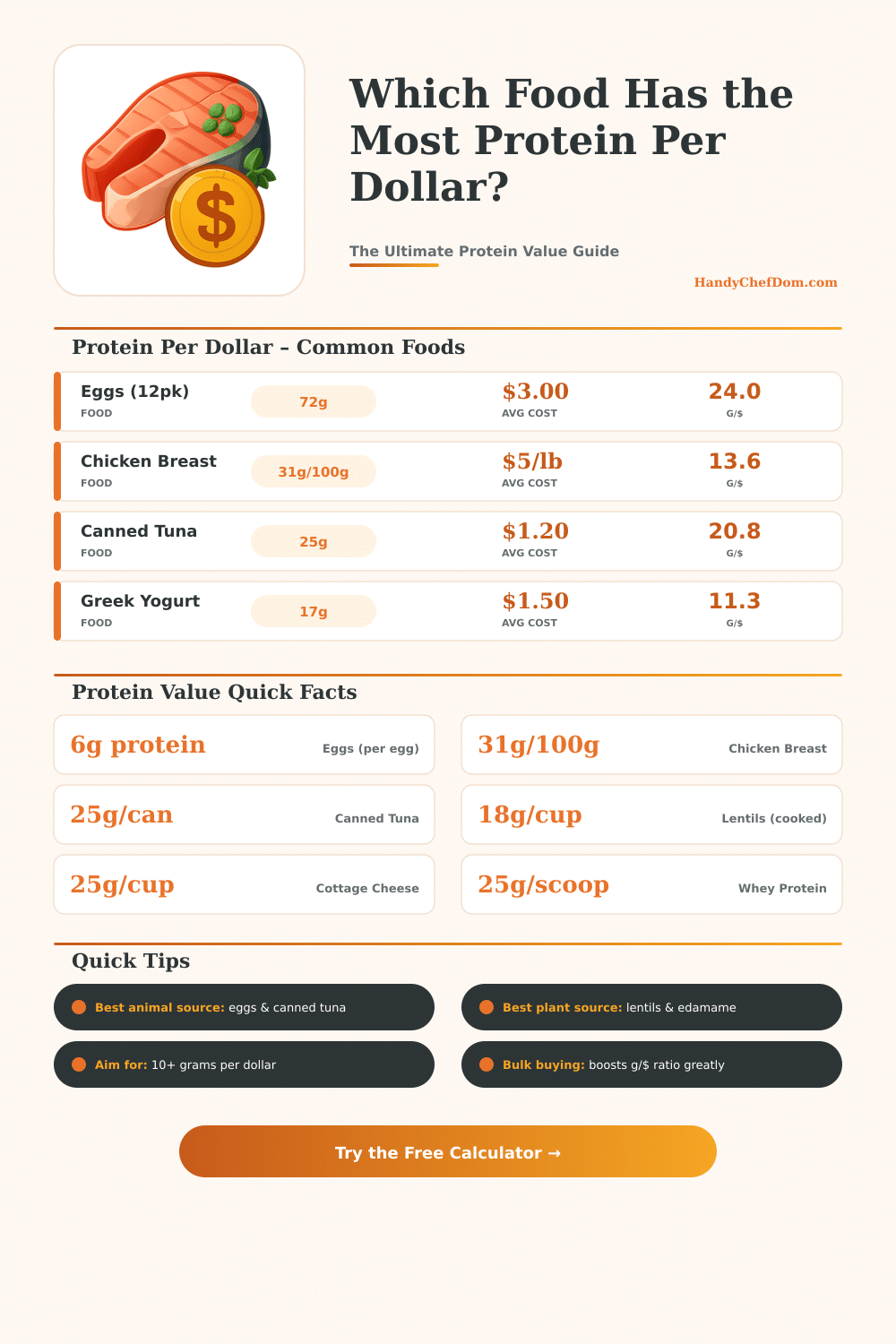
💪 Protein Per Dollar Calculator
Find the best protein value for any food — compare grams of protein per dollar spent
| Food | Protein (g/100g) | Typical Serving | Protein/Serving | Approx g/$ | Rating |
|---|---|---|---|---|---|
| Eggs (large) | 12.6g | 1 egg (50g) | 6.3g | 22–26g | Excellent |
| Canned Tuna (water) | 26g | 1 can (142g) | 30g | 20–25g | Excellent |
| Chicken Breast (raw) | 31g | 4 oz (113g) | 35g | 18–22g | Excellent |
| Lentils (dry) | 25g | 1/4 cup dry (48g) | 12g | 16–20g | Excellent |
| Black Beans (canned) | 8.9g | 1/2 cup (130g) | 7.6g | 14–18g | Excellent |
| Cottage Cheese (2%) | 11.1g | 1/2 cup (113g) | 12.5g | 12–16g | Good |
| Ground Beef (80/20) | 25.9g | 4 oz (113g) | 29g | 10–14g | Good |
| Greek Yogurt (plain) | 10g | 3/4 cup (170g) | 17g | 10–13g | Good |
| Firm Tofu | 8g | 1/2 block (140g) | 11.2g | 9–13g | Good |
| Whey Protein Powder | 80g | 1 scoop (30g) | 24g | 7–12g | Fair |
| Salmon (fresh) | 25g | 4 oz (113g) | 28g | 6–9g | Fair |
| Edamame (frozen) | 11g | 1/2 cup (78g) | 8.5g | 11–14g | Good |
| Food | Serving Size | Protein (g) | Calories | Protein % of Calories |
|---|---|---|---|---|
| Chicken Breast (cooked) | 3 oz (85g) | 26g | 128 | 81% |
| Eggs (large, whole) | 2 eggs (100g) | 12.6g | 143 | 35% |
| Canned Tuna (in water) | 1 can (142g) | 33g | 109 | 91% |
| Greek Yogurt (0% fat) | 1 cup (227g) | 22g | 130 | 68% |
| Whey Protein (1 scoop) | 30g powder | 24g | 120 | 80% |
| Lentils (cooked) | 1 cup (198g) | 17.9g | 230 | 31% |
| Black Beans (cooked) | 1 cup (172g) | 15.2g | 227 | 27% |
| Cottage Cheese (1%) | 1 cup (226g) | 28g | 163 | 69% |
| Ground Beef (93% lean) | 3 oz (85g) | 22g | 152 | 58% |
| Edamame (shelled) | 1 cup (155g) | 18.4g | 188 | 39% |
| Imperial | Metric | Common Food Context |
|---|---|---|
| 1 oz | 28.35g | 1 egg white approx. |
| 4 oz | 113g | Standard chicken breast portion |
| 6 oz | 170g | 1 Greek yogurt container |
| 8 oz | 227g | 1 cup cottage cheese |
| 1 lb (16 oz) | 454g | 1 block firm tofu |
| 2 lb | 907g | Bulk chicken pack |
| 5 lb | 2,268g | Bulk protein powder tub |
Protein is in your whole body (in muscles), bones, skin, hair and everywhere else. It works as the main tool for many chemical processes, especially because of the enzymes that it produces. What carries oxygen through your blood?
Hemoglobin, and that also is Protein. Truly, no cell in your body lacks it.
Protein: What It Does and How Much You Need
Here is how it works at a molecular level: Protein is made up of chains of amino acids. Around 20 different amino acids float around, and one can mix them in endless number of ways. When those amino acids link in various sequences, every combination forms its own three-dimensional shape with a particular task.
Your body then uses those amino acids to build new Protein, for muscle tissue, bones or whatever you want.
What is the role of Protein? They work everywhere. They help the communication between cells, care about your digestion, that runs smooth, and allow your muscles to contract and move well.
They form the base of your immune system and help to fight infections. They also take part in the copying of DNA and in the reactions of your body to changes. They provide structure to your cells and tissues and they are totally needed for energy, growth, repair and for keeping everything working (especially for your bones and muscles).
When talking about the need, the standard advice for an average adult is 0,8 grams each kilo of body weight. Imagine a person weighing 165 pounds; that is around 75 kilos. And one needs around 60 grams daily.
Now, if some have kidney problems, staying at those 0,8 grams each kilo is key for avoiding problems. But if you actively lift weights, the targets go higher. Athletes aim for 1,0 to 1,6 grams each pound of ideal body weight to build muscles.
One benefit of Protein is that they keep you full more long and help to build muscle mass. Even so, too much is not without dangers.
Most Americans get their Protein from animal sources, but that is not the only way. Whole grains like quinoa and buckwheat work well, just like tofu, lentils and peas. Three pieces of chicken breast deliver around 26 grams.
A big egg gives about 7,5 grams (or 8,7 for extra big). Fruits mostly are not rich in Protein, although passion fruit is an exception with 5 grams each cup. Cheese, lentils, vegetables and mushrooms all add there part.
Surprisingly, bread carries decent amounts also.
Here is where plant-based eating becomes clear: vitamin B12, iron and zinc, nutrients rich in animal products. Can be harder to get. But a plant-based diet does not mean that you will miss your Protein targets.
Combining beans with rice or quinoa makes full and strong mixes. And do not forget fiber; getting enough of it is justas important as reaching Protein targets.