🔎 Samsung Recipe Converter
Convert recipes between Samsung oven modes, scale servings, and switch between imperial & metric units
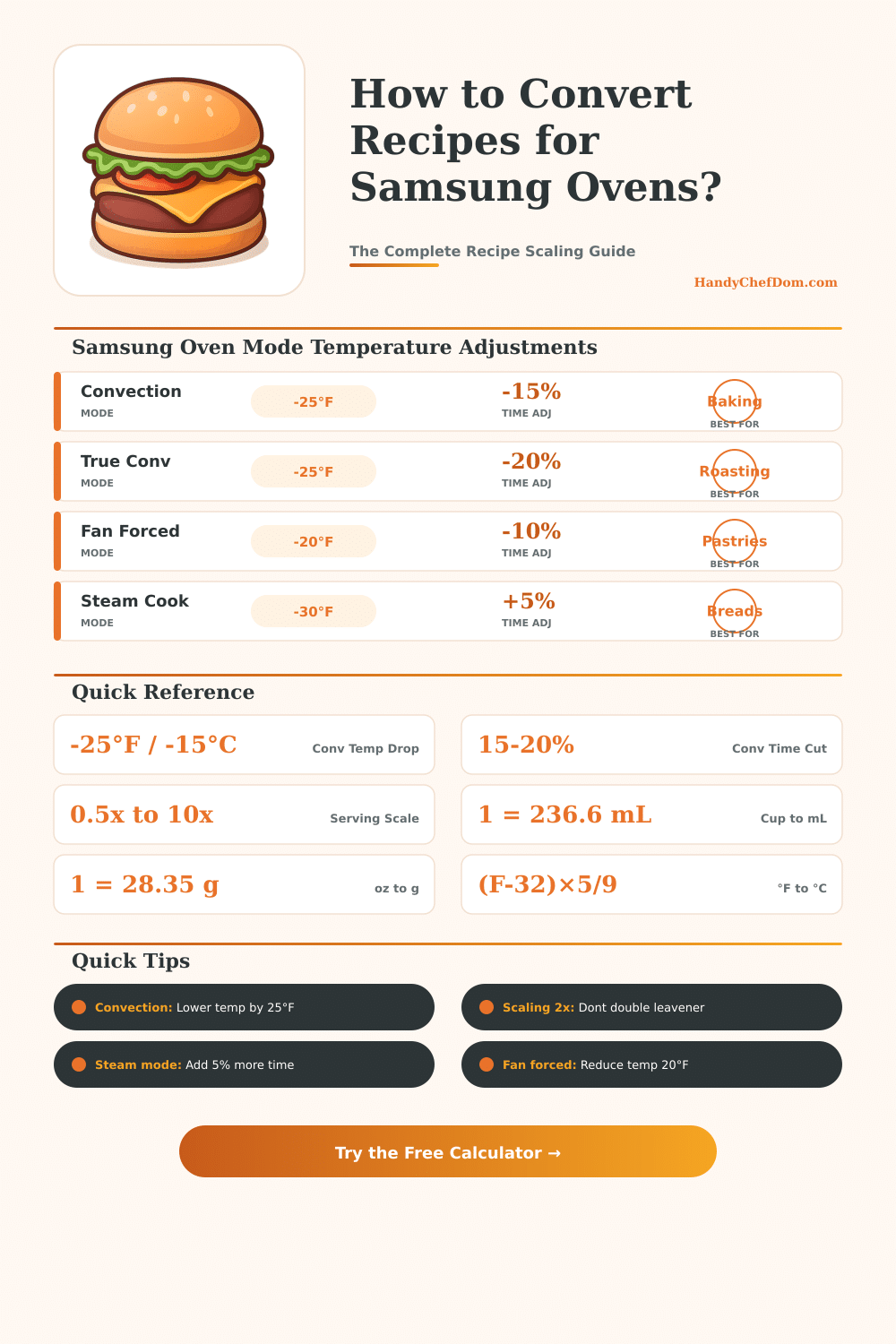
| Conversion | Temp Adjustment (°F) | Temp Adjustment (°C) | Time Adjustment |
|---|---|---|---|
| Conventional → Convection | -25°F | -15°C | -15% |
| Conventional → True Convection | -25°F | -15°C | -20% |
| Conventional → Fan Forced | -20°F | -10°C | -10% |
| Conventional → Steam Cook | -30°F | -15°C | +5% |
| Convection → Conventional | +25°F | +15°C | +15% |
| True Convection → Conventional | +25°F | +15°C | +20% |
| Fan Forced → Conventional | +20°F | +10°C | +10% |
| Steam Cook → Conventional | +30°F | +15°C | -5% |
| Imperial | Metric | Imperial | Metric |
|---|---|---|---|
| 1 cup | 236.6 mL | 1 oz | 28.35 g |
| 1 tbsp | 14.79 mL | 1 lb | 453.6 g |
| 1 tsp | 4.93 mL | 1 fl oz | 29.57 mL |
| 1 quart | 946.4 mL | 1 gallon | 3.785 L |
| 1/4 cup | 59.15 mL | 8 oz | 226.8 g |
| 1/3 cup | 78.86 mL | 16 oz | 453.6 g |
| 1/2 cup | 118.3 mL | 2.2 lbs | 1 kg |
| Scale Factor | Baking Powder Adj. | Baking Soda Adj. | Yeast Adj. |
|---|---|---|---|
| 0.5x (half) | Use 0.5x | Use 0.5x | Use 0.6x |
| 1.5x | Use 1.25x | Use 1.25x | Use 1.3x |
| 2x (double) | Use 1.5x | Use 1.5x | Use 1.5x |
| 3x (triple) | Use 2x | Use 2x | Use 2x |
| 4x | Use 2.5x | Use 2.5x | Use 2.5x |
| 5x+ | Use 3x max | Use 3x max | Use 3x max |
| Food Type | Conventional Rack | Convection Rack | Notes |
|---|---|---|---|
| Cookies / Pastries | Middle | Any (multi-rack OK) | Rotate halfway |
| Cakes | Middle | Middle | Lower temp 25°F |
| Roast Meats | Lower-middle | Lower-middle | Use probe |
| Casseroles | Middle | Middle | Cover first half |
| Pizza | Lower | Lower | Use pizza stone |
| Broiling | Upper | Upper | Door ajar 2 in |
Samsung convection oven work a bit more hot than usual oven so I found it useful to lower the time by around 25 degrees Fahrenheit, what matches almost 15 degrees Celsius. When one uses them, the duration of cook must be a bit shorter, by 15 to 20 percent, whether one chooses the average convection or the stronger rule called Real Convection. This last indeed spreads the heat greatly, because of what I noticed almost 20 percent reduction of the involved time for baking.
Adapting recipes can become difficult. When one doubles the amount, it is enough to expand the amount of risers like baking powder only by 1.5 times, not by the whole double. For triple scale, limit the baking powder to maximum 2 times.
Simple Tips for Convection Ovens and Changing Recipe Size
Do not forget, that one cup matches around 237 milliliters, while tablespoons are only under 15 milliliters, those tiny differences in measurement truly add up, when one prepares for 10 or 12 servings. The mode called Fan requires no such dramatic lowering of temperature, more like 20 degrees Fahrenheit and only 10 percent reduction of time. On the otehr hand, Steam Kitchen adds around 5 percent to the cooking duration, but lowers the time by 30 degrees Fahrenheit.
The information below does not come from any computer device… It is based on real experiences of users, discussions in forums and opinions from cooking communities across the net.
recipe converters form very handy tools in the kitchen, that allow you to easily multiply, share or adapt recipes according too your wanted amount of product or servings. One sometimes calls them scalers for recipes or tuners for servings. The main idea stays simple: simply enter or copy the original ingredients, and the program immediately changes everything.
The math for conversion is totally basic. Take the wanted number of servings, divide it by the amount of the original recipe and use that ratio as a multiplier. For instance, if a recipe serves 10 folks, but you want only 4, the factor is 0.4.
So if it requires 3 tablespoons of something, multiplied by 0.4 gives 1.2 tablespoons for your reduced version.
The best free calculators for recipe conversions fit to handle every type of amount in ingredients, whether weight, volume or other units. They do the fraction calculations without pause, so that adapting a recipe for any group of folks becomes easy. Some even allow you to enter the whole recipe at once for one conversion.
Conversion charts are also very useful. They show, for instance, that one cup of flour weighs around 150 grams, or that one cup of sugar has about 200 grams. For common cooking liquids, simple matching between milliliters and grams works well.
Baking is science, so accuracy matters truly.
A personal chart for recipe conversions at hand helps hugely when one halves or thirds recipes. Simply stick it to the fridge or in a cabinet, and you can shrink a recipe without any tricky math efforts.
One thing to recall: recipes become sensitive when the conversion factor moves too far from one, for instance more than tripling of the original. In such cases, it is better to prepare several small sets instead of one huge one.
Some apps for cooking take recipe conversions even further to the next level. They work as a personal organizer for recipes, with full tools like calculators, converters for measures and settings for servings. You can expand or shrink recipes without effort.
Some even automatically change volume units to weights for basic ingredients.
I like apps that can download recipes directly from pages on the net and import them, without need of manual typing. One of them, called Measury, has a great main function for recipe conversions. And the apps of NYT Cooking offer a new tool for metric conversions, though it does not always translate tablespoons and teaspoons.
When I find a recipe that pleases me truly, I print the adapted version and add notes for the next times, for instance, increase the flour in dough for cookies. That forms an excellent way to keep adapted recipes, whether expanded or shrunk, for many uses.
These tools for converting recipes truly work, even for difficult foods. They remove the need of blind tries foradapting the recipe to the amount that you cook for.