🍺 Secondary Fermentation Sugar Calculator
Calculate the exact amount of priming sugar needed for perfect carbonation in beer, cider, or kombucha
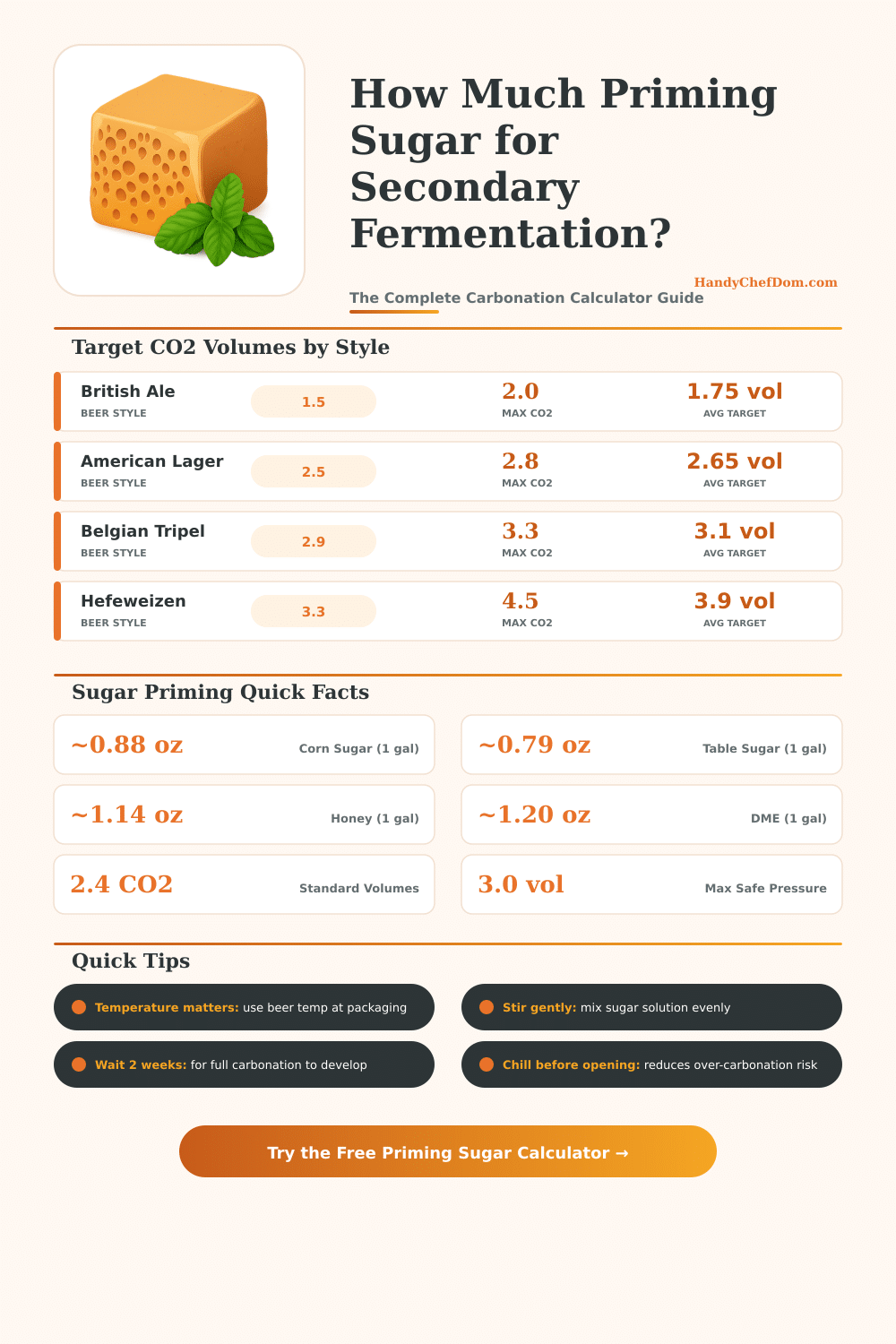
| Beer Style | Min CO₂ | Max CO₂ | Recommended | Notes |
|---|---|---|---|---|
| British Bitter / Mild | 1.5 | 2.0 | 1.75 vol | Low carbonation, cask style |
| Porter / Stout | 1.7 | 2.3 | 2.0 vol | Moderate, dry finish |
| American Ale / IPA | 2.2 | 2.7 | 2.4 vol | Standard US carbonation |
| American Lager | 2.5 | 2.8 | 2.65 vol | Crisp and effervescent |
| Saison / Farmhouse | 2.8 | 3.5 | 3.1 vol | Highly carbonated |
| Belgian Tripel / Golden | 2.9 | 3.3 | 3.1 vol | Champagne-like mousse |
| Hefeweizen / Wit | 3.3 | 4.5 | 3.9 vol | Very high, traditional style |
| Hard Cider | 2.0 | 2.8 | 2.4 vol | Varies by style preference |
| Kombucha (2nd Ferm) | 2.0 | 3.0 | 2.5 vol | Watch for over-carbonation |
| Fruit Beer | 2.0 | 2.5 | 2.2 vol | Subtle carbonation preferred |
| Sugar Type | Fermentability | CO₂ Factor | Notes |
|---|---|---|---|
| Corn Sugar (Dextrose) | 100% | 1.00x (baseline) | Most predictable, homebrew standard |
| Table Sugar (Sucrose) | 100% | 0.91x | Slightly denser; works very well |
| Dry Malt Extract (DME) | ~75% | 0.74x | Adds slight malt character |
| Honey | ~95% | 0.77x | Variable sugar content (~77% sugar) |
| Brown Sugar | 100% | 0.89x | Adds subtle molasses flavor |
| Maple Syrup | ~95% | 0.60x | ~60% sugar by weight; subtle maple |
| Turbinado / Raw Sugar | 100% | 0.91x | Similar to table sugar; slightly nutty |
| Rice Sugar | 100% | 0.91x | Very clean, neutral flavor |
| Temp (°F) | Temp (°C) | Residual CO₂ (vol) | Typical Use |
|---|---|---|---|
| 35°F | 2°C | 1.09 vol | Cold crash / lagering |
| 40°F | 4°C | 1.00 vol | Refrigerator conditioning |
| 50°F | 10°C | 0.88 vol | Lager fermentation |
| 60°F | 16°C | 0.78 vol | Cool ale fermentation |
| 65°F | 18°C | 0.74 vol | Standard ale temp |
| 68°F | 20°C | 0.72 vol | Common room temperature |
| 72°F | 22°C | 0.70 vol | Warm room / summer ale |
| 78°F | 26°C | 0.66 vol | Belgian high-temp fermentation |
Sugars belong to the group of sweet, soluble carbohydrates that appear in foods almost everywhere. Here the basic kinds… Glucose, fructose and galactose, that is separate molecules working alone.
Also exist combined forms, when two basic sugars join to create a disaccharide. While you eat carbohydrates, the body breaks them into those basic sugars, especially glucose, that burns soon to give energy. Truly this is the essence of sugar, it serves as fuel and appears in many different tastes.
Sugar: What It Is, Where It Comes From, and How It Affects Your Body
Naturally sugar appears in various places, for instance in fruits, where fructose features, or in lactose of milk. Fructose from fruits indeed refills the glycogen reserves of the liver, what is useful for sleep more well or for rest after long tiring exercise. Every cell in your body requires energy from carbohydrates, and sugars simply help that; yes, that includes also cancerous cells.
Even so, stay calm, eating sugar does not casue cancer.
Here where everything becomes interesting: sugar switches a key in your brain, that triggers dopamine and other brain pathways. Dopamine is basically the enjoyable button, what shows, why sweets feel like this satisfying during a meal. That feeling of reward is real and strong.
When dealing about the amount of sugar, that you should pick, it matters too make a point. Free sugars, those added to products, together with naturally happening in honey, syrups and fruit juices without extra sugar, should not pass 5 percent of your whole everyday energy. The most many healthy guides point around 25 grams of added sugar a day for women, during men aim for 36 grams.
For foods, stay under 10 grams seems the sweet spot, pun intended. Too much sugar links to diabetes of type 2 and heart disease, what deserves to think. The typical American eats more than 17 spoons of added sugar each day (almost twice the suggested).
Cutting down sugary drinks to less than one serving weekly is another good idea.
Here commonly where folks err: the size of a serving makes a big difference during tracking of sugar. What appears on the label can be only half or third of what truly ends in your bowl. If you eat double than the pointed serving, you receive double sugar.
Now labels show added sugars in grams and as percentage of the everyday value, and they include the information about calories and servings to ease the sight.
For cooking and baking, the options for sugars seem endless. Brown sugar gives rich taste, that white sugar simply does not have. You can prepare light brown type by means of one tablespoon of molasses for one cup of white sugar, or darker with two tablespoons.
Switching between light-brown and dark-brown usually will not destroy your recipe in any way. Turbinado is a rough, less processed option, that adds pleasant crunch to cookies and cakes. Another choice is muscovado, because it keeps its natural molasses.
Maple sugar has wonderful taste, but costs a lot to the purse, so save it for special occasions. One final comment… Fermentation does not truly require sugar to work, because it wellferments flour alone.