🔥 Smoker Cooking Time Calculator
Estimate smoking duration for any cut of meat with precision
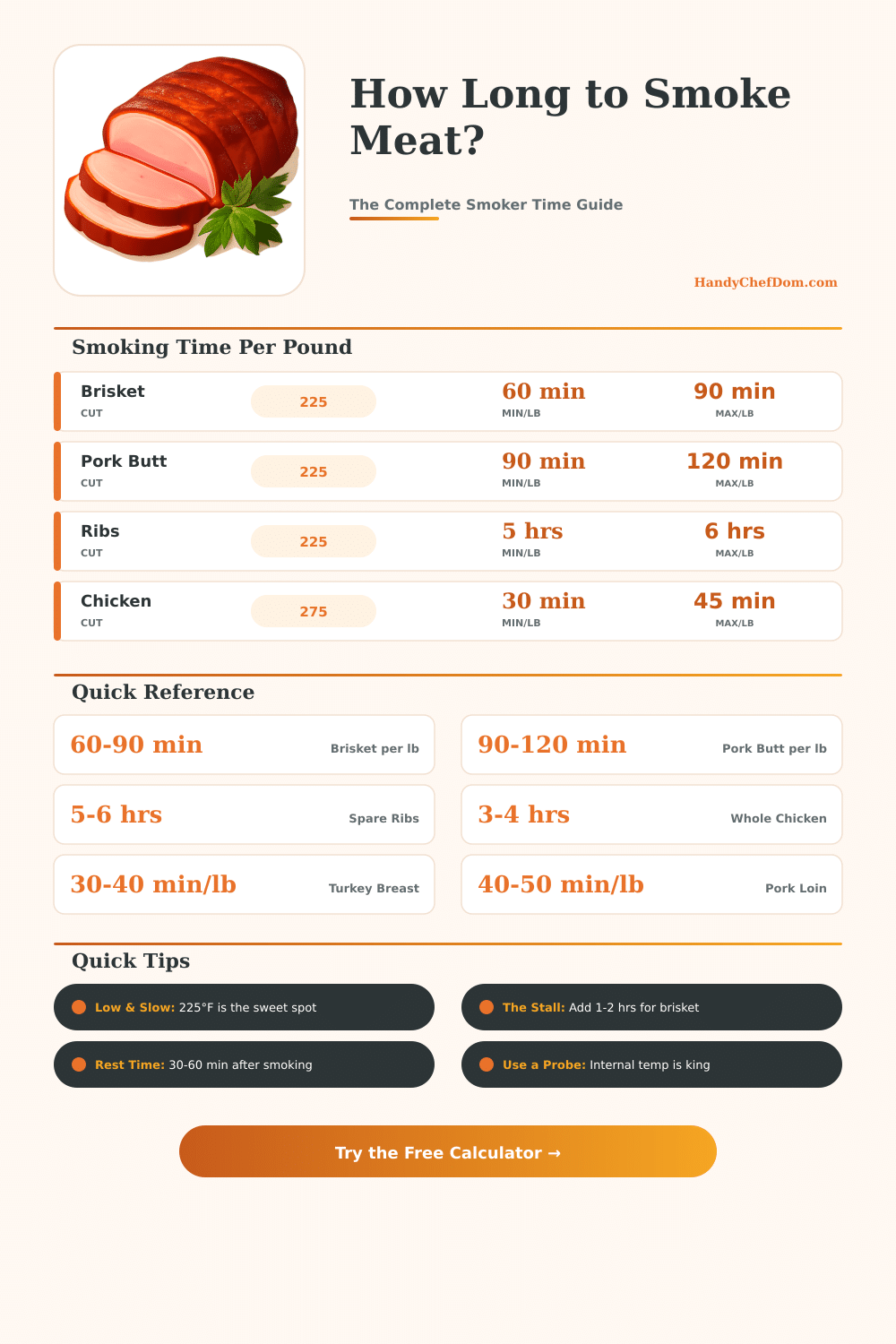
| Meat Cut | Temp (°F) | Min/lb | Max/lb | Target Internal °F |
|---|---|---|---|---|
| Whole Brisket | 225 | 60 min | 90 min | 200–205 |
| Brisket Flat | 225 | 60 min | 75 min | 200–205 |
| Pork Butt | 225 | 90 min | 120 min | 195–205 |
| Pork Loin | 225 | 40 min | 50 min | 145 |
| Baby Back Ribs | 225 | 5 hrs* | 6 hrs* | 190–203 |
| Spare Ribs | 225 | 5 hrs* | 6 hrs* | 190–203 |
| Whole Chicken | 275 | 30 min | 45 min | 165 |
| Turkey Breast | 275 | 30 min | 40 min | 165 |
| Whole Turkey | 275 | 25 min | 35 min | 165 |
| Chuck Roast | 225 | 60 min | 90 min | 195–205 |
| Tri-Tip | 225 | 30 min | 40 min | 130–135 |
| Beef Short Ribs | 250 | 6 hrs* | 8 hrs* | 200–210 |
| Salmon Fillet | 225 | 30 min* | 45 min* | 145 |
| Pork Belly | 250 | 60 min | 75 min | 195–200 |
| Lamb Shoulder | 225 | 75 min | 90 min | 195–205 |
| Category | Target °F | Target °C | Doneness |
|---|---|---|---|
| Brisket / Pork Butt | 195–205 | 91–96 | Probe tender |
| Pork Loin | 145 | 63 | Medium |
| Ribs (Pork) | 190–203 | 88–95 | Fall off bone |
| Beef Short Ribs | 200–210 | 93–99 | Probe tender |
| Chicken / Turkey | 165 | 74 | Fully cooked |
| Tri-Tip (Medium Rare) | 130–135 | 54–57 | Medium rare |
| Salmon | 145 | 63 | Flaky |
| Lamb Shoulder | 195–205 | 91–96 | Shreddable |
| Pounds (lb) | Kilograms (kg) | Ounces (oz) | Grams (g) |
|---|---|---|---|
| 1 | 0.45 | 16 | 454 |
| 2 | 0.91 | 32 | 907 |
| 5 | 2.27 | 80 | 2,268 |
| 8 | 3.63 | 128 | 3,629 |
| 10 | 4.54 | 160 | 4,536 |
| 12 | 5.44 | 192 | 5,443 |
| 15 | 6.80 | 240 | 6,804 |
| 20 | 9.07 | 320 | 9,072 |
| Meat Cut | Yield % | 1 lb Raw Yields | 1 kg Raw Yields |
|---|---|---|---|
| Whole Brisket | 50% | 8 oz cooked | 500 g cooked |
| Pork Butt | 55–60% | 9 oz cooked | 550 g cooked |
| Pork Ribs | 50–55% | 8 oz cooked | 500 g cooked |
| Whole Chicken | 65–70% | 10.5 oz cooked | 675 g cooked |
| Turkey Breast | 70–75% | 11.5 oz cooked | 725 g cooked |
| Chuck Roast | 55–60% | 9 oz cooked | 550 g cooked |
| Tri-Tip | 70–75% | 11.5 oz cooked | 725 g cooked |
| Salmon | 80–85% | 13 oz cooked | 825 g cooked |
| Context | Cooked oz/Person | Cooked g/Person | Raw Needed (lb/Person) |
|---|---|---|---|
| Main Course (pulled pork) | 6–8 oz | 170–225 g | 0.5–0.67 lb |
| Main Course (brisket) | 6–8 oz | 170–225 g | 0.75–1 lb |
| Buffet (mixed meats) | 4–5 oz | 115–140 g | 0.33–0.5 lb |
| Ribs per person | 3–4 ribs | ~340 g raw | 0.75 lb |
| Chicken (whole) | 6–8 oz | 170–225 g | 0.5–0.6 lb |
| Appetizer portion | 2–3 oz | 55–85 g | 0.2–0.25 lb |
A 12 lb packer brisket at 225 degrees takes anywhere from 12 to 18 hours, and I didnt expect that range to be so wide until Ive run through about a dozen cooks myself. Pork butt is even slower per pound, roughly 90 to 120 minutes each pound at that same temp. Wrapping in foil shaves off about 15% of total cook time, which on a long brisket smoke saves you 2 to 3 hours easily.
The information below does not come from some computer program or tool. It is based on real knowledge, discussions in forums and shared experiences of communities that one finds everywhere on the net.
How Long to Smoke Meat and How Much to Serve
Barbecue, or simply BBQ, is a short word for that way of cooking and it is spelled in many different ways. For instance Bar-B-Q, BarBQ, Bar-B-Que or Bar-B-Cue; the variations do not end. Basically it is made up of a cooking method that uses low fire and smoke to prepare foods.
However the precise meaning changes according to the place where one lives. In many regions of the world, what truly deserves the name barbecue, stays the cause of heated rows.
In Australia one considers BBQ everything that cooks on a grill or above flame outside, or as they say, “cooked on the barbie.” Typical foods include sausages (that they call snags), steaks, sticks of chicken, chops of sheep and hamburgers. Whether one uses propane or coal, that dose not matter too much.
In a typical American restaurant about barbecue one finds on the menu beef brisket, pork ribs, beef ribs, chicken, pulled pork and hot dogs. All they are smoked or cooked a bit slowly. One prepares pulled pork usually from pork butt or pork shoulder, that commonly has bones inside.
Normal pork butt weighs between seven and ten pounds, and gives around fifty percent of product. Like this, a ten-pound raw pork butt results in around seven pounds of finished pulled pork.
When one plans, how much food to serve, that matters a lot. For one person the good amount of raw meat is half to three-quarter pounds. Children most probably will eat only around a quarter pound of meat.
It is smart to plan for one and half servings each guest, because many folks want to add a second. During smoking brisket loses between thirty and fifty percent of its wait, so one must compensate for that. When also other dishes will serve, around five to six ribs for one person works well.
Side dishes play a big role. At big festivals each guest will eat around one cup from every side. For a home meal half a cup each person for every side is more usual.
It always helps to have hamburger patties and hot dogs in the refrigerator as backup for unexpected guests or wayward children.
Smoking requires a lot of time. A brisket of sixteen to eighteen pounds requires around eighteen hours. A Boston butt of twelve to fifteen pounds cooks in about twelve hours.
If one tries to rush the process, one risks serving raw meat, what truly embarrasses.
Ribs, pulled pork, hamburgers and hot dogs go well with homemade baked beans. Grilled corn cobs with butter and a rub of BBQ make a good finish. Pineapple, papaya and mango grilled go well with pork, chicken or fish straight from the grill.
Forums on the net about barbecue store more than nine hundredthousand messages, what only shows the big passion of the community.