🌾 Soluble Fiber Calculator
Get your personalized daily soluble fiber target based on age, sex & health goals
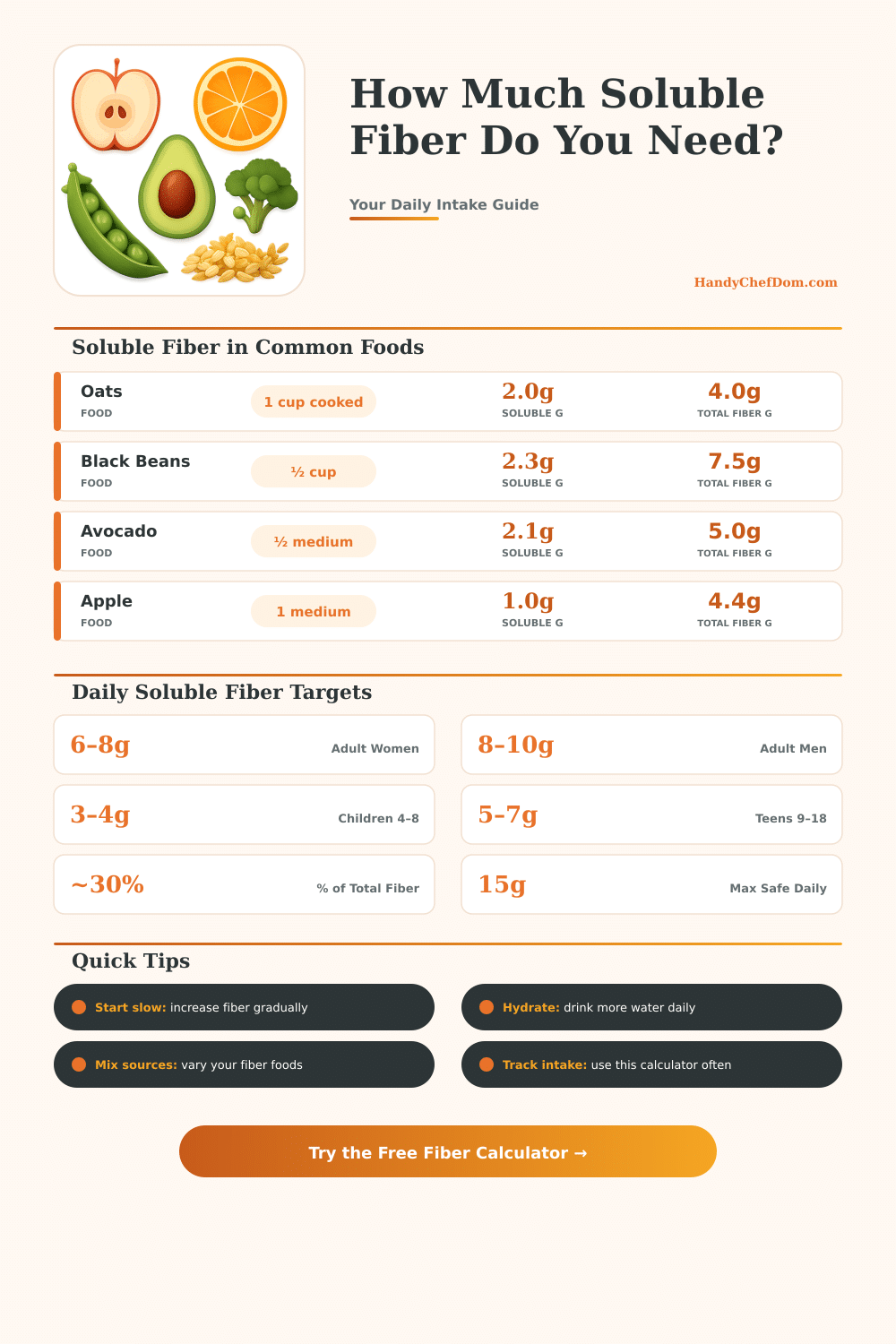
| Food | Serving Size | Soluble Fiber (g) | Total Fiber (g) | Soluble % |
|---|---|---|---|---|
| Oats (cooked) | 1 cup (234g) | 2.0 | 4.0 | 50% |
| Oat Bran (cooked) | ½ cup (110g) | 2.2 | 2.9 | 76% |
| Black Beans (cooked) | ½ cup (86g) | 2.3 | 7.5 | 31% |
| Kidney Beans | ½ cup (89g) | 2.5 | 5.7 | 44% |
| Lentils (cooked) | ½ cup (99g) | 1.8 | 7.8 | 23% |
| Chickpeas (cooked) | ½ cup (82g) | 1.3 | 6.2 | 21% |
| Avocado | ½ medium (75g) | 2.1 | 5.0 | 42% |
| Apple (with skin) | 1 medium (182g) | 1.0 | 4.4 | 23% |
| Pear (with skin) | 1 medium (178g) | 1.5 | 5.5 | 27% |
| Orange | 1 medium (131g) | 1.8 | 3.1 | 58% |
| Banana | 1 medium (118g) | 0.7 | 3.1 | 23% |
| Psyllium Husk | 1 tbsp (9g) | 6.0 | 7.0 | 86% |
| Flaxseeds (ground) | 2 tbsp (14g) | 1.1 | 3.8 | 29% |
| Chia Seeds | 2 tbsp (28g) | 2.0 | 9.8 | 20% |
| Brussels Sprouts | 1 cup cooked (156g) | 2.0 | 4.1 | 49% |
| Broccoli (cooked) | 1 cup (156g) | 1.5 | 5.1 | 29% |
| Sweet Potato | 1 medium (130g) | 1.8 | 3.8 | 47% |
| Barley (cooked) | ½ cup (79g) | 1.0 | 3.0 | 33% |
| Age Group | Sex | Total Fiber (g/day) | Soluble Fiber (g/day) | Insoluble (g/day) |
|---|---|---|---|---|
| 1–3 years | All | 19 | 5–6 | 13–14 |
| 4–8 years | All | 25 | 7–8 | 17–18 |
| 9–13 years | Female | 26 | 7–8 | 18–19 |
| 9–13 years | Male | 31 | 8–10 | 21–23 |
| 14–18 years | Female | 26 | 7–8 | 18–19 |
| 14–18 years | Male | 38 | 10–12 | 26–28 |
| 19–50 years | Female | 25 | 6–8 | 17–19 |
| 19–50 years | Male | 38 | 10–12 | 26–28 |
| 51–70 years | Female | 21 | 6–7 | 14–15 |
| 51–70 years | Male | 30 | 8–10 | 20–22 |
| 70+ years | Female | 21 | 5–7 | 14–16 |
| 70+ years | Male | 30 | 7–9 | 21–23 |
| Pregnant | Female | 28 | 7–9 | 19–21 |
| Breastfeeding | Female | 29 | 8–10 | 19–21 |
| Health Goal | Recommended Soluble Fiber | Primary Source | Reference |
|---|---|---|---|
| Lower LDL Cholesterol | 5–10g / day | Oats, psyllium, barley | AHA / FDA |
| Blood Sugar Control | 10–25g / day | Legumes, oats, fruits | ADA Guidelines |
| IBS – Diarrhea dominant | 3–5g / day | Psyllium, oats | ACG Guidelines |
| IBS – Constipation | 6–10g / day | Psyllium, flaxseed | ACG Guidelines |
| Weight Management | 8–12g / day | Legumes, avocado, oats | NIH Research |
| Heart Health | 10–15g / day | Oats, beans, flaxseed | AHA Nutrition |
| General Wellness | 6–10g / day | Variety of plant foods | IOM / USDA |
Fiber has two main kinds, and Soluble fiber forms only part of them. The other fiber makes up the biggest part of the rest. Both kinds are useful for your health although they work in entirely different ways.
Basically, fiber is made up of carbs from plants, and here is the key: your body does not get to truly digest or absorb it like it does normal food. Rather, it simply passes through your body and ultimately leaves.
Soluble Fiber: How It Helps and Where to Find It
What separates Soluble fiber is its ability to dissolve when it meets water. So, when you eat it, it arrives in your belly, absorbs water and turns into a gel-like mass. That thick stuff indeed slows the digestion, which results in benefits.
Because of the slower movement of everything, you feel full for a longer tiem after a meal. Moreover, the level of sugar in blood does not spike as quickly, because your body does not manage to break down Soluble fiber like other carbs.
Here is another bonus: Soluble fiber binds with cholesterol in your bowel. That allows your body to remove it instead of absorbing it. According to studies, getting between five and ten grams of Soluble fiber daily can help lower the bad cholesterol.
Such drops also reduce the risk of hart disease. Most experts advise around six to eight grams of fiber from Soluble sources daily.
Finding sources of Soluble fiber is pretty easy. Oats, oat bran, barley, nuts, seeds, beans and lentils all have it. Peas work well, just like some fruits and vegetables.
Apples, bananas, avocados and citrus fruits are good options. Black beans are full of it in a tasty way… They have pectin, that becomes gummy when it touches water.
Chickpeas are another good choice. One cup of cooked chickpeas gives more than four grams of Soluble fiber, or at least that.
Psyllium bark is almost all Soluble fiber. It breaks down slowly, so the gel-like mass stays around the whole gut instead of breaking early. Chia and flax seeds provide both kinds of fiber at the same time.
Really the Soluble fiber gives oatmeal that smooth texture and makes flax seeds thicken recipes.
Cooking does not destroy fiber, that is worth knowing. Soluble fiber absorbs water during cooking, staying unchanged. Interestingly, a bit of other fiber can shift and become more soluble after cooking, which maybe makes certain vegetables easier to digest.
Most plants carry both types in different amounts. Eating a variety of whole plant foods will naturally cover both kinds without needing to obsess about exact amounts. Soluble fiber also works as a prebiotic, feeding theuseful bacteria in your bowels.