🍞 Sourdough Hydration Calculator
Calculate exact hydration percentage & adjust flour/water for your perfect loaf
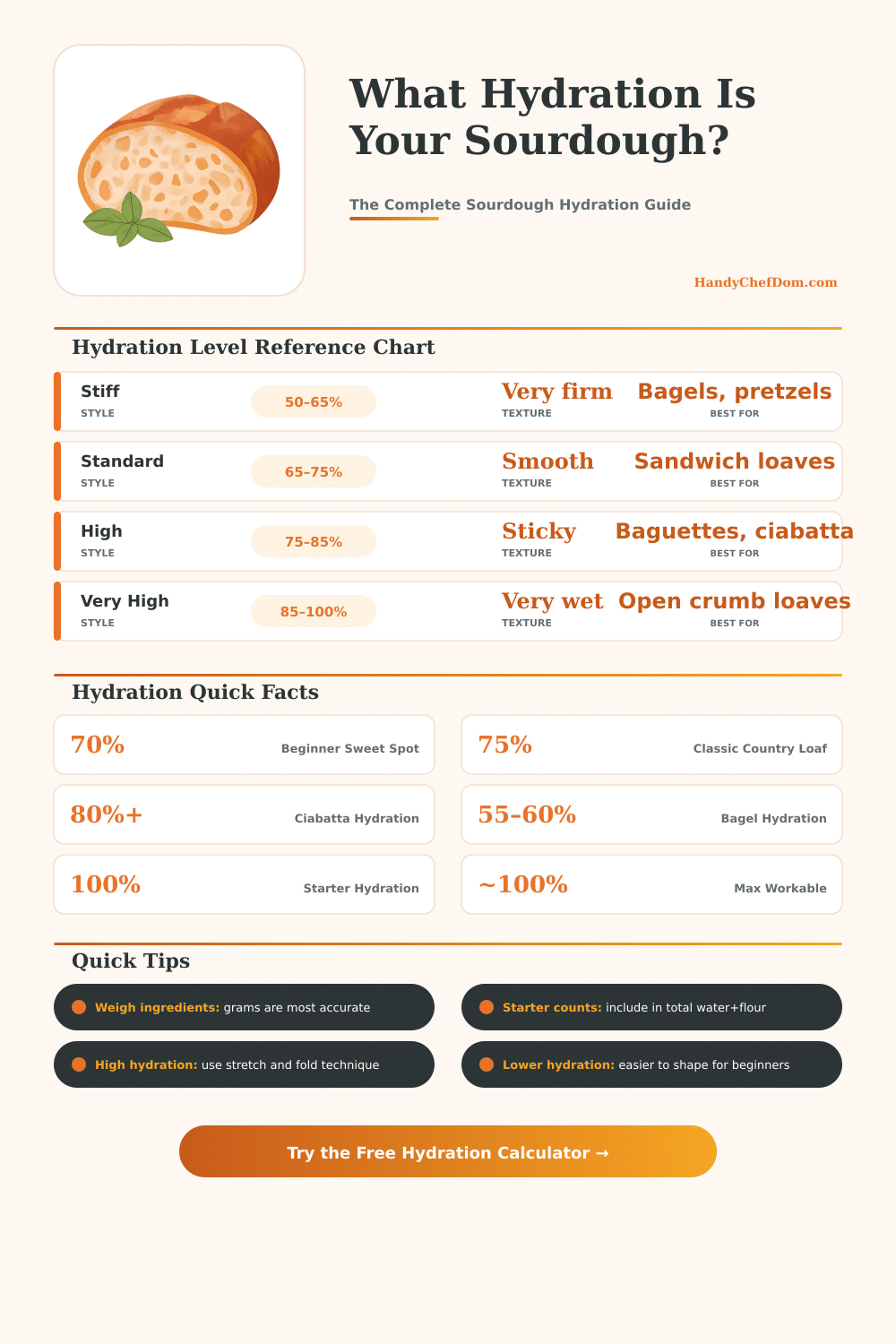
| Hydration Level | % Range | Dough Texture | Best For | Difficulty |
|---|---|---|---|---|
| Very Stiff | 50–60% | Firm, non-sticky | Bagels, pretzels, crackers | ⭐ Beginner |
| Standard | 60–70% | Smooth, workable | Sandwich loaves, pizza | ⭐⭐ Easy |
| Moderate | 70–78% | Slightly tacky | Country loaves, baguettes | ⭐⭐⭐ Moderate |
| High | 78–85% | Sticky, slack | Tartine, open-crumb loaves | ⭐⭐⭐⭐ Challenging |
| Very High | 85–100% | Very wet, loose | Ciabatta, focaccia | ⭐⭐⭐⭐⭐ Advanced |
| Ultra High | 100%+ | Batter-like | 100% starters, experiment | ⚠ Expert Only |
| Starter Type | Flour | Water | Hydration | Characteristics |
|---|---|---|---|---|
| Stiff starter | 100g | 50g | 50% | Firm, slow ferment, less sour |
| Firm starter | 100g | 65g | 65% | Holds shape, balanced flavor |
| Standard starter | 100g | 100g | 100% | Most common, easy to maintain |
| Liquid starter | 100g | 125g | 125% | Very active, more sour flavor |
| Poolish-style | 100g | 150g | 150% | Very runny, fast fermentation |
| Loaf Size | Flour (g) | Flour (oz) | At 70% | At 75% | At 80% |
|---|---|---|---|---|---|
| Small loaf | 300g | 10.6 oz | 210g water | 225g water | 240g water |
| Standard loaf | 500g | 17.6 oz | 350g water | 375g water | 400g water |
| Large loaf | 700g | 24.7 oz | 490g water | 525g water | 560g water |
| Double batch | 1000g | 35.3 oz | 700g water | 750g water | 800g water |
- Salt: Typically 1.8–2.2% of flour weight (9–11g per 500g flour)
- Starter: Usually 10–25% of flour weight (50–125g per 500g flour)
- Water: Your target hydration % of flour weight
- Tip: Increase hydration by 2–3% when using whole wheat flour
| Grams (g) | Ounces (oz) | Cups (approx. flour) | Cups (approx. water) |
|---|---|---|---|
| 100g | 3.53 oz | ~0.8 cups | ~0.42 cups |
| 250g | 8.82 oz | ~2 cups | ~1.06 cups |
| 500g | 17.64 oz | ~4 cups | ~2.11 cups |
| 750g | 26.46 oz | ~6 cups | ~3.17 cups |
| 1000g | 35.27 oz | ~8 cups | ~4.23 cups |
Sourdough bread is made up of dough, that rises naturally. Rather than use store lever or aids like baking powder or baking soda, one depends on sourdough culture for the rise. Sourdough culture forms a live mix of flour and water.
In it live natural yeasts and bacteria that help the dough rise. During fermentation one produces lactic acid, and that gives the bread its special taste.
How Sourdough Bread Is Made
Wild yeasts and bacteria in the culture come from various species, that float in the air of the kitchen. Basically, culture is a mix of flour, water, wild yeasts, bacteria and organic acids. One can prepare it at home from just flour, buy it or receive it as a gift from another baker.
There are a lot of diferent kinds of such cultures.
Rise forms the core of sourdough baking. Getting the time of fermentation right decides if the breads come out well shaped. More easily learns one fold, form and develop the gluten.
Rise stays the tricky element, that requires experience too control it.
A basic recipe for sourdough bread uses mainly bread flour, with a bit of whole grain flour to add taste and detail. The share of whole grain ranges according to the available flours. For newcomers, strong white bread flour of good quality works great as a start.
An easy ratio to recall is 1:2:3 for sourdough dough. It means one part of culture, two parts of water and three parts of flour, everything weighed and not by volume. Salt is added at two percent of the flour weight.
For example: 100 g culture, 200 g water, 300 g flour and 6 g salt.
Sourdough focaccia ranks among the simplest recipes for sourdough baking. It requires basic ingredients, some folds and enough time to rise. Sourdough culture does not limit to bread; it works for muffins, crepes and cakes also.
Sourdough baking is fun. It feels like doing science work in the kitchen. Anyone can make sourdough bread.
It is about feeding the culture, mixing the dough and watching the rise in the bowl. At first one only slowly learns thewhole process. After one succeeds, everything becomes natural.