🍞 Sourdough Starter Feeding Calculator
Calculate exact flour, water & hydration ratios for a healthy, active starter
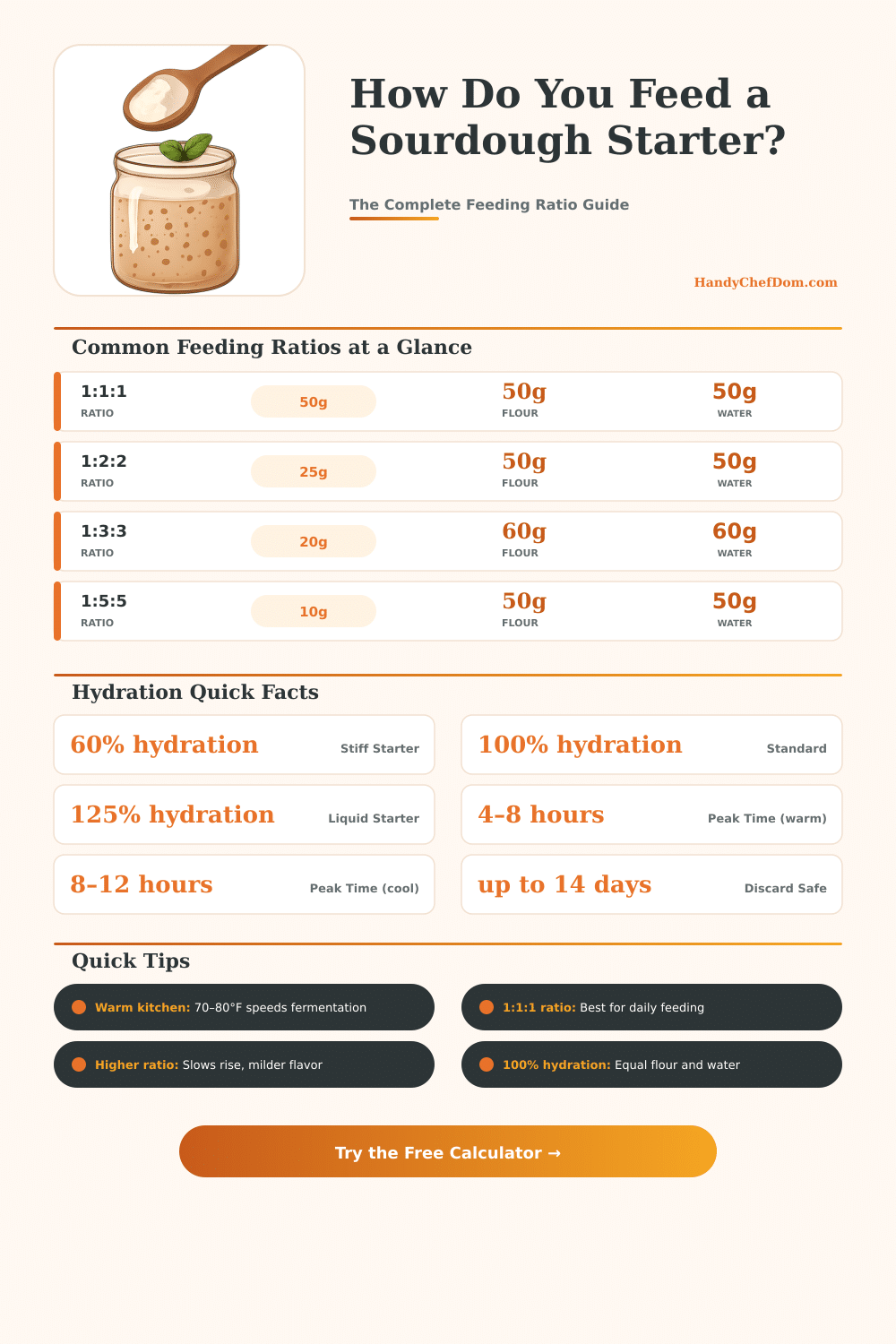
| Ratio (S:F:W) | Best For | Peak Time (70°F) | Starter Flavor |
|---|---|---|---|
| 1:1:1 | Daily maintenance | 4–6 hrs | Tangy & active |
| 1:2:2 | Regular feeding | 6–8 hrs | Balanced |
| 1:3:3 | Pre-bake boost | 8–10 hrs | Mild |
| 1:4:4 | Overnight schedule | 10–12 hrs | Very mild |
| 1:5:5 | Extended overnight | 12–16 hrs | Very mild |
| 1:10:10 | Long cold retard | 18–24 hrs | Near neutral |
| Hydration | Flour | Water | Type |
|---|---|---|---|
| 60% | 100g | 60g | Stiff |
| 80% | 100g | 80g | Firm |
| 100% | 100g | 100g | Standard |
| 125% | 100g | 125g | Liquid |
| 150% | 100g | 150g | Very Liquid |
| Grams (g) | Ounces (oz) | Cups (approx) | Tbsp |
|---|---|---|---|
| 10g | 0.35 oz | — | ~0.7 tbsp |
| 25g | 0.88 oz | — | ~1.7 tbsp |
| 50g | 1.76 oz | ~¼ cup | ~3.4 tbsp |
| 100g | 3.53 oz | ~½ cup | ~6.8 tbsp |
| 200g | 7.05 oz | ~1¼ cup | ~13.5 tbsp |
| Flour Type | Absorption | Recommended Hydration | Notes |
|---|---|---|---|
| All-Purpose | 55–65% | 95–105% | Standard baseline |
| Bread Flour | 60–70% | 100–110% | Higher protein, absorbs more |
| Whole Wheat | 65–75% | 80–90% | Reduce water 10–15% |
| Rye | 70–85% | 100–125% | Very thirsty, boosts activity |
| Spelt | 55–65% | 80–95% | Fragile gluten, less water |
| Gluten-Free | 70–90% | 100–120% | Varies by blend |
The Sourdough starter for sour bread is made up of live culture, that prepares from simply flour and water. It attracts natural yeast that naturally lives in the flour itself and in the surrounding air. One cares for this mix by means of regular feedings, so that it stay active and can be used for bread making without store yeast.
It also bears various names, like “mother” or “starter culture“.
How to Make and Use a Sourdough Starter
To create such a Sourdough starter from nothing requires around seven days or even more time. It does not happen fast. Usually one starts the process by means of whole wheat flour, to quickly start the fermentation.
Later, one uses regular whole wheat flour or bread flour, to feed and strengthen the culture. On the first day, one mixes flour with water in a safe bowl, for instance from glass, stainless steel or plastic container. A jar with capacity of 250 to 500 milliliters works fine.
Here enters the feeding, that forms the daily habit. One dumps half of the Sourdough starter, and later adds fresh flour together with lukewarm water, until the mix becomes smooth. The jar one covers and leaves to rest for another 24 hours in lukewarm room temperature.
It is enough to feed every day once, although some recipes suggest twice every 12 hours. After two weeks of faithful feeding, the Sourdough starter should have nice smell and be ready for use in baking. If one waits only a weak, the culture can be yet too weak to give good rise to the bread.
A live Sourdough starter doubles its volume during four to six hours after feeding. It should smell slightly sour, but not unpleasant. The surface should be bubbly and airy, while it passes the float test.
Bubbles at the surface, sweet yeasty smell with a hint of yoghurt, and clear doubling of the size all point to good state.
Regular white whole wheat flour can give a working Sourdough starter, if one gives time and regular feeding. It is not absolutely needed to use special kinds, although the choice of flour affects the speed and the taste. The Sourdough starter is only as “fresh” as how much time passed since the last feeding, so that age does not matter truly, despite some sales claims.
Do not bother to spend money for something sold as “very ancient”.
One also can buy a Sourdough starter or get it as a gift from another baker. Buying live culture online is a good option, and many arrive already almost ready for use in baking. For long term storage, drying works better than freezing.
The dumped part from feedings has its uses. It works well to create rolls, crepes, pizza dough, cookies, brownies or pretzel bites. A Sourdough starter in the freezer only needs feeding once a week, which makesthings easier for those that bake less often.
Keeping a small amount, one wastes less flour.