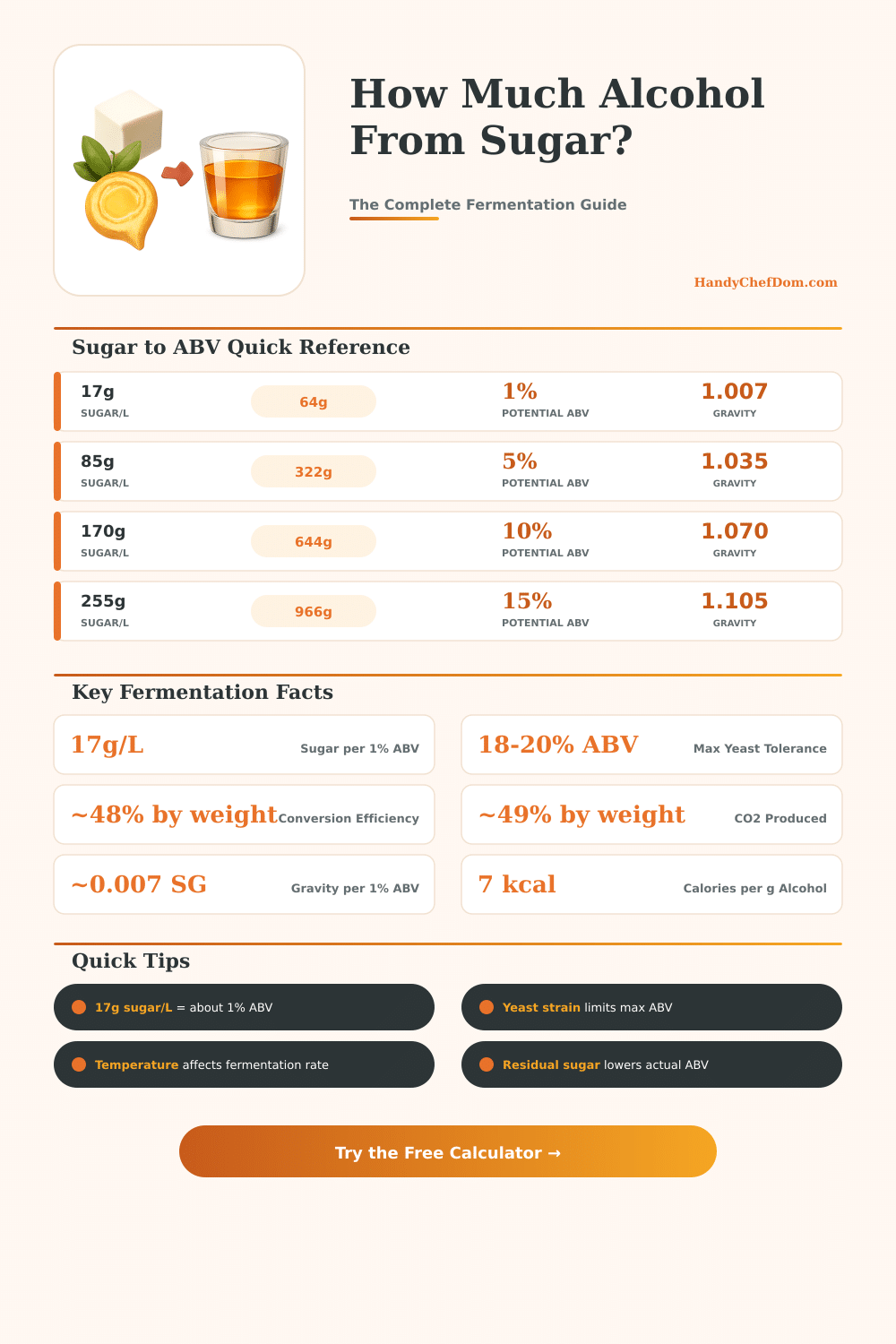
🍺 Sugar to Alcohol Calculator
Calculate potential alcohol (ABV) from sugar content in your fermentation
| Sugar per Liter | Sugar per Gallon | Gravity (SG) | Potential ABV |
|---|---|---|---|
| 17 g | 64 g (2.3 oz) | 1.007 | ~1% |
| 43 g | 161 g (5.7 oz) | 1.017 | ~2.5% |
| 85 g | 322 g (11.4 oz) | 1.034 | ~5% |
| 110 g | 416 g (14.7 oz) | 1.044 | ~6.5% |
| 136 g | 515 g (1.13 lb) | 1.054 | ~8% |
| 170 g | 644 g (1.42 lb) | 1.068 | ~10% |
| 204 g | 772 g (1.70 lb) | 1.081 | ~12% |
| 255 g | 966 g (2.13 lb) | 1.101 | ~15% |
| 306 g | 1,159 g (2.55 lb) | 1.122 | ~18% |
| Sugar Source | Fermentable % | Per kg in Grams Sugar | Notes |
|---|---|---|---|
| White Sugar (Sucrose) | 100% | 1,000 g | Fully fermentable, no residual flavor |
| Dextrose (Corn Sugar) | 100% | 1,000 g | Monosaccharide, ferments faster |
| Brown Sugar | ~95% | 950 g | Slight molasses flavor |
| Honey | ~80% | 800 g | ~20% water by weight |
| Maple Syrup | ~60% | 600 g | ~33% water, mineral content |
| Light Malt Extract (LME) | ~65% | 650 g | ~20% water, complex sugars |
| Dry Malt Extract (DME) | ~80% | 800 g | Concentrated, no water |
| Agave Nectar | ~75% | 750 g | High fructose content |
| Yeast Type | Max ABV | Ideal Temp | Common Use |
|---|---|---|---|
| Bread Yeast | 8–10% | 24–30°C (75–86°F) | Basic sugar wash |
| Ale Yeast (US-05) | 10–12% | 15–24°C (59–75°F) | Beer, cider |
| Lager Yeast (W-34/70) | 9–11% | 9–15°C (48–59°F) | Lager, pilsner |
| Wine Yeast (EC-1118) | 16–18% | 10–30°C (50–86°F) | Wine, mead, champagne |
| Wine Yeast (K1-V1116) | 16–18% | 15–25°C (59–77°F) | White wine, cider |
| Turbo Yeast | 18–23% | 20–35°C (68–95°F) | Fuel alcohol, distilling |
| Saison Yeast (BE-134) | 12–14% | 20–35°C (68–95°F) | Farmhouse ales |
| Batch Size | Volume | Sugar for 5% ABV | Sugar for 12% ABV |
|---|---|---|---|
| Small (1 gal) | 3.79 L | 322 g (11.4 oz) | 772 g (1.7 lb) |
| Homebrew (5 gal) | 18.93 L | 1.61 kg (3.55 lb) | 3.86 kg (8.5 lb) |
| Carboy (6 gal) | 22.71 L | 1.93 kg (4.26 lb) | 4.63 kg (10.2 lb) |
| Half Barrel (15.5 gal) | 58.67 L | 4.99 kg (11.0 lb) | 11.97 kg (26.4 lb) |
| Full Barrel (31 gal) | 117.35 L | 9.97 kg (22.0 lb) | 23.94 kg (52.8 lb) |
The process of turning sugar into alcohol ranks among the most basic steps in brewing and fermentation. The fermentation takes the sugar and breaks it, which releases two by-products: ethanol and carbon dioxide. One calls this process ethanol fermentation, that changes sugars like glucose, fructose and sucrose into energy for the cells, while it creates alcohol and gases as side results.
Sugar simply mixed with water by itself will not become alcohol. To trigger the chemical reaction fermentation is needed. It absorbs the molecules of sugar, breaks them and releases energy together with ethanol.
How Sugar Turns Into Alcohol
Here several elements play a role, also the amount of sugar, the kind of fermentation and the setting. The fermentation requires right conditions, neither too cold nor too warm. Also the duration forms a key part of everything.
The simple method is made up of mixing sugar with water until it dissolves, later add the fermentation and simply wait. Like this one receives alcohol, although its taste will not be wonderful. Based on the added sugar, the final product can raech around 14% ABV.
For instance, one can use 250 grams of sugar for one liter of water: first boil the water, later add the sugar, leave to cool until 35 to 40 degrees Celsius before adding the fermentation, because too high temperatures destroy it.
About 17 grams of sugar per liter is enough to make one percentage of alcohol. That number works as a usual practical rule. For glucose, the output reaches around 50 percent, so that from 100 kilos one receives about 50 kilos of ethanol.
The table sugar, that is made up of bound glucose and fructose, tends to give a bit less, because it requires more chemical changes.
To produce alcohol, fancy sugar is not actually needed. Most alcohol comes from grains, that one cooks to break starch into sugars. Later the sugar ferments and creates the alcohol.
If dealing with spirits, one distills the alcohol after that. Basically, fermented sugar gives all alcohols there kick. By means of boiling grains one releases sugars, that the fermentation later can process.
Generally, more sugar should cause more alcohol, but only until a certain limit. Too sweet drinks can mask the real alcohol content. Correctly the amount of added sugar during the fermentation determines the alcohol strength of the final drink.
Few portions of brown sugar can strengthen the ABV in stuff like cider, without changing the taste too much, even so too much creates strong alcoholic notes. Some brewers add extra sugar, honey or corn sugar during the boil to boost the alcohol potential. If sugar stays after the fermentation, one should add more fermentation to consume it.
Only when allsugar is used up, the readings of alcohol give precise signs.