🍁 Sugar to Maple Syrup Calculator
Convert white sugar to maple syrup with precise ratios and baking adjustments
| White Sugar | Maple Syrup | Reduce Liquid By | Baking Soda |
|---|---|---|---|
| 1 tsp (4g) | ¾ tsp (3.7 ml) | — | Pinch |
| 1 tbsp (12.5g) | 2¼ tsp (11 ml) | ½ tsp | Pinch |
| ¼ cup (50g) | 3 tbsp (44 ml) | 1 tbsp | Scant ¼ tsp |
| ⅓ cup (67g) | ¼ cup (59 ml) | 1½ tbsp | Scant ¼ tsp |
| ½ cup (100g) | 6 tbsp (89 ml) | 1½ tbsp | ¼ tsp |
| ¾ cup (150g) | ½ cup + 1 tbsp (133 ml) | 2¼ tbsp | Scant ½ tsp |
| 1 cup (200g) | ¾ cup (177 ml) | 3 tbsp | ¼ tsp |
| 1½ cups (300g) | 1⅛ cups (266 ml) | 4½ tbsp | ½ tsp |
| 2 cups (400g) | 1½ cups (355 ml) | 6 tbsp | ½ tsp |
| 3 cups (600g) | 2¼ cups (533 ml) | 9 tbsp | ¾ tsp |
| Ingredient | 1 Cup Weight | 1 Tbsp Weight | Density |
|---|---|---|---|
| White Granulated Sugar | 200g (7.05 oz) | 12.5g (0.44 oz) | 0.85 g/ml |
| Brown Sugar (packed) | 220g (7.76 oz) | 13.8g (0.49 oz) | 0.93 g/ml |
| Powdered Sugar | 120g (4.23 oz) | 7.5g (0.26 oz) | 0.56 g/ml |
| Maple Syrup | 315g (11.11 oz) | 20g (0.70 oz) | 1.33 g/ml |
| Grade | Light Transmittance | Flavor | Best For |
|---|---|---|---|
| Grade A Golden | 75%+ | Delicate, mild | Drizzling, light dishes |
| Grade A Amber | 50–74.9% | Rich, full-bodied | Pancakes, general use |
| Grade A Dark | 25–49.9% | Robust, caramel | Baking, cooking |
| Grade A Very Dark | <25% | Strong, intense | Savory glazes, marinades |
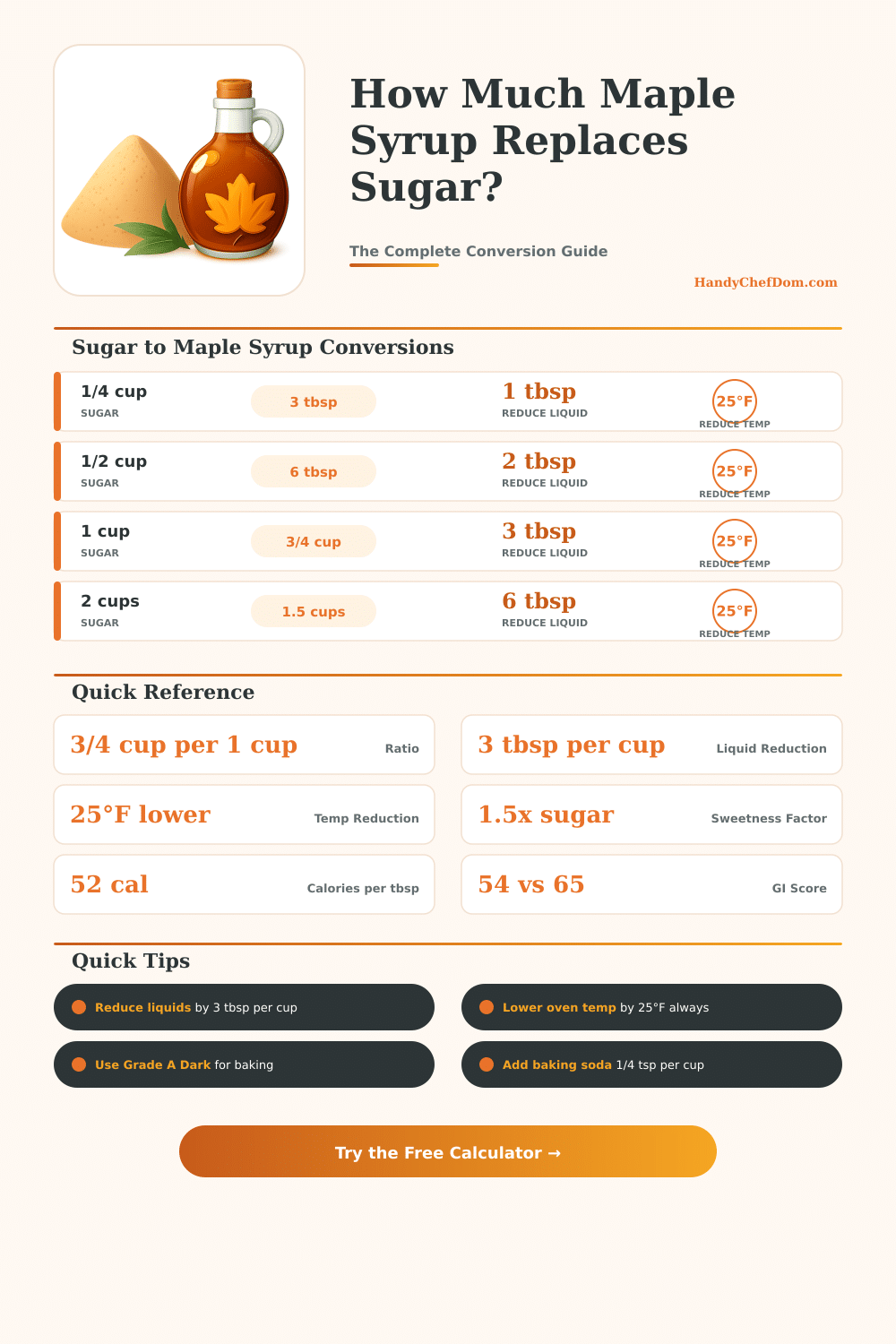
The main advice, that I found after testing several recipes, is use three quarters of maple syrup for every cup of white sugar. That matches around 177 ml instead of 236 ml. By weight it is even easier, 75 percent of the weight of sugar.
So 200 g of regular sugar becomes 150 g of syrup. No perfect one-for-one change, and that is the whole point, because maple syrup is around 1.5 times sweeter than pure sugar.
How to Replace Sugar with Maple Syrup
Here where things become tricky. One cup of syrup weighs almost 315 grams… Much more than the 200 g of sugar for the same amount.
Those differences in density (1.33 g/ml against 0.85 g/ml) require that you clearly reduce other liquids by three spoons for each swapped cup of sugar. Skip that step, and your mix becomes too liquid. Also I lower the tmeperature of the oven by 25°F always, because the natural sugars in maple syrup burn more quickly.
For calories it almost matches, 52 calories per spoon of syrup against 49 for sugar. But the glycemic index is lower, 54 compared too 65, what genuinely surprised me more than those calorie numbers.
The details below do not come from some calculator or converter. They are based on actual users, forum chatters and experiences of cooking groups across the net.
maple syrup is sweet liquid from the juice of maple trees. In cold regions the trees store starch in their trunks and roots before the winter. That starch later turns into sugar, that dissolves in the juice during the end of winter and start of spring.
One taps the trees by means of holes and gathers the juice, that one boils and filters. That method gives a result that is dense, full of sugar and without dirt.
To produce syrup requires a lot of juice. One boils around 50 liters until around one liter of ready maple syrup. The juice itself has only a bit of sweetness, between one and three percent of sugar.
The whole boiling can last around four hours, although it does not need as much work as brewing.
Natural maple syrup has a smooth sweetness with hints of vanilla and candy. The flavor is rich and strongly sweet, almost like a mix of liquid candy and butter chocolate. It goes well with rich foods, poured on pancakes.
maple syrup is made up of around 50 to 75 percent of sucrose. It carries also a bit of glucose and fructose, with the rest being water. It is rich in manganese and riboflavin, and a quarter cup provides 72 percent of the daily need for manganese and 27 percent for riboflavin.
Pure maple syrup has up to 24 types of antioxidants in the form of phenol compounds, that help to lower damage from free radicals, what can cause swelling.
Real maple syrup is very different from the false product. Many stores sell mostly corn syrup, water and other cheap sugars. Everything that does not say 100 percent pure maple syrup on the label, is not the real thing.
The real one costs more, but it is worth it. It is barely processed food, produced the same way for centuries.
There are many ways to use maple syrup beyond breakfast. It works well on roasted vegetables like sweet potatoes, carrots and squash, mixed with olive oil. Jalapenos with maple syrup go surprisingly well, and adding cinnamon is always a good idea.
It can replace honey or brown sugar in most recipes, or serve as a simple one-for-one swap for vanilla extract. Pour it on bacon before slow cooking in the oven, use in marinades and salad dressings, or mix into treats with pecans. Maple syrup makes iced coffee easy, because it already is liquid.
Even one can makefrom it maple sugar candy by heating until the right temperature.