🧈 Vegetable Oil to Butter Converter
Instantly convert between vegetable oil and butter for baking & cooking
| Vegetable Oil | Butter (Volume) | Butter (Weight) | Butter Sticks |
|---|---|---|---|
| 1 tsp (5 mL) | 1¼ tsp | 6g | — |
| 1 tbsp (15 mL) | 1 tbsp + ¼ tsp | 17g | — |
| 2 tbsp (30 mL) | 2 tbsp + ½ tsp | 34g | ¼ stick |
| ¼ cup (60 mL) | ¼ cup + 1 tbsp | 71g | ½ stick+ |
| ⅓ cup (80 mL) | ~6 tbsp | 95g | ¾ stick |
| ½ cup (120 mL) | ½ cup + 2 tbsp | 142g | 1¼ sticks |
| ⅔ cup (160 mL) | ¾ cup + 1 tbsp | 190g | 1½ sticks+ |
| ¾ cup (180 mL) | ¾ cup + 3 tbsp | 213g | 1¾ sticks |
| 1 cup (240 mL) | 1 cup + 2½ tbsp | 284g | 2¼ sticks |
| 1½ cups (360 mL) | 1¾ cups | 426g | 3¾ sticks |
| 2 cups (480 mL) | 2⅓ cups | 567g | 4½ sticks |
| Butter | Vegetable Oil (Volume) | Oil (mL) | Oil (Grams) |
|---|---|---|---|
| 1 tbsp (14g) | 2¼ tsp | 11 mL | 10g |
| 2 tbsp (28g) | 1½ tbsp | 22 mL | 20g |
| ¼ cup / ½ stick (57g) | 3 tbsp | 45 mL | 41g |
| ⅓ cup (76g) | ¼ cup | 60 mL | 55g |
| ½ cup / 1 stick (113g) | ⅓ cup + 1 tbsp | 90 mL | 82g |
| ¾ cup (170g) | ½ cup + 2 tbsp | 135 mL | 123g |
| 1 cup / 2 sticks (227g) | ¾ cup + 1 tbsp | 180 mL | 164g |
| 2 cups / 4 sticks (454g) | 1½ cups + 2 tbsp | 360 mL | 327g |
| Ingredient | 1 Cup Weight | 1 Tbsp Weight | Density (g/mL) |
|---|---|---|---|
| Vegetable Oil | 218g (7.7 oz) | 13.6g | 0.91 |
| Canola Oil | 218g (7.7 oz) | 13.6g | 0.91 |
| Olive Oil | 216g (7.6 oz) | 13.5g | 0.91 |
| Coconut Oil (melted) | 218g (7.7 oz) | 13.6g | 0.92 |
| Sunflower Oil | 218g (7.7 oz) | 13.6g | 0.92 |
| Butter (solid) | 227g (8 oz) | 14.2g | 0.95 |
| Butter (melted) | 227g (8 oz) | 14.2g | 0.95 |
| Fat Source | Saturated | Monounsat. | Polyunsat. |
|---|---|---|---|
| Butter | 63% | 26% | 4% |
| Vegetable Oil (Soybean) | 16% | 23% | 58% |
| Canola Oil | 7% | 63% | 28% |
| Olive Oil | 14% | 73% | 11% |
| Coconut Oil | 82% | 6% | 2% |
| Sunflower Oil | 10% | 20% | 66% |
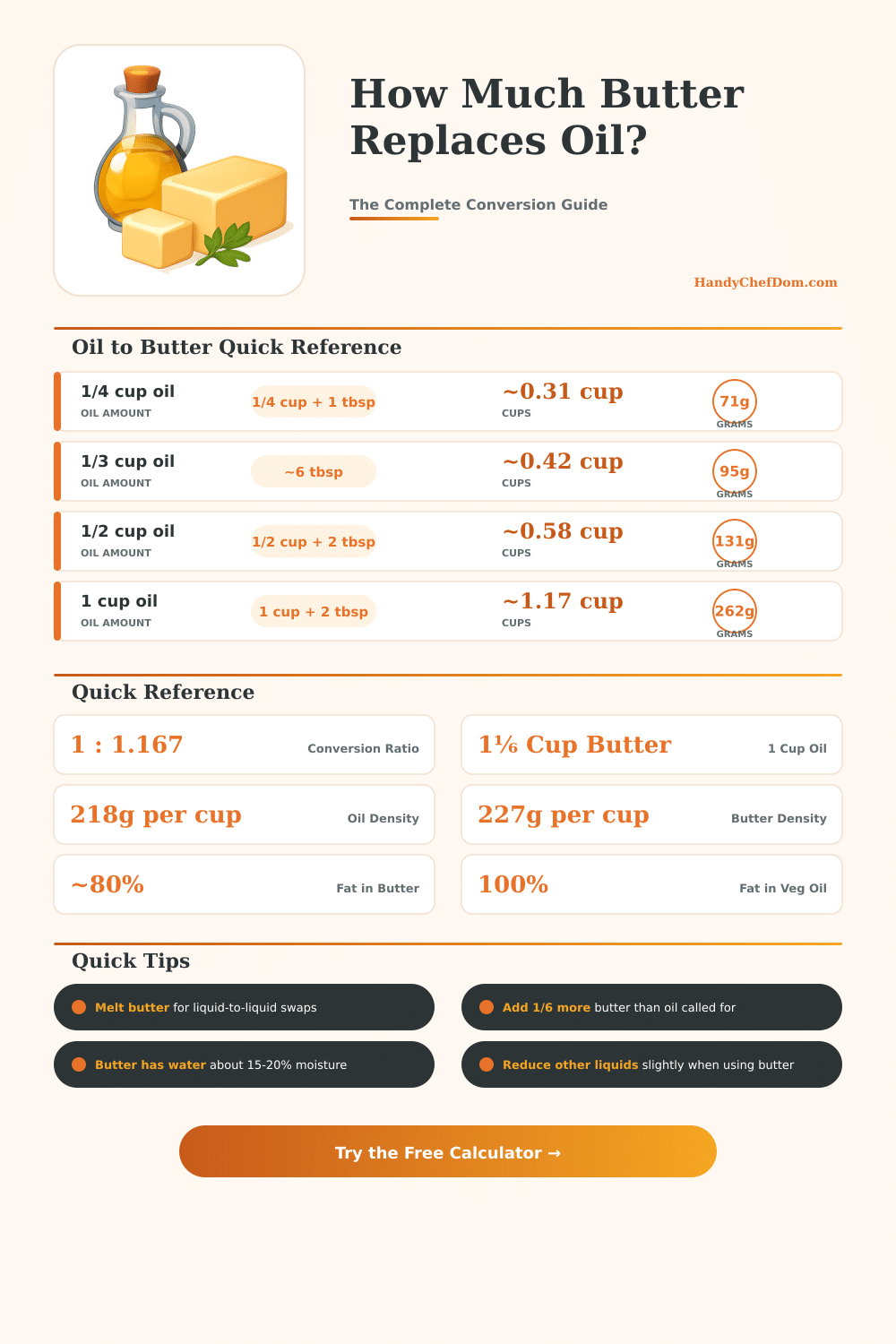
The main ratio, that I found during testing of some recipes, are 7 to 6. So for every 6 spoons of oil you need 7 spoons of butter. That is around 16.7% more volume.
The reason is simple: butter is made up of around 80% fat, while vegetable oil is 100% fat, and that absence of 15 to 17% of water in butter requires a bigger amount to reach the same fat impact.
How to Replace Vegetable Oil with Butter
One cup oil matches to almost 1 and one quarter of cups butter; around 284 grams. In the metric system that is 240 ml oil, that becomes 280 ml melted butter, depending on the brand. One stick butter weighs 113 grams, so you need two and a quarter sticks to replace one cup oil.
About calories, every spoon of oil has 120 calories against 102 for butter so the change indeed lowers the calories by around 15% each spoon.
The details below do not come from any calculator or converter. They are based on actual cooking experience, forum chats and shared knowledge from the net.
vegetable oil is a general name for many kinds of oils from plants. Common types are corn oil, canola oil, palm oil, safflower oil, sesame oil, soy oil and sunflower oil. Although the name suggests otherwise, it does not come directly from vegetables themselves.
The oils come from the seeds of those plants. One grows the seeds, then presses them to extract the oil.
That oil is gentle and light-colored for cooking. It almost does not have smell or strong taste, which makes it good for frying, cooking and salad dressings. The neutral flavor lets the food itself stand out, without covering it.
In most cases vegetable oil simply is refined soy oil.
Using it requires attention to safety. One should not overheat it. When it starts to smoke, lower the heat.
Never pour water on burning or flared oil. Do not return warm oil in the original tin. Always keep it away from heat sources and open fires, when it is in a container.
The talk about the health of vegetable oil is a bit confusing. Refined vegetable oils commonly lack antioxidants. Studies on mice pointed, that eating fried oil expanded gut swelling, helped tumor growth and caused leaks in the bowels, which spreads bacteria in the blood.
On the other hand, finding alike negative effects for oils used at low temperatures or in mayonnaise is more hard. All vegetable oils differ in makeup, sometimes a lot, and so they have different effects on health. The preparation, whether they go bad or overheat during cooking, also plays a big role.
vegetable oil does not store cholesterol, because plants produce only very little of it compared to animals. Some oils, like high-oleic sunflower oil, are mainly single-unsaturated fats instead of multi-unsaturated omega-6. Oil from grape seeds, corn, cottonseed and many nuts are especially rich in omega-6.
Soy oil also, though not quite as much.
Canola oil has a smoke point at 468°F, while soy oil at 450°F. Those high points make them good for cooking at low and high heats. If oil passes its smoke point, it breaks down and can create cancer-causing substances. Cold-pressed oils are pressed without letting the temperature rise too much, to escape problems.
Peanut oil works well for frying, but it is not as neutral in taste as others. Most vegetable oils have a shelflife of around one year. Also, one can use vegetable oil to condition or moisturize hair.