🧪 Xanthan Gum Calculator
Find the exact xanthan gum amount for any gluten-free recipe – by flour weight or liquid volume
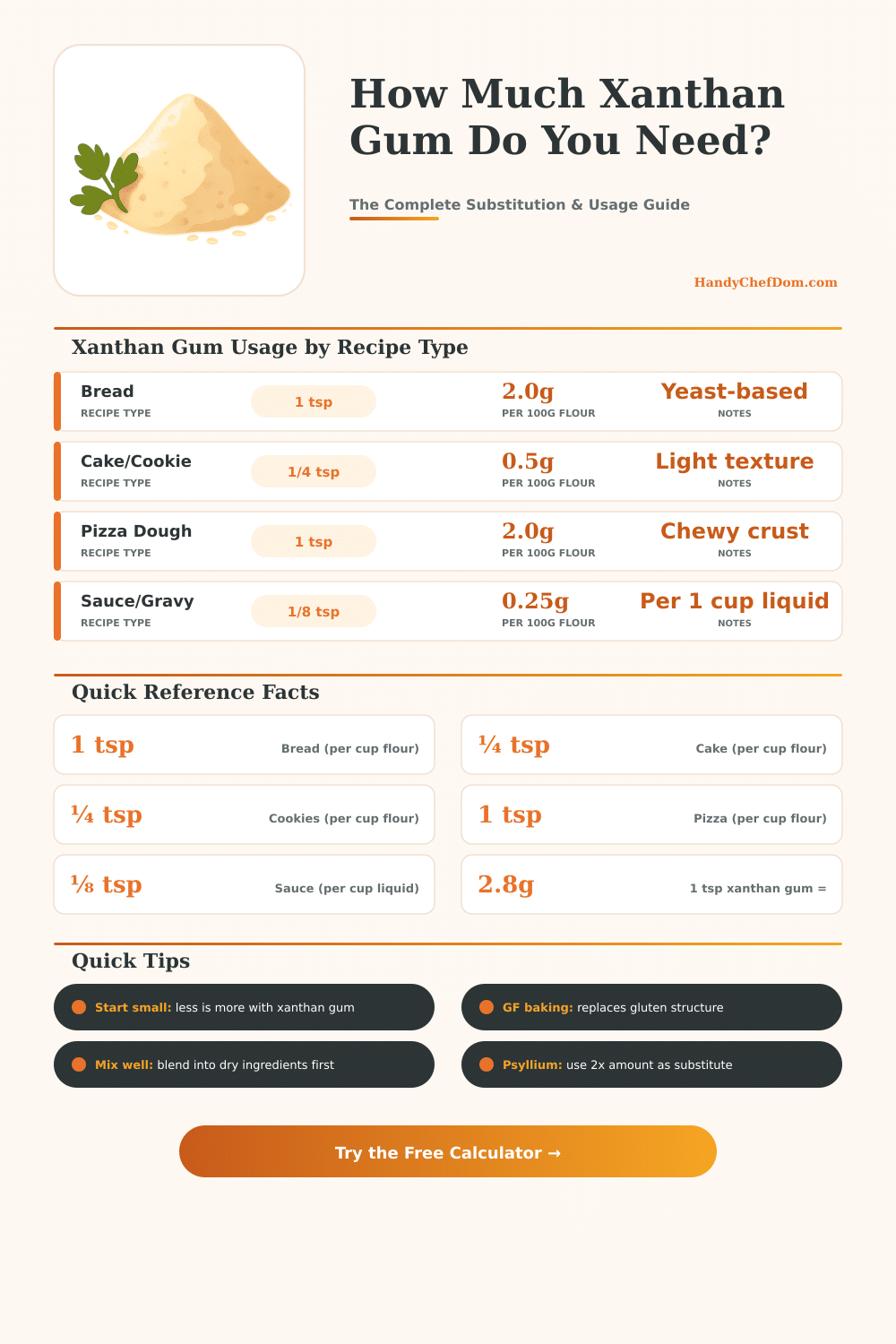
| Recipe Type | Per Cup of Flour | Per 100g Flour | Per Cup Liquid | Notes |
|---|---|---|---|---|
| Bread / Rolls | 1 tsp (2.8g) | 2.0g | — | Yeast-based; needs strong structure |
| Pizza Dough | 1 tsp (2.8g) | 2.0g | — | Chewy texture; can use slightly less |
| Pasta / Noodles | ¾ tsp (2.1g) | 1.5g | — | Helps bind without eggs |
| Muffins / Quick Bread | ½ tsp (1.4g) | 1.0g | — | Chemical leavening; moderate bind |
| Cake / Cupcakes | ¼ tsp (0.7g) | 0.5g | — | Light crumb; too much = gummy |
| Cookies / Biscuits | ¼ tsp (0.7g) | 0.5g | — | Often optional; helps with spread |
| Pancakes / Waffles | ¼ tsp (0.7g) | 0.5g | — | Thin batter; minimal needed |
| Sauce / Gravy | — | — | ⅛ tsp (0.35g) | Thickens at low temp; blend well |
| Salad Dressing | — | — | ⅛ tsp (0.35g) | Emulsifies oil & water |
| Substitute | Ratio to Xanthan | Best For | Notes |
|---|---|---|---|
| Psyllium Husk Powder | 2x amount | Bread, pizza | Works best in yeast breads |
| Guar Gum | Equal amount | Cold foods, sauces | Less effective when heated |
| Chia Seeds (ground) | 2x amount | Muffins, cookies | Soak in 2x water first |
| Flax Seeds (ground) | 2x amount | Dense breads | Adds earthy flavor |
| Cornstarch | 2x amount | Thickening sauces | Not ideal for baking structure |
| Arrowroot Powder | 2x amount | Sauces, gravies | Glossy finish; not for baking |
| Egg White (1 large) | Per 1/4 tsp XG | Cakes, cookies | Not vegan; adds moisture |
| Teaspoons | Grams | Milliliters |
|---|---|---|
| ⅛ tsp | 0.35g | 0.6 ml |
| ¼ tsp | 0.70g | 1.2 ml |
| ½ tsp | 1.40g | 2.5 ml |
| ¾ tsp | 2.10g | 3.7 ml |
| 1 tsp | 2.80g | 5.0 ml |
| 1½ tsp | 4.20g | 7.5 ml |
| 1 tbsp | 8.40g | 15.0 ml |
| Flour (cups) | Approx. Grams | Fluid oz |
|---|---|---|
| ¼ cup | 30g | 2 fl oz |
| ½ cup | 60g | 4 fl oz |
| 1 cup | 120g | 8 fl oz |
| 1½ cups | 180g | 12 fl oz |
| 2 cups | 240g | 16 fl oz |
| 2½ cups | 300g | 20 fl oz |
| 3 cups | 360g | 24 fl oz |
xanthan gum is a substance that works as a commonly used food additive. One prepares it by fermenting basic sugars, for instance glucose, sucrose or lactose, by means of a particular bacterium. The name comes from the bacterial species that participates in that fermentation namely Xanthomonas campestris.
The resulting product forms a powdery substance that dissolves easily in water.
Xanthan gum: what it is and how to use it
Its main role consists in thickening and stabilizing. It stops ingredients from dividing, and hence it appears in many products. In salad dressings, sauces, ice cream, yoghurt, baked goods and puddings it commonly appears.
Moreover it suspends solid bits, like spices, in liquids. Even a little dose has big impact, because it creates thickness in very low amounts, also in cold settings. During high temperatures the thcikness drops, but it repeatedly appears when the mix cools.
One of the main uses of xanthan gum happens in gluten-free baking. Gluten forms two proteins that give the dough elastic and stretchy quality. Xanthan gum replaces part of that role, acting as a tie that ties ingredients and adds rise too the dough.
Use around a quarter spoon for one cup of gluten-free flour as a starting point. Before adding it, check though, if the flour mix already carries it.
xanthan gum thickens without affecting the taste of the food. It is useful when a sauce or gravy has ideal flavor but simply requires a bit more thickness. Adding more oil or fat ruins the taste, but xanthan gum does not do that.
It can thicken and blend in warm and cold sauces, that even last through reheating.
xanthan gum naturally does not carry gluten or common allergens. It works for keto, vegan and vegetarian lifestyles. For one serving it has zero calories, zero fat, zero sugars and zero cholesterol.
The body hardly absorbs it, and stomach bacteria are expected to ferment it.
It helps against hungry feeling, because it delays stomach emptying and slows digestion. It also helps water motion in the bowels, which results in wet stool that passes more easily. There is no organic version of xanthan gum, because the production happens by means of bacterial fermentation.
Getting the right amount matters a lot. Too much can make the food too thick or gummy. Ice cream with too much xanthan gum ends up so thick that it does not melt correctly.
It also causes weird, sticky texture if the amounts are wrong. Sometimes one uses it in liquid soap, although reaching smooth results without lumps requires care. Besides foods, one studied it even as anenvironmental alternative to stabilize soil.