☕ Daily Caffeine Intake Calculator
Track your total caffeine consumption and check if you're within safe daily limits
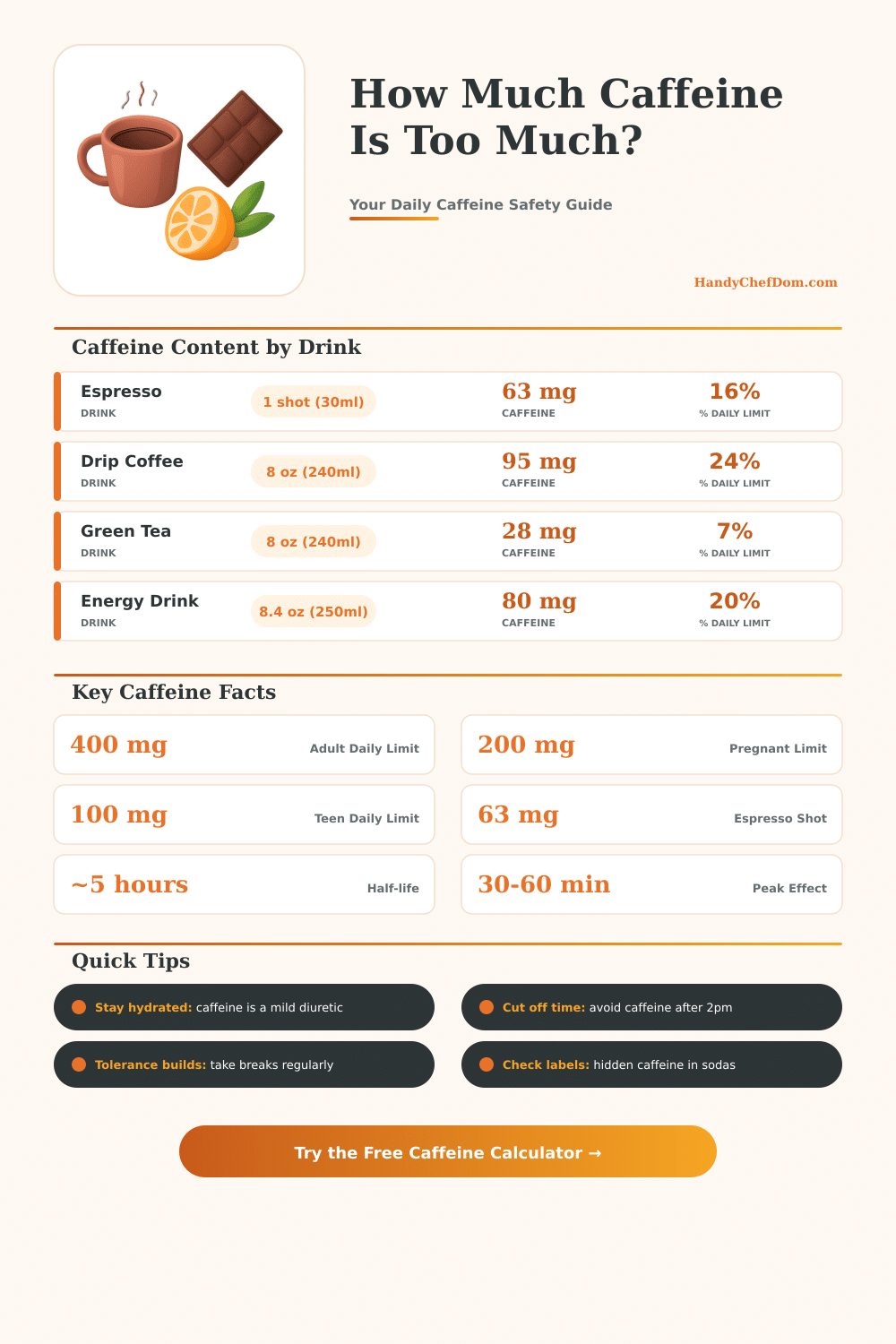
| Drink / Food | Serving Size | Caffeine (mg) | Caffeine per oz |
|---|---|---|---|
| Drip / Filter Coffee | 8 fl oz (240 ml) | 80–120 mg | ~11 mg/oz |
| Espresso Shot | 1 oz (30 ml) | 63 mg | 63 mg/oz |
| Double Espresso | 2 oz (60 ml) | 126 mg | 63 mg/oz |
| Americano (2 shots) | 8 oz (240 ml) | 126 mg | 16 mg/oz |
| Latte / Cappuccino | 12 oz (360 ml) | 63–126 mg | ~8 mg/oz |
| Cold Brew Coffee | 12 oz (360 ml) | 150–240 mg | ~16 mg/oz |
| Instant Coffee | 8 oz (240 ml) | 60–80 mg | ~8 mg/oz |
| Black Tea | 8 oz (240 ml) | 40–70 mg | ~6 mg/oz |
| Green Tea | 8 oz (240 ml) | 20–35 mg | ~3 mg/oz |
| White Tea | 8 oz (240 ml) | 15–30 mg | ~2.5 mg/oz |
| Matcha Latte | 8 oz (240 ml) | 70 mg | ~9 mg/oz |
| Chai Tea Latte | 12 oz (360 ml) | 50–70 mg | ~5 mg/oz |
| Red Bull | 8.4 oz (250 ml) | 80 mg | 9.5 mg/oz |
| Monster Energy | 16 oz (473 ml) | 160 mg | 10 mg/oz |
| Celsius Energy | 12 oz (355 ml) | 200 mg | 17 mg/oz |
| 5-hour Energy | 1.93 oz (57 ml) | 200 mg | 104 mg/oz |
| Reign / Bang | 16 oz (473 ml) | 300 mg | 19 mg/oz |
| Coca-Cola Classic | 12 oz (355 ml) | 34 mg | 2.8 mg/oz |
| Diet Coke | 12 oz (355 ml) | 46 mg | 3.8 mg/oz |
| Mountain Dew | 12 oz (355 ml) | 54 mg | 4.5 mg/oz |
| Dark Chocolate (1 oz) | 1 oz (28 g) | 20 mg | 20 mg/oz |
| Pre-Workout (typical) | 1 scoop | 150–300 mg | — |
| Population Group | Recommended Limit | Source | Notes |
|---|---|---|---|
| Healthy Adults | Up to 400 mg/day | FDA / Mayo Clinic | Generally safe for most adults |
| Pregnant Women | Under 200 mg/day | ACOG / WHO | Higher risk with more caffeine |
| Breastfeeding | Under 200 mg/day | AAP | Can pass through breast milk |
| Teens (13–17) | Under 100 mg/day | Health Canada | Growing bodies more sensitive |
| Children (under 13) | Not recommended | AAP | Avoid caffeine entirely |
| Heart Conditions | Consult doctor | AHA | May trigger arrhythmia |
| Anxiety Disorders | Under 200 mg/day | APA | Caffeine can worsen anxiety |
| Time After Intake | Caffeine Remaining | Effects | Recommendation |
|---|---|---|---|
| 0–30 minutes | ~100% | Absorption begins | Effects not yet felt |
| 30–60 minutes | ~100% | Peak alertness | Optimal performance window |
| 3–4 hours | ~50% | Half eliminated | May need top-up for some |
| 6–8 hours | ~25% | Mild stimulation | Avoid new caffeine after 2pm |
| 10–12 hours | ~12% | Trace amounts | Can affect sleep quality |
| 24 hours | <5% | Mostly cleared | Safe for next intake |
Caffeine is a natural chemical that works as a stimulant. It boosts the signals that travel between the brain and the body. It belongs to the group of stimulants and affects the central nervous system.
It ranks among the most used active substances globally. Only because of that, let’s deal about something that is worth knowing a bit more carefully.
Caffeine: what it is, where it is found, and how much is safe
One finds it in coffee, tea, cola drinks, cocoa, guarana, yerba mate and more than 60 other products. The main types of coffee deliver the most, even though Caffeine naturally appears also in some kinds of other plant seeds. For instance, yerba mate existed originally as a traditional drink from a South American plant called Ilex paraguariensis.
The content of Caffeine in it ranges according to the way one prepares it, just as happens with coffee.
Caffeine acts by means of boosting the central nervous system, heart, muscles and centres that control blood pressure. It promises more energy, helps to improve the physical output and maybe also the mental skills. One can use it to stay awake during long journey by car or to receive energy, when one feels a bit exhausted.
How much can one drink without danger? Widely, until 400 milligrams a day is considered safe for most healthy adults. That matches around four cups of brewed coffee, ten cans of cola or two energy drinks.
Cups of 12 units of brewed coffee store between 113 and 247 milligrams of Caffeine. The exact amount depends on the kind of coffee. An average cup of tea has almost half the Caffeine compared too coffee.
Green tea stores around 25 milligrams for an 8-ounce serving, while black tea has less, around 30 to 50 milligrams. A can of 12 units of Coca-Cola carries around 34 milligrams.
Usage of big size for a cup in a coffee machine does not give more Caffeine. It simply makes the coffee weaker.
There are downsides. Commonly they include nervousness and restlessness. Caffeine works also as a diuretic, which can cause dehydration, if one does not replace the lost liquids.
If one consumes Caffeine, the body can produce more adenosine, a hormone that helps folk feel tired. That maybe shows how the tolerance grows. Daily use can cause harmful impacts, and Caffeine can interfere with some medicines, like stimulants, some antibiotics, medicines against asthma and those for the heart.
Caffeine does not disappear during cooking, even if one bakes or heats it. It stays stable in usual kitchen heats and does not alter its chemistry. Rather, it becomes even denser.
Hence a bit of tiramisu with coffee can keep sensitive folkawake during the night.
Caffeine used in moderation is widely seen as positive. However the impacts truly change from folk to folk.