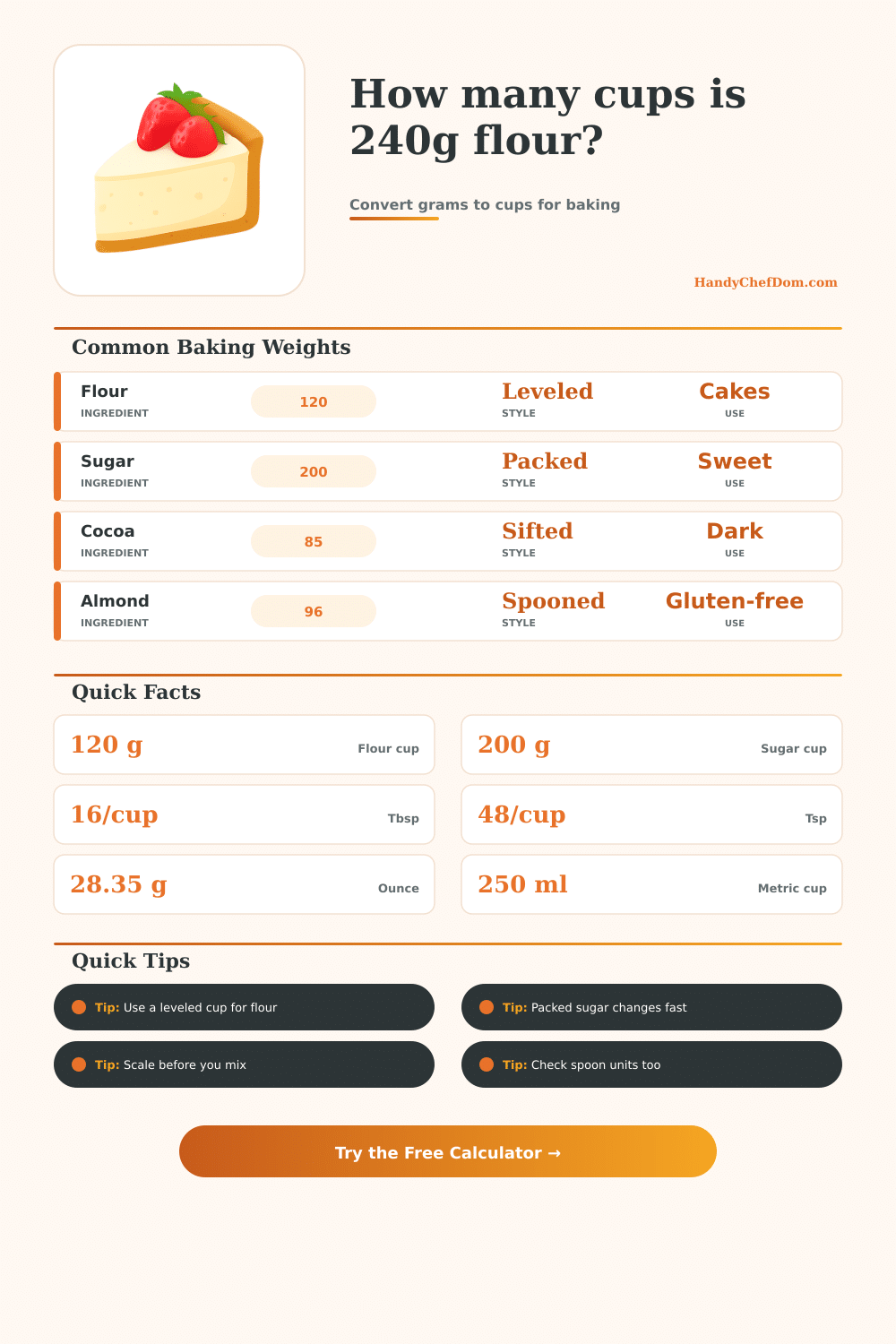
Baking Conversion Calculator: Grams to Cups
Convert baking grams into cups with ingredient density, measure style, and recipe scaling built in for cleaner, more accurate batches.
Use the measure style to match how you fill the cup. Flour, sugar, cocoa, and nut flours all behave differently once packed, sifted, or leveled.
| Ingredient | g / Cup | Best Style | Use |
|---|---|---|---|
| All-purpose flour | 120 | Leveled | Cakes |
| Bread flour | 127 | Leveled | Yeast |
| Cake flour | 114 | Sifted | Soft crumb |
| Granulated sugar | 200 | Packed | Sweetening |
| Brown sugar | 220 | Packed | Chewy bakes |
| Powdered sugar | 120 | Sifted | Frosting |
| Cocoa powder | 85 | Spooned | Chocolate |
| Almond flour | 96 | Aerated | Gluten-free |
| Volume | mL | tbsp | tsp |
|---|---|---|---|
| 1 cup | 236.6 | 16 | 48 |
| 1/2 cup | 118.3 | 8 | 24 |
| 1/3 cup | 78.9 | 5.3 | 16 |
| 1/4 cup | 59.1 | 4 | 12 |
| 1 tbsp | 14.8 | 1 | 3 |
| 1 tsp | 4.9 | 0.33 | 1 |
| Style | Factor | Density Shift | Note |
|---|---|---|---|
| Leveled | 1.00x | Baseline | Keep flat |
| Sifted | 0.92x | Lighter | Airier cup |
| Spooned | 0.96x | Gentle | No packing |
| Packed | 1.10x | Heavier | Compress it |
| Aerated | 0.88x | Looser | Whisk first |
| Settled | 1.05x | Denser | Tap cup |
| Shortcut | About | Texture | Best For |
|---|---|---|---|
| Flour scoop | Use leveled cup | Soft | Cakes |
| Sugar press | Pack lightly | Dense | Cookies |
| Cocoa sift | Break lumps | Fine | Brownies |
| Nut whisk | Loosen flour | Airy | Macros |
| Oat scoop | Fluff first | Rustic | Bars |
| Cornstarch | Spooned cup | Silky | Fillings |
To convert gram to cups, understanding how dense the ingredient is necessary. Density is the mass of an ingredient divide by it’s volume. The mass of an ingredient is a measurement of how much matter are in the ingredient.
The volume of an ingredient is the space that the ingredient occupy. The grams of an ingredient that will occupy one cup will differ from ingredient to ingredient due to the densities of each ingredient. For example, an ingredient like flour is more less dense than sugar; therefore, one cup of flour will weigh less gram than one cup of sugar.
How to Convert Grams to Cups
The weight of flour change based on how the flour is measured. If you scoop flour directly from the bag, the flour will become compressed and thus more denser. Spooned flour will be less dense than flour that is scooped from a bag.
Many recipes use flour and require the flour to weigh a specific amount; too much flour can lead to a cake that is too tough to chew while too little flour will lead to bread dough that is too slack. To avoid incorrect result in the baked goods, it is important to measure the flour according to the specification of the recipe. Sugar has a different density than flour and have specific requirements for how dense the sugar must be.
Granulated sugar is more dense than flour and will weigh 200 grams per cup. Brown sugar is the most densest of the sugars and needs to be pack into the measuring cup with a spoon to remove the air pockets between the granulated sugar crystals. If the cook does not pack the brown sugar into the measuring cup, the weight will not be correct for the amount of brown sugar that is weighed.
Cocoa powder is less dense than granulated sugar. Cocoa powder will weigh 85 grams per cup because it is a light powder. Not all flours has the same weight per cup.
Bread flour is the most dense of the flours while cake flour is the least densest. Bread flour weighs 127 grams per cup because it contain more gluten than other types of flour. Cake flour is ground into a finer powder than other flours which make it lighter in weight at 114 grams per cup.
Almond flour is different than other flours and need to be whisked to separate the almond flour clumps. If the cook does not whisk almond flour, the flour will be too dense for the recipe in which it is being use. Common measuring tools for converting grams to cups include cups, tablespoons, and teaspoons.
One US cup contain 237 milliliters while a metric cup contain 250 milliliters. Therefore, one cup is larger than the other. Tablespoons are used to measure amount of an ingredient that are less than a cup.
There are 16 tablespoons in a US cup. In cooking, using grams is the most accurate way to measure the amount of an ingredient because weight does not change based on the amount of air that are in the ingredient. When converting a recipe, it is important to multiply each ingredient by the same number.
To make 1.5 times the recipe, you will need to multiply each ingredient by 1.5. Using grams allow cooks to maintain pure ratio of ingredients within a recipe. Using cups to measure ingredients will introduce error with the density of the ingredients, and the more the batch of food increase, the greater the error.
Thus, using grams is the better method of scaling recipes to ensure consistent results to the recipe outcome.