🍺 Fermentation Calculator
Calculate ABV, attenuation, gravity, pitch rate & fermentation time for beer, wine, cider & more
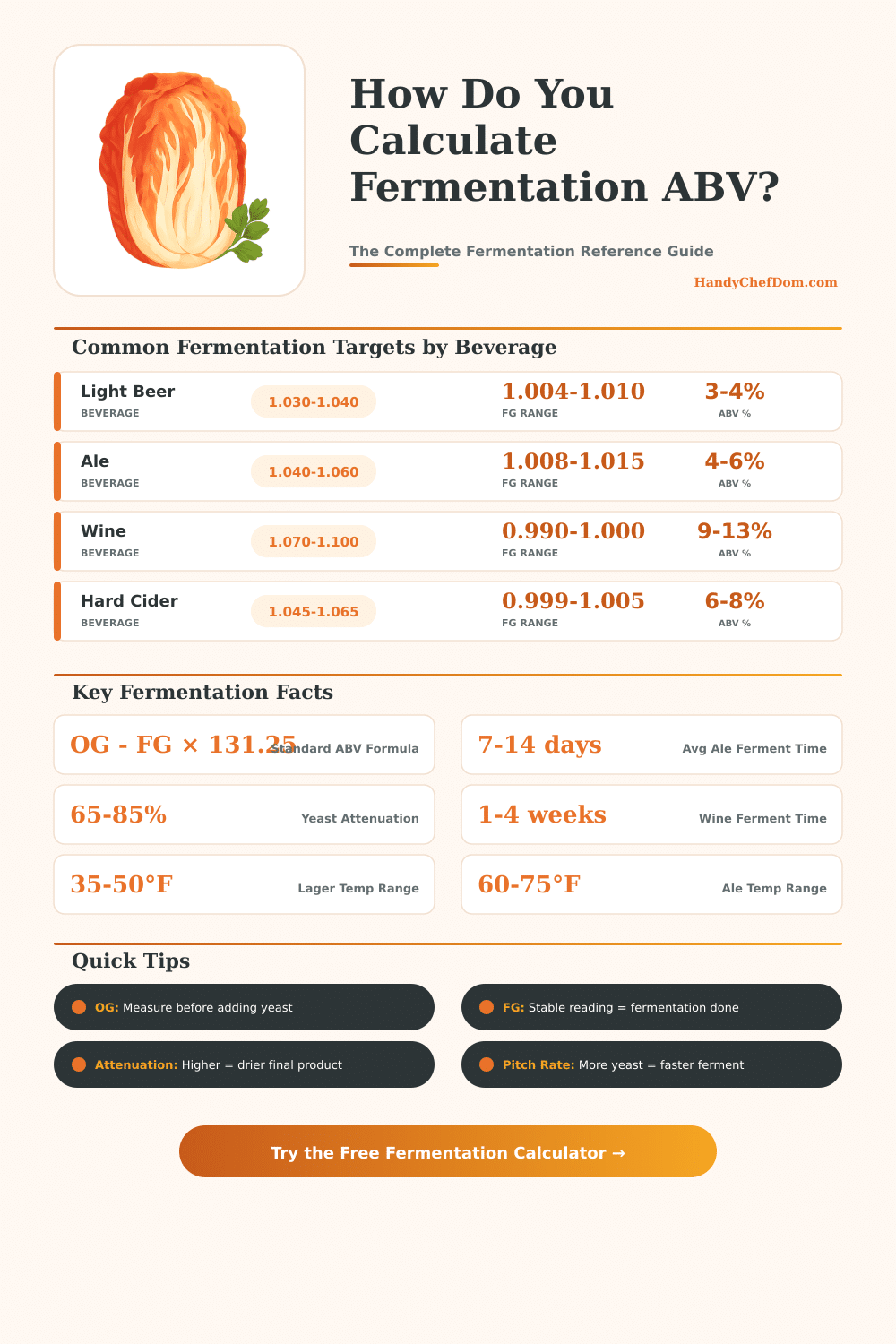
| Beverage | OG Range (SG) | FG Range (SG) | Typical ABV | Attenuation |
|---|---|---|---|---|
| Light Lager | 1.028 – 1.040 | 1.004 – 1.008 | 2.5 – 4% | 75 – 82% |
| American Ale | 1.040 – 1.060 | 1.008 – 1.015 | 4 – 6% | 73 – 80% |
| IPA | 1.056 – 1.075 | 1.008 – 1.018 | 6 – 8% | 75 – 82% |
| Stout / Porter | 1.060 – 1.090 | 1.012 – 1.022 | 5 – 9% | 70 – 78% |
| Belgian Tripel | 1.075 – 1.095 | 1.008 – 1.014 | 8 – 12% | 78 – 90% |
| Dry Table Wine | 1.070 – 1.095 | 0.990 – 0.998 | 9 – 13% | 92 – 100% |
| Sweet Wine | 1.085 – 1.130 | 1.010 – 1.030 | 8 – 14% | 70 – 85% |
| Hard Cider | 1.045 – 1.065 | 0.999 – 1.005 | 5 – 8% | 88 – 95% |
| Mead (Traditional) | 1.080 – 1.120 | 0.998 – 1.010 | 10 – 14% | 88 – 98% |
| Kombucha | 1.020 – 1.040 | 1.002 – 1.008 | 0.5 – 3% | 75 – 90% |
| Specific Gravity (SG) | Plato (°P) | Brix (°Bx) | Approx. Sugar (g/L) |
|---|---|---|---|
| 1.010 | 2.56 | 2.56 | 25 |
| 1.020 | 5.07 | 5.07 | 50 |
| 1.030 | 7.54 | 7.54 | 75 |
| 1.040 | 9.99 | 9.99 | 101 |
| 1.050 | 12.39 | 12.39 | 126 |
| 1.060 | 14.75 | 14.75 | 152 |
| 1.070 | 17.05 | 17.05 | 177 |
| 1.080 | 19.33 | 19.33 | 203 |
| 1.100 | 23.77 | 23.77 | 254 |
| 1.120 | 28.09 | 28.09 | 304 |
| Style | Rate (M cells/ml/P) | 5 gal @ 1.050 | 5 gal @ 1.070 |
|---|---|---|---|
| Standard Ale | 0.75 | 178B cells | 249B cells |
| Ale (High Gravity) | 1.0 | 237B cells | 332B cells |
| Standard Lager | 1.5 | 356B cells | 498B cells |
| High Gravity Lager | 2.0 | 474B cells | 664B cells |
Fermentation is made up of chemical change, in that molecules like glucose divide without the presence of oxygen. This method of energy use draws energy from starting materials to generate ATP together with organic end products. In the core of this process, sugars and similar organic substances divide, and their electrons move to other organic compounds.
In other words tiny organisms like bacteria carry out Fermentation breakdown of foods, what results in fresh flavors and useful compounds during the process.
Fermentation: What It Is and How It Helps Food
This process already existed for a very long period. The bubbling that shows in the making of wine and beer, comes from Fermentation, and it dates back at least 10 000 years. Old societies used tiny cultures to preserve foods, prepare alcoholic drinks and improve the nutritious value of various foods, from yoghurt to tempeh.
People used Fermentation long before anyone grasped the scientific base of it.
Two main kinds exist. During alcoholic Fermentation, pyruvate from sugar breakdown turns into carbon dioxide and ethanol. In lactic acid Fermentation, pyruvate faces a different conversion.
In essence, Fermentation serves as a way for cells to renew NAD+ for sugar breakdown, what forces the ongoing making of ATP without oxygen. It relies on sugar, and when that ends, the Fermentation stops.
Fermented foods involve particular strains of funguses or bacteria, which do not create dangerous by-products. If food simply rots on its own, none controls what grows their and it can sicken folks. Here is the key distinction between Fermentation and rot.
Fermentation happens on purpose and under control. One adds starter culture or salt to create surroundings that resist molds and dangerous contaminants.
Thanks to that process, foods like sauerkraut and kimchi receive their bitter taste. Fermentation covers a wide kind of foods, from breads to soy sauce and cheeses. It forms the main driver of bread rising, that turns thick dough into a rising loaf.
During bread making, Fermentation absorbs sugar and starch, breaking them into carbon dioxide and ethanol.
Industrial Fermentation raises the efforts to a higher level. Substances like acetic acid, citric acid and ethanol are produced on a large scale by means of Fermentation. Progress in biotechnology currently lets scientists direct germs with great accuracy.
That method, called precise Fermentation, works to generate ingredients for foods, proteins, vitamins and fibers.
The microbiome in the belly similarly processes fiber from foods, what creates compounds like butyric acid and propionic acid. Some of those creatures are useful, while others simply cause gasproblems at folks. By means of Fermentation of some foods, one can make foods more accessible for thebody, for instance by means of decrease of phytic acid in millet.