🍙 Sushi Rice Water Ratio Calculator
Get the exact water amount for perfectly cooked sushi rice every time — in cups, grams, or ml.
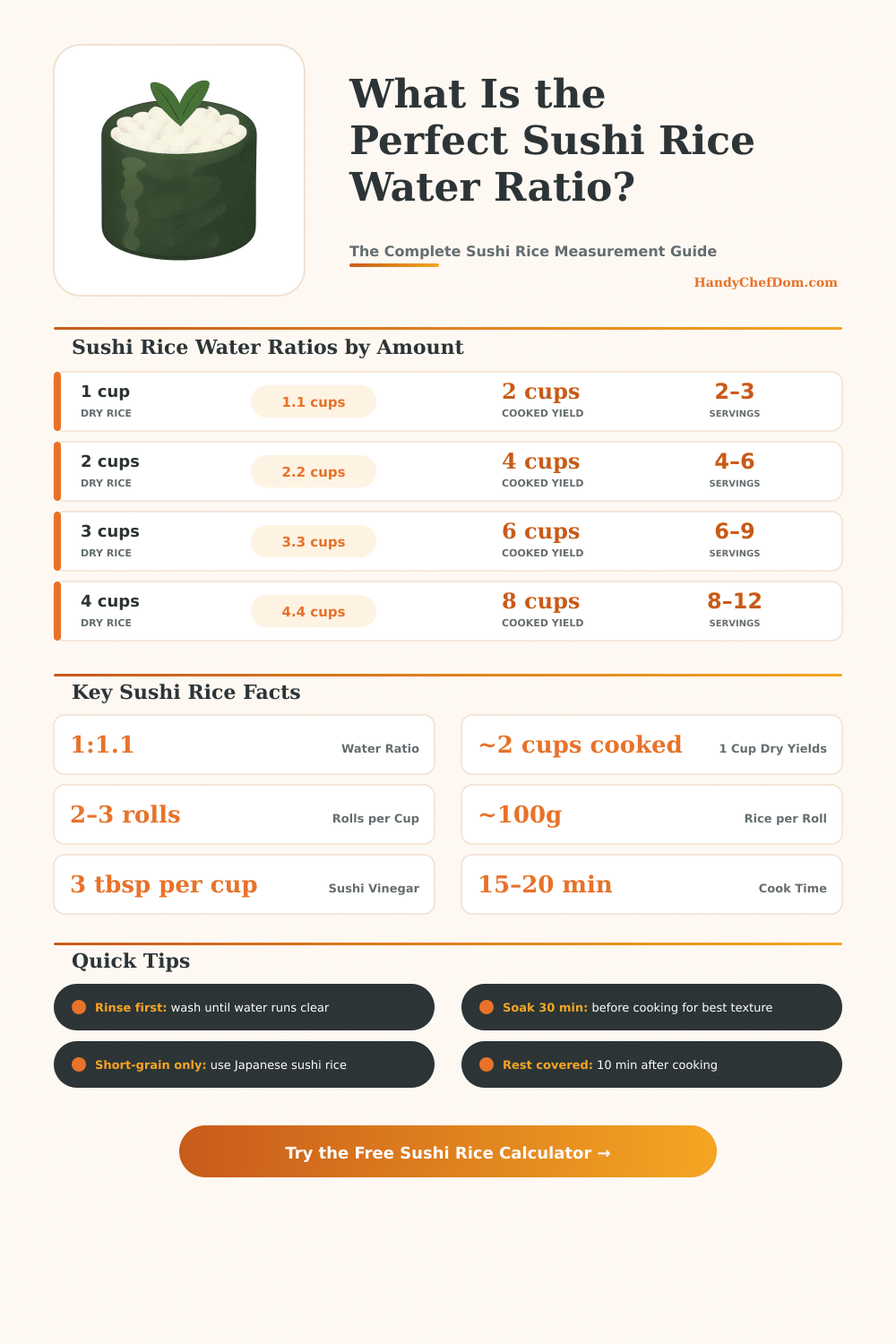
| Dry Rice | Water (Stovetop) | Water (Rice Cooker) | Cooked Yield | Approx. Rolls | Servings |
|---|---|---|---|---|---|
| ½ cup (90g) | ½ cup + 1 tbsp (130ml) | ½ cup (120ml) | ~1 cup | 1–2 rolls | 1–2 |
| 1 cup (180g) | 1 cup + 2 tbsp (265ml) | 1 cup (240ml) | ~2 cups | 2–3 rolls | 2–3 |
| 1.5 cups (270g) | 1 cups + 11 tbsp (395ml) | 1.5 cups (355ml) | ~3 cups | 4–5 rolls | 3–4 |
| 2 cups (360g) | 2 cups + 4 tbsp (530ml) | 2 cups (475ml) | ~4 cups | 5–6 rolls | 4–6 |
| 3 cups (540g) | 3 cups + 6 tbsp (795ml) | 3 cups (710ml) | ~6 cups | 8–9 rolls | 6–9 |
| 4 cups (720g) | 4 cups + 8 tbsp (1060ml) | 4 cups (950ml) | ~8 cups | 10–12 rolls | 8–12 |
| 5 cups (900g) | 5 cups + 10 tbsp (1325ml) | 5 cups (1180ml) | ~10 cups | 13–15 rolls | 10–15 |
| 6 cups (1080g) | 6 cups + 12 tbsp (1590ml) | 6 cups (1420ml) | ~12 cups | 15–18 rolls | 12–18 |
| Rice Type | Ratio (Stovetop) | Ratio (Rice Cooker) | Notes |
|---|---|---|---|
| Japanese Short-Grain (Sushi) | 1 : 1.1 | 1 : 1.0 | Standard sushi rice — most common |
| Medium-Grain Japanese | 1 : 1.15 | 1 : 1.0 | Slightly stickier texture |
| Calrose (American Sushi) | 1 : 1.2 | 1 : 1.1 | Commonly found in US grocery stores |
| Regular Long-Grain | 1 : 1.5 | 1 : 1.3 | Not suitable for sushi — too dry |
| Item | Rice Per Piece | Pieces Per Serving | Rice Per Serving |
|---|---|---|---|
| Maki Roll (full) | ~100g cooked rice | 1 roll (6 pcs) | 100g |
| Nigiri Sushi | ~18–22g each | 2–3 pieces | ~55g |
| Temaki (Hand Roll) | ~75g each | 1–2 per person | ~100g |
| Chirashi Bowl | ~160g cooked rice | 1 bowl per person | 160g |
| Onigiri (Rice Ball) | ~90–110g each | 1–2 per person | ~100g |
| Sushi Platter (catered) | varies | 8–10 pieces | ~180g |
| Dry Rice | Rice Vinegar | Sugar | Salt |
|---|---|---|---|
| 1 cup (180g) | 3 tbsp (45ml) | 2 tbsp (25g) | 1 tsp (6g) |
| 2 cups (360g) | 6 tbsp (90ml) | 4 tbsp (50g) | 2 tsp (12g) |
| 3 cups (540g) | 9 tbsp (135ml) | 6 tbsp (75g) | 3 tsp (18g) |
| 4 cups (720g) | 12 tbsp (180ml) | 8 tbsp (100g) | 4 tsp (24g) |
| 6 cups (1080g) | 18 tbsp (270ml) | 12 tbsp (150g) | 6 tsp (36g) |
Sushi rice forms the base for all sushi. The word sushi itself means “bitter tasting” in Japanese which fits well, because one seasons it with vinegar. Specifically, one mixes rice vinegar with sugar and salt, to reach that bitter taste in the rice.
Although it needs only some parts, it gives all its taste and feel. Every dish prepared with that spicy rice deserves to be called sushi, even if it does not carry fish.
How to Cook Sushi Rice
The main difference between sushi rice and normal rice lies in what happens after the cook. One adds sweet vinegar to give the rice a bit of taste, together with more shine and stickiness. After cooking, the sushi rice seems shiny, sticky and quite chewy.
Rice from Japan is sticky compared to that from many other Asian regions. The more sticky the rice, the more well it holds, which helps it grab with sticks or mold in rolls and balls of sushi.
One uses rice with short grains. Long grain or handled rice simply does not work, because it does not have the needed stickiness. Between good types of sushi rice are Sasanishiki and Koshihikari.
One commonly mixes them from leftovers of the past season with this year’s harvest, to ensure high quality. Rice Jasmine allows to make decent sushi, even though it has other taste and is hard to form. It most works for fast home sushi or four bowls, that one eats right away, instead of for precise nigiri.
Cooking the rice, one should put it in a wide pan. Use wooden or plastic spoon to spread it while drying. Add the vinegar mix above the rice and be careful about stirring.
Later, leave it cool for around twenty until thirty minutes, while one stirs all five minutes to let out the steam. When it is warm, but no warmer than the touch, it is ready for use.
Preparation of rice ranks between the most honored skills in sushi cooking. Students of sushi in Japan usually help under a master during almost ten years, before they are allowed to prepare the rice themselves. Each sushi chef has his own recipe, and different versions commonly stay trade secrets.
Cold rice creates troubles. It most seriously loses its sweetness, what weakens the richness of sushi and affects the other parts. One can keep sushi rice briefly in the fridge, but that hurts it because of loss of moisture.
One cup of sushi rice is enough for three rolls, that gives six until eight little bits. Two rolls for one person are a good serving. Sushi rice even so also works forother foods, for instance risotto, where it works well.