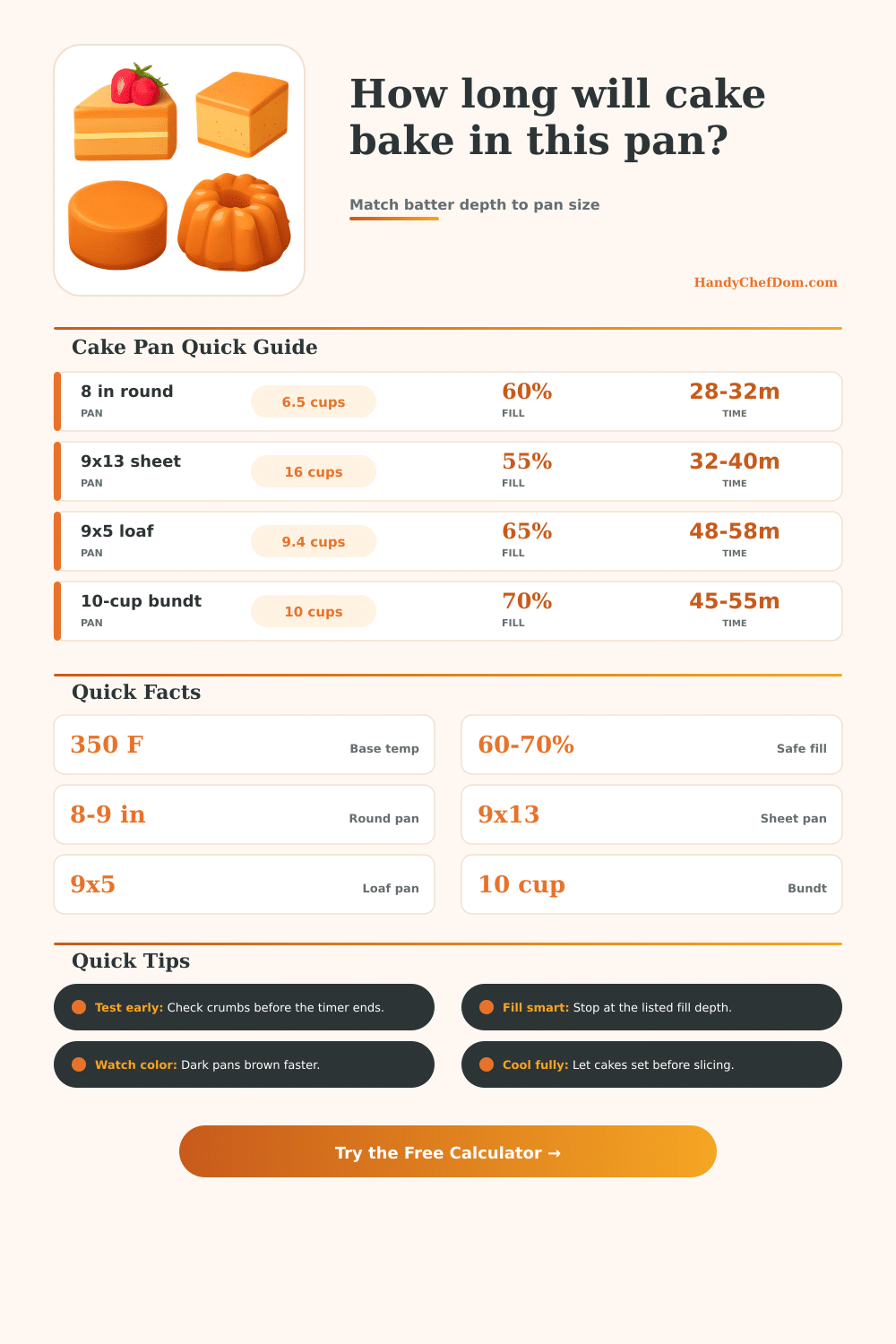
Cake Baking Times by Pan Size Calculator
Estimate cake time from pan size, batter depth, and oven temperature
| Pan | Area | Capacity | Time |
|---|---|---|---|
| 8-inch round | 50 sq in | 6.6 cups | 28-32 min |
| 9-inch round | 64 sq in | 8.8 cups | 30-35 min |
| 8x8 square | 64 sq in | 8.9 cups | 30-36 min |
| 9x13 sheet | 117 sq in | 16.2 cups | 32-40 min |
| 9x5 loaf | 45 sq in | 9.4 cups | 48-58 min |
| 10-cup bundt | 74 sq in | 10.0 cups | 45-55 min |
| Style | Base | Depth | Notes |
|---|---|---|---|
| Butter layer | 32 min | 1.5 in | Classic layer cake |
| Sponge | 24 min | 1.25 in | Light crumb |
| Chocolate | 34 min | 1.5 in | Moist and rich |
| Carrot | 40 min | 1.6 in | Dense batter |
| Pound | 48 min | 1.75 in | Dense crumb |
| Loaf cake | 55 min | 2.1 in | Tall center |
| Material | Factor | Heat | Note |
|---|---|---|---|
| Light metal | 1.00 | Even | Baseline |
| Dark metal | 0.95 | Faster | Browns early |
| Glass | 1.08 | Slower | Add time |
| Ceramic | 1.06 | Steady | Gentle heat |
| Silicone | 1.05 | Soft | Flexible edges |
| Insulated | 1.10 | Slow | Longest bake |
| Condition | Temp shift | Time shift | Note |
|---|---|---|---|
| 325 F | -25 F | +4% | Lower temp |
| 350 F | Base | 0% | Standard |
| 375 F | +25 F | -4% | Faster set |
| 3000 ft | None | +2% | Start here |
| 5000 ft | None | +4% | Drier air |
| 7000 ft | None | +6% | Extra adjust |
Baking cakes requires an understanding of how the cake batter interact with different pan shapes and pan materials. If you have a specific amount of cake batter that you would like to bake, you must purchase an cake pan that can accommodate the amount and depth of the cake batter. If the depth of the cake batter is too deep for the pan, the center of the cake may not cook while the edges of the cake cook beyond a necessary level.
Conversely, if the cake batter is too shallow for the pan, the edges of the cake may cook to the point of dryness before the center of the cake has fully cooked. Because heat travels through cake batter at varying speeds depending on the depth of the cake batter, it is important to adjust the baking time based off the dimension of the pan in which you will cook the cake batter. Two of the main factors that determine how the cake batter will bake within a pan are the volume of the pan and the surface area of the pan.
How Pan Size, Shape and Oven Heat Change Cakes
A standard 9-inch round cake pan can hold 8 to 9 cups of liquid, but you should only fill the pan to two-thirds of the pans capacity. A 9×13 inch sheet pan has a much more larger surface area than a 9-inch round pan. When you pour the cake batter into a 9×13 inch sheet pan, the cake batter will be thinner.
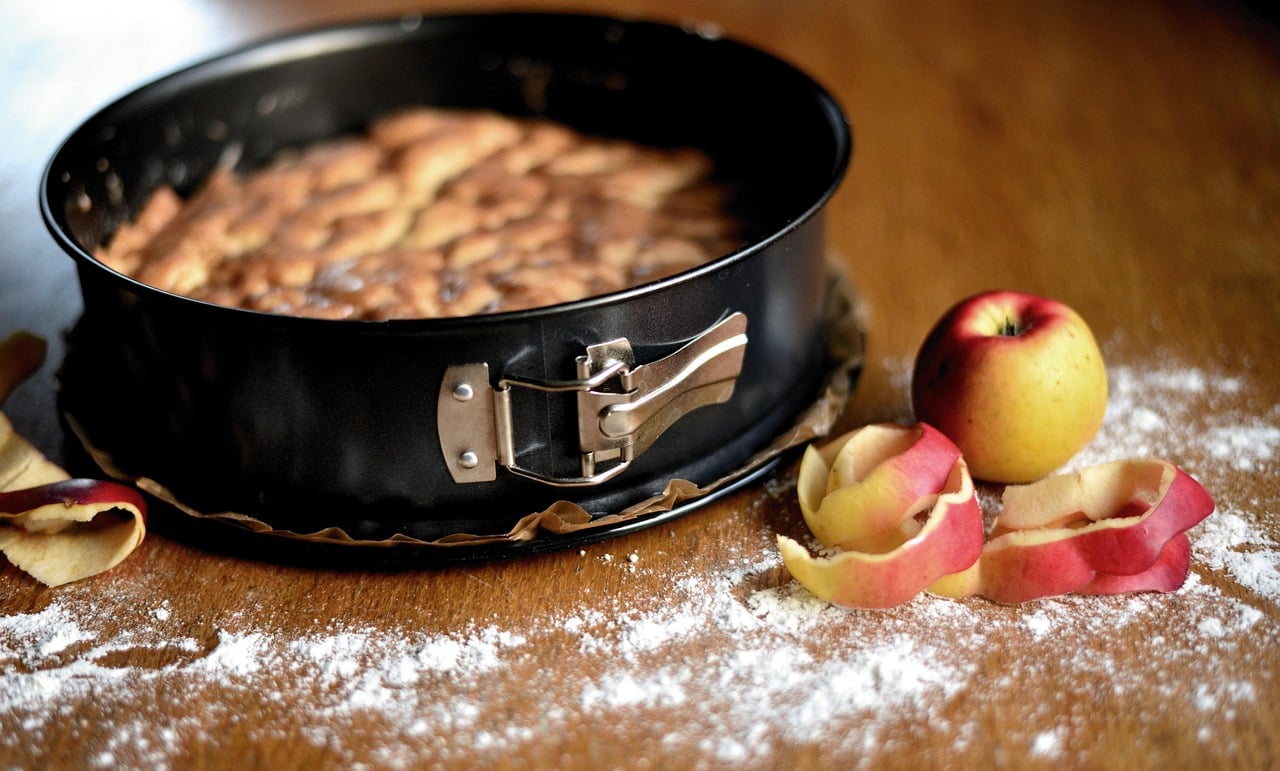
Because the cake batter is thinner in the 9×13 inch sheet pan, the heat will travel to the center of the cake batter more quick, which means that the cake will take less baking time to reach the proper doneness. Deep pans, such as loaf pans, hold the cake batter in thick layers. These thick layers of cake batter will take more baking time to cook through to the center of the cake.
The material out of which the pan is made can have an influence upon the baking of the cake batter as well. Pans made of light aluminum will reflect the heat evenly throughout the pan. Dark metal pans will absorb the heat more aggressively than pans made of light aluminum.
Using a dark metal pan may cause the edges of the cake to brown more quickly than the center of the cake. Pans made of glass will hold the heat for long period. However, the glass pans will also release the heat from the cake more slowly.
Cakes baked in glass pans may require more baking time to allow the center of the cake to set. Increasing or decreasing the oven temperature can help to control the baking process of the cake. For instance, if baking dense cake batter, like pound cake, it is helpful to lower the oven temperature to 325 degrees Fahrenheit.
Lowering the oven temperature to this level allows the cake to cook more evenly. In the opposite example, increasing the oven temperature to 375 degrees Fahrenheit will allow the cake to firm up more quickly. However, increasing the oven temperature may result in the cake setting to the point of dry crumbs.
Depending upon the type of cake batter that you use, the baking time for cakes will differ. Butter layer cakes will take 30 to 35 minutes to bake, depending upon the type of pan that is used. Sponge cakes will bake more quickly because they contain less dense ingredient than butter cakes.
Cakes that contain carrots or that are pound cakes will be denser and more moist. These cakes will require more baking time in the oven to ensure that the cakes dont become soggy on the outside while drying out on the inside. Bundt cakes contains a central tube through which heat can easily reach the center of the cake.
However, the walls of the cake may cook at a different rate than the center of the cake. Additionally, if the cakes are being baked at high altitudes, the drier air may lead to the cakes losing moisture at a faster rate. In this instance, you will have to adjust the baking times for cakes baked at altitudes above 3,000 feet above sea level.
When baking cakes, it is important to fill the baking pans to between 60 and 70 percent of the pans total capacity. Using this percentage ensures that the cake will have enough space to rise after baking. To determine if the cake has finished baking, insert a skewer into the center of the cake.
If the skewer comes out with moist crumbs, the cake isnt yet finished baking. If the skewer comes out clean, the cake has finished baking. In addition to the proper baking techniques, there are some common mistake that you should avoid.
One of the most common mistakes is overfilling the pan with cake batter. This can cause the cake to spill out of the pan. Underfilling the pan can lead to the edges of the cake drying out during baking.
Finally, it is also necessary to rotate the pans halfway through the baking process. This step ensures that each cake cooks evenly, as some areas of the oven may be hotter than others. After baking, it is important to allow the cake to cool properly.
If the cake is sliced while still hot, the steam that the hot cake releases can make the cake texture soggy. Allow the cake to rest on cooling racks to allow the cake to set and for the edge to pull away from the pan. By understanding the effect that the depth of the pan, the material that the pan is made of, and the temperature of the oven have upon the baking of the cake batter, it is possible to adjust the baking methods that are used to create well-baked cakes.
You should of used alot of care when selecting your furnitures. Its very important to recieve the right pan. If you want to bake a cake, your going to need a moddern oven.
It doesnt have to be luxurius.