🧂 Ham Brine Calculator
Calculate exact salt, sugar & water ratios for a perfect wet cure brine
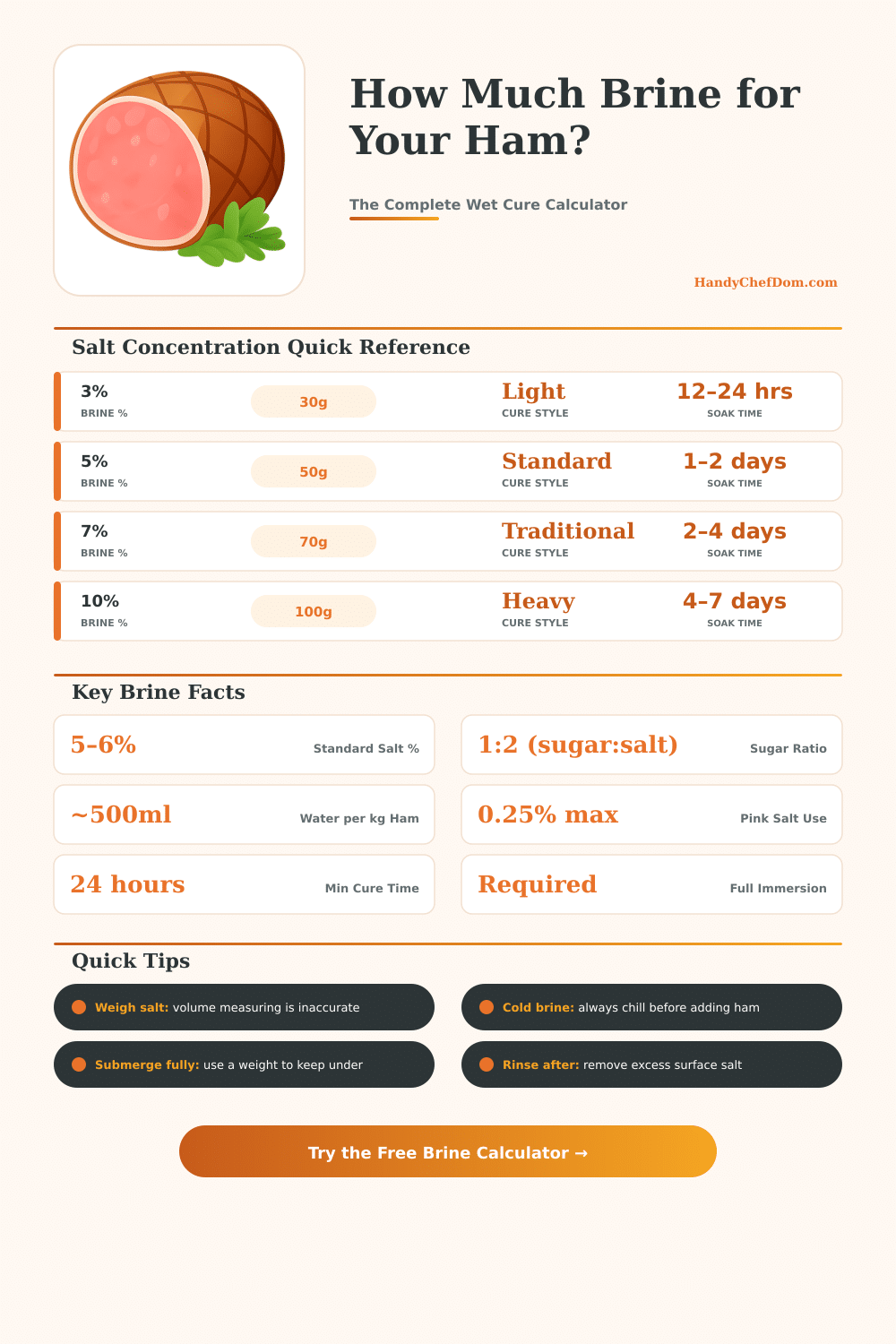
| Brine % | Salt per Liter Water | Salt per Quart (Imperial) | Cure Style | Typical Soak Time |
|---|---|---|---|---|
| 3% | 30g | 1.0 oz | Light / Mild | 12–24 hours |
| 4% | 40g | 1.35 oz | Gentle Cure | 1–2 days |
| 5% | 50g | 1.7 oz | Standard | 1–3 days |
| 6% | 60g | 2.0 oz | Medium Cure | 2–4 days |
| 7% | 70g | 2.35 oz | Traditional | 3–5 days |
| 8% | 80g | 2.7 oz | Strong Cure | 4–7 days |
| 10% | 100g | 3.4 oz | Heavy Brine | 5–10 days |
| Ham Weight (kg) | Ham Weight (lbs) | Min Brine (1x) | Standard Brine (1.5x) | Full Submersion (2x) |
|---|---|---|---|---|
| 1 kg | 2.2 lbs | 1,000 ml | 1,500 ml | 2,000 ml |
| 2 kg | 4.4 lbs | 2,000 ml | 3,000 ml | 4,000 ml |
| 3 kg | 6.6 lbs | 3,000 ml | 4,500 ml | 6,000 ml |
| 4 kg | 8.8 lbs | 4,000 ml | 6,000 ml | 8,000 ml |
| 5 kg | 11 lbs | 5,000 ml | 7,500 ml | 10,000 ml |
| 7 kg | 15.4 lbs | 7,000 ml | 10,500 ml | 14,000 ml |
| 10 kg | 22 lbs | 10,000 ml | 15,000 ml | 20,000 ml |
| Ingredient | 1 Tablespoon | 1 Cup | Notes |
|---|---|---|---|
| Table Salt (fine) | ~18g | ~273g | Most accurate by weight |
| Kosher Salt (Diamond Crystal) | ~8g | ~130g | Use 2x volume vs table salt |
| Kosher Salt (Morton) | ~15g | ~240g | Similar to table salt |
| Sea Salt (coarse) | ~15g | ~220g | Varies by grain size |
| White Sugar | ~12g | ~200g | Standard granulated |
| Brown Sugar (packed) | ~14g | ~220g | Adds molasses flavor |
| Honey | ~21g | ~340g | Dissolve in warm water |
| Pink Salt (Cure #1) | ~18g | ~273g | Max 0.25% of brine weight |
| Salometer (SAL) | Salt % by Weight | Salt per Liter | Application |
|---|---|---|---|
| 20° SAL | 5.3% | 53g | Light brining, short cure |
| 30° SAL | 7.9% | 79g | Standard ham brine |
| 40° SAL | 10.5% | 105g | Medium-strong cure |
| 60° SAL | 15.8% | 158g | Strong preservation brine |
| 80° SAL | 21.1% | 211g | Very strong, long-term cure |
| 100° SAL | 26.4% | 264g | Fully saturated (max) |
Ham is made from pork from the leg, preserved by drying or salting, sometimes with smoking. In the context of ready meat, this word relates to whole pieces and also to those that are shaped by machine. Around the whole world people prepare it and it is good to know the various local versions.
Ham and pork are similar, but not identical. Pork simply means the meat of a domestic pig. Ham belongs to it as a particular product from the pig leg, occasionally from the whole pig body, that is salted and usually smoked or cooked.
All About Ham
There are several kinds of ham. The common, fully cooked type usually has no bone and is wrapped in paper packaging. There is also the country ham, that is dried only by means of salt, hanging it to dry and leaving it uncooked.
This is fairly hard to find in usual food stores. One can smoke it besides the salting, or soak in water and later cook. Usually country ham is served in thin slices, similar to prosciutto.
Some of them receive manual curing by means of salt, brown sugar and cane sugar, and later they age for deep flavor. Being boneless and fully cooked, they save time during cooking.
Baked hams appear in various forms. Some are already sliced before, others are frozen or stay fresh. In some, honey or brown sugar is added as a glaze during baking, while others keep the bone whole.
Frozen ham usually comes with a packet of glaze for self apply. While glazing, open the ham, so that the glaze does not burn. Do not remove strips too soon, otherwise the surface dries.
Ham smoked with apple wood is one of the favourite kinds. It is smoked over red ashes of sweet apple wood for up to 24 hours. The Virginia country ham offers another version, smoked and aged, with strong taste and red-brown colour.
You can also find organic, unsalted, boneless and traditional smoked types.
Boneless ham is liked because of the simple slicing. Plan around half or a third pound each person for that. The bony ham, which better keeps the moisture thanks too the bone, needs half to one pound for each.
On average, bony ham of around seven and a half pounds is enough for ten folks.
Preparing ham before cooking is a usual practice. By adding a bit of water in the pan and good covering with foil, you avoid the drying. The leftovers of ham bones work well in split pea soup.
Chopped leftovers of ham, mixed with mayo, sweet pickles, chopped celery and honey mustard, make a fast ham salad. Ham goeswell with cheese in foods, for instance in grilled cheese sandwiches.